



Nvidia sheds 258 trillion won in market value in a single day
Nov 10, 2026, 09:29 am


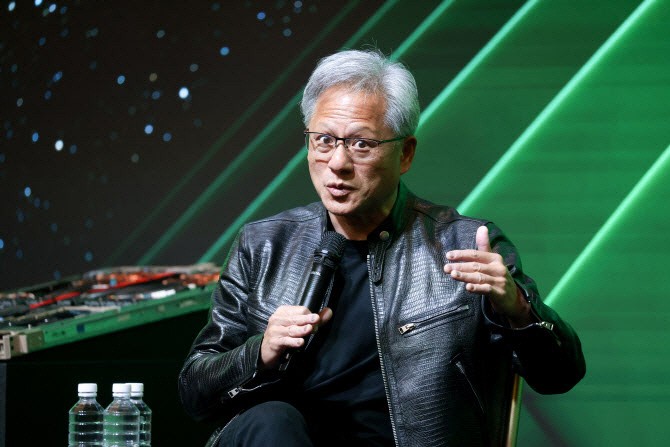 |
| Nvidia CEO Jensen Huang, who has become embroiled in allegations involving economic espionage. Nvidia shares plunged on Nov. 9, 2026, even as major U.S. stock indexes rallied. /AFP-Yonhap |
Major technology and artificial intelligence (AI) semiconductor stocks rebounded sharply on Wall Street, but Nvidia shares plunged.
Investors reacted after the company's board of directors launched an independent investigation into allegations that founder and CEO Jensen Huang had been targeted by a foreign intelligence operation.
As the controversy surrounding Huang, a central figure in the AI industry, expanded from his personal conduct to corporate governance and national security concerns, investors responded swiftly.
Nvidia shares closed at $178.67 on Monday, down 4.3% from the previous trading session. The stock fell as much as 8.8% during the day.
Trading volume reached 446.29 million shares, nearly four times its usual level. The decline wiped approximately $192.1 billion (about 258 trillion won) off Nvidia's market capitalization in a single day.
Over the past week, Nvidia shares have fallen 11.6%, erasing $564 billion (approximately 759 trillion won) in market value.
The stock is now trading 26.6% below its 52-week high of $243.37.
Its market capitalization has fallen to approximately $4.31 trillion, widening the gap with Apple, the world's most valuable company at around $5.1 trillion, to roughly $790 billion (approximately 1,064 trillion won).
Nvidia's decline stood in stark contrast to the broader market rally.
The Dow Jones Industrial Average rose 2.15% to close at 52,389.75, while the S&P 500 gained 2.35% to finish at 7,549.94.
The technology-heavy Nasdaq Composite also climbed 2.74% to 25,253.14.
Semiconductor stocks, which had plunged last week amid concerns about tighter AI industry regulations following the U.S. midterm elections, attracted bargain hunters.
Advanced Micro Devices (AMD) surged 13.3%, while Western Digital jumped 9.9%, Broadcom 8.8%, Micron Technology 6.3% and Sandisk 6.2%.
SK hynix's American depositary receipts (ADRs) rose 5.5%, while Taiwan Semiconductor Manufacturing Co. (TSMC) ADRs gained 3.5%.
The Philadelphia Semiconductor Index also soared 6.9%.
All other members of the so-called Magnificent Seven (M7) posted gains.
Tesla advanced 5.5%, followed by Meta at 5.1%, Amazon at 2.9%, Microsoft at 2.8%, Apple at 2.4% and Alphabet at 1.2%.
CoreWeave and Nebius, two neocloud companies that provide computing infrastructure for AI data centers, also climbed 5.6% and 9.2%, respectively.
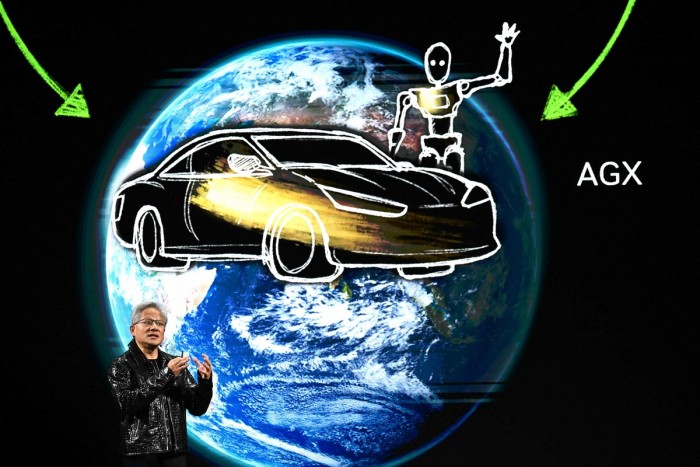 |
| Nvidia CEO Jensen Huang delivers a keynote address at CES 2025. /AFP-Yonhap |
Independent board investigation raises uncertainty over Huang's leadership
The immediate catalyst for Nvidia's stock decline was the controversy surrounding Huang's alleged involvement in a foreign intelligence operation.
On Nov. 8, Nvidia's board announced that it had launched an independent investigation following reports that Huang had been targeted by a foreign intelligence agency.
The investigation will be overseen by a committee of independent directors with assistance from outside legal counsel.
Earlier, international media reports raised questions about Huang's close relationship with an individual linked to China, including allegations that the person may have passed information to Chinese authorities.
The controversy subsequently expanded to include Huang's private life and concerns about the possible disclosure of confidential corporate information.
However, the allegations remain unverified.
Nvidia's board has stated that it has no reason to believe that either national security or the company's confidential information has been compromised.
Huang reportedly apologized to employees for his inappropriate personal conduct and pledged to cooperate with the board's investigation.
The company also emphasized that it continues to have confidence in Huang and his leadership team.
Nevertheless, the potential impact on Huang's leadership could depend on the scope, duration and eventual findings of the investigation.
National security risks emerge amid U.S.-China technology rivalry
Nvidia holds a dominant position in the AI industry.
The company leads the market for high-performance graphics processing units (GPUs), which are essential for training AI models and operating data centers.
Its strategic importance has grown as the U.S. government increasingly treats advanced AI semiconductors as critical national security assets, including through restrictions on chip exports to China.
Huang, in particular, has become the public face of Nvidia's technological competitiveness and its ability to negotiate with governments and major corporate customers.
He has personally engaged with the U.S. government and global technology giants on AI chip supplies and broader industry strategies.
As a result, growing uncertainty surrounding his leadership could affect the company's external credibility and business strategy.
However, the sharp gains posted by other semiconductor companies on Monday suggest that investors are distinguishing Nvidia's company-specific problems from their outlook for the broader AI industry.
Easing inflation concerns following a decline in international oil prices, along with bargain hunting after last week's steep sell-off, also supported the market rebound.
Reuters reported that buying interest returned to semiconductor stocks as investors increasingly viewed concerns about tighter AI industry regulations following last week's midterm elections as excessive.
Cheon Hyun-bin
Most Read
-
1
AMD's Lisa Su floated as potential Nvidia successo..

-
2
China President Xi's Keynote Speech at the APEC C..

-
3
Iran resumes attacks after two months, targeting U..

-
4
Alice Huang, affair partner of Jensen Huang, repor..

-
5
Inside Kylin Villa, the symbol of China's reform h..

-
6
Xi secures fourth term as China reshuffles next-ge..

-
7
Trump, Xi, Putin call for security cooperation at..

PEOPLE






-
Address : In-Young Bldg., 34, Uisadang-daero 1-gil, Yeongdeungpo-gu, Seoul
Copyright by ASIATODAY CO., LTD. All rights resereved