



[Exclusive] S. Korea's 85 trillion won offshore wind zones face risk of total cancellation
Nov 05, 2026, 09:16 am


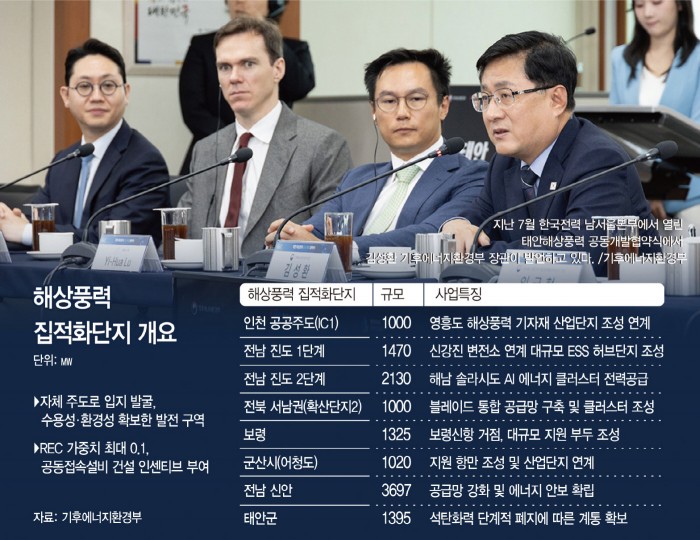 |
Seven months after the government conditionally designated eight offshore wind power clusters that had yet to complete consultations on military operational feasibility, none has completed the process. The clusters, with a combined planned investment of 85.4 trillion won, face the risk of losing their designations at the end of the year. In some cases, military units not previously involved in the consultations have also submitted objections.
According to the Ministry of Climate, Energy and Environment (MCEE) and industry sources on Wednesday, all eight clusters newly designated or expanded nationwide in March were still undergoing military operational feasibility consultations as of Oct. 27. Their combined planned generating capacity stands at 13,037 megawatts (MW). The government required all eight clusters to complete military consultations by the end of this year, warning that failure to meet the condition could result in a reduction in their designated capacity or the revocation of their designations.
The consultations have become more complicated as new objections have emerged from military units. In some cases, units that were not originally involved in the consultation process submitted objections at a later stage. The Navy also provided operational review opinions on all eight clusters. These ranged from concerns about potential problems in certain maritime areas to warnings of serious disruptions to military operations, leaving local governments to negotiate differing demands from military units.
In particular, where military training areas overlap with planned wind power sites, developers may have to change not only the locations of wind turbines but also the project areas themselves. While gaps in radar detection can be addressed with supplementary equipment, overlaps with military training areas could restrict the installation of turbines altogether. Local governments selected maritime sites based on project feasibility and community acceptance but were unable to fully identify military restrictions. As the military also finds it difficult to disclose areas of operational importance, developers are submitting proposed turbine layouts to determine whether installation is possible.
Specific military requirements were also outlined in a response sent by the Ministry of National Defense to South Jeolla Province in June. Regarding the Jeonnam 10 power generation project within the Shinan offshore wind power cluster, the ministry raised concerns about restrictions on the detection and identification functions of maritime surveillance equipment and called for the securing of naval transit routes. The Air Force also warned that radar obstruction could limit air traffic control missions and requested that turbine locations be changed or measures be developed to eliminate operational restrictions.
When the government finalized the offshore wind power cluster designations in March, it set the end of the year as the deadline for completing military consultations for all eight clusters. The second Jindo cluster must also complete consultations over maritime boundary disputes by the same deadline, in addition to military operational feasibility consultations. Although the government launched an Offshore Wind Power Promotion Task Force in December last year to support coordination among relevant agencies, all eight clusters, each facing different military requirements, will now undergo assessments to determine whether their designations can remain in effect.
In the second expansion phase of the Southwest Jeonbuk offshore wind power cluster, military consultations are also affecting the selection of a new developer. After a consortium led by Korea Western Power withdrew its project proposal, North Jeolla Province internally considered issuing a new tender notice in late November. However, the MCEE is not prioritizing a new call for proposals, saying the immediate priority is to determine whether military consultations can be completed within the year to maintain the cluster's designation.
Applications for new offshore wind power cluster designations effectively ended in March. If an existing designation is revoked, it would be difficult to reapply under the same system. Even if a project is converted into an individual power generation project or a government-designated planned site under the Special Act on the Promotion of Offshore Wind Power Development and Industry, military operational feasibility consultations would have to be conducted again. Even selecting a new developer or changing the project implementation approach would not eliminate the need to resolve siting issues with the military first.
"All eight clusters are holding consultations with their respective military units, but none has resolved the issues yet," an official from the MCEE's Offshore Wind Power Promotion Task Force said. "We will have to consider revoking the designations of clusters that fail to meet the conditions by the end of the year."
Jeong Soon-young
Most Read
-
1
AMD's Lisa Su floated as potential Nvidia successo..

-
2
China President Xi's Keynote Speech at the APEC C..

-
3
Iran resumes attacks after two months, targeting U..

-
4
Alice Huang, affair partner of Jensen Huang, repor..

-
5
Xi secures fourth term as China reshuffles next-ge..

-
6
Inside Kylin Villa, the symbol of China's reform h..

-
7
Trump, Xi, Putin call for security cooperation at..

PEOPLE







-
Address : In-Young Bldg., 34, Uisadang-daero 1-gil, Yeongdeungpo-gu, Seoul
Copyright by ASIATODAY CO., LTD. All rights resereved