



Hyundai WIA showcases electrification components at IZB in Germany
Oct 28, 2026, 09:31 am


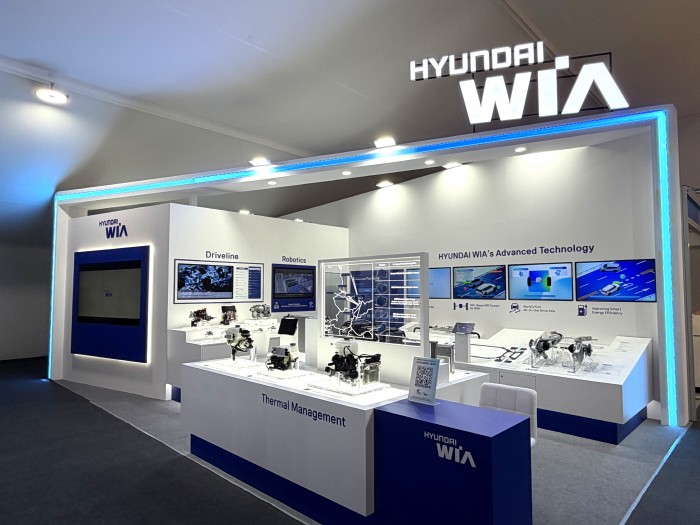 |
| Hyundai WIA's booth at IZB 2026, the international automotive parts exhibition that opened at Allerpark in Wolfsburg, Germany, on Oct. 27 (local time). / Hyundai WIA |
Hyundai WIA is seeking to expand its presence in the European automotive market with its thermal management systems and next-generation drivetrain technologies. The company aims to strengthen ties with local automakers, including Volkswagen, and secure more orders by showcasing electrification components designed to improve energy efficiency and space utilization.
Hyundai WIA announced on Oct. 28 that it had unveiled components for electrified vehicles at IZB 2026, an international automotive parts exhibition that opened at the Allerpark exhibition grounds in Wolfsburg, Germany, on Oct. 27 (local time). The exhibition, which runs through Oct. 29, is an automotive supplier trade fair organized by Volkswagen, with 858 companies from 36 countries participating this year.
At the exhibition, Hyundai WIA focused on showcasing future mobility technologies, including thermal management systems and next-generation drivetrain components. The company emphasized improving energy efficiency and space utilization in electrified vehicles.
As the European Union (EU) moves to tighten vehicle carbon emissions regulations by 2035, Hyundai WIA plans to strengthen its position in the local market by leveraging its competitiveness in electrification components.
In the thermal management sector, the company displayed a heating, ventilation and air conditioning (HVAC) unit, a key component of vehicle climate control systems. The unit supplies air at an appropriate temperature to the vehicle's interior. Hyundai WIA also showcased its "slim HVAC," which has a lower height than conventional products. The system is designed to reduce the space required for installation, improve interior space utilization and enhance the energy efficiency of the climate control system.
The company also unveiled a cooling module that manages heat generated by batteries and power electronics systems. Hyundai WIA integrated two previously separate radiators into a single unit, reducing the component's thickness and weight. The module is designed to cool both the battery and the power electronics (PE) system simultaneously, with a focus on improving thermal management efficiency in electrified vehicles.
Among its next-generation drivetrain technologies, Hyundai WIA showcased its Wheel Disconnect System (WDS). The WDS disconnects the drive shaft from the wheels depending on driving conditions, reducing unnecessary drivetrain losses.
The company also exhibited components related to vehicle body control and steering. Its Active Roll Stabilization (ARS) system improves driving stability by reducing body roll during cornering. Its dual constant velocity joint connects two constant velocity joints in series to achieve a maximum articulation angle of 60 degrees.
Hyundai WIA plans to use the exhibition as an opportunity to expand technological cooperation with European automakers, including Volkswagen, and pursue new orders.
"This exhibition has given us an opportunity to introduce Hyundai WIA's future drivetrain and thermal management technologies to the European market," a Hyundai WIA official said. "We will continue to expand orders in Europe through ongoing research and development and proactive sales efforts."
Kim Jeong-gyu
Most Read
-
1
Celltrion nears additional contract with major U.S..

-
2
Putin proposes trilateral U.S.-China-Russia summit..

-
3
U.S. weighs dropping MOAB, world's most powerful n..

-
4
"Aren't those foreigners on welfare?": M..

-
5
Attention centers on APEC for possible Trump-Xi-Pu..

-
6
U.S., Israel plan to resume strikes on Iran after..

-
7
China tightens grip on boosting domestic demand an..

PEOPLE







-
Address : In-Young Bldg., 34, Uisadang-daero 1-gil, Yeongdeungpo-gu, Seoul
Copyright by ASIATODAY CO., LTD. All rights resereved