



Farmboss sees sales rise 30% after joining Temu
Oct 27, 2026, 05:40 pm


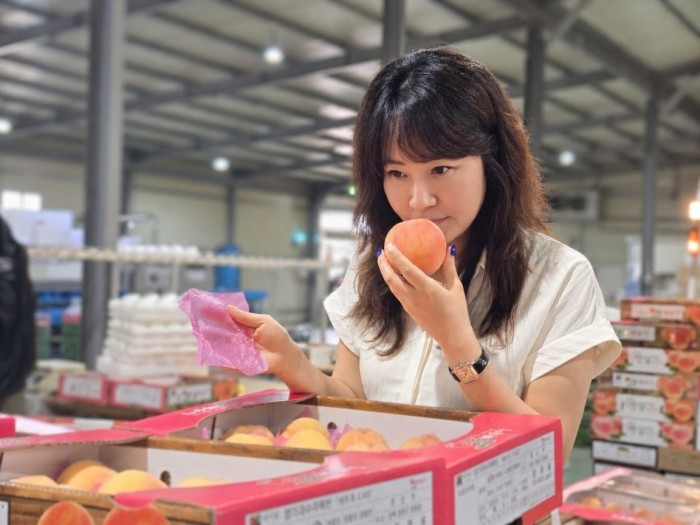 |
| Farmboss CEO Jeong Eun-ju carefully inspects fruit purchased by the company at its own distribution warehouse. / Temu |
Farmboss, an agricultural products distributor that joined the global e-commerce platform Temu, continues to grow on the back of expanding online sales. An increase in orders through Temu is leading to greater investment in logistics and job creation. Temu currently accounts for approximately 30% of Farmboss' total online sales.
Farmboss, an agricultural products distributor established in April last year, purchases fruits, vegetables and seaweed from farming regions across the country, including Cheongdo, and sells them online. The company began selling products through Temu's Local Seller Program for domestic sellers in October last year.
According to Temu on Oct. 27, Farmboss, headquartered in Cheongdo, North Gyeongsang Province, currently sources agricultural products from about 20 farms. The number of farms it works with has increased by approximately 30% compared with when it first joined Temu. Discussions are also underway with new farms regarding additional supplies.
Farmboss' growth has been driven by a rapid increase in sales since joining Temu. Within two to three months of starting sales on the platform, its overall revenue increased by approximately 30%. Orders on Temu grew two to three times faster than on its existing online sales channels, with daily orders exceeding 1,000 on some days.
The increase in sales has also led to expanded business relationships with local farms. Farmboss operates by purchasing products directly from farmers, inspecting and packaging them at its logistics warehouse in Cheongdo, and delivering them to consumers. By reducing intermediate distribution stages, the company maintains price competitiveness while securing a stable supply of products from farmers.
Differences in cost structures among online platforms also influenced the company's choice of sales channels. According to Farmboss, the company sometimes spent as much as 20% of its revenue on advertising and marketing on certain existing platforms to improve search visibility and product exposure. On Temu, however, the company said it was able to reduce its advertising expenses while attracting new customers in their 20s and 30s, a demographic that had been relatively difficult to reach through its existing sales channels.
"We use online sales data to forecast seasonal demand and secure products by discussing the required quantities with farmers in advance," Farmboss said. "On Temu, we were able to reduce the burden of separate advertising expenses by taking advantage of product recommendations based on customer reviews and price competitiveness, as well as platform promotions."
Products that have seen notable sales increases on Temu include semi-dried persimmons from Cheongdo, sweet potatoes from Gochang, and seaweed and kelp from Wando. The company is also expanding sales of seasonal agricultural products and vegetables used for making kimchi, depending on the season.
As its business grows, Farmboss is also expanding its workforce and logistics facilities. The number of employees has increased from five before joining Temu to 10 currently. The company also plans to pursue the purchase of land in Seongju County, North Gyeongsang Province, for a new logistics warehouse and manufacturing plant.
Farmboss also intends to broaden its cooperation with local farms. In addition to its existing suppliers, the company plans to expand its business relationships to include farms growing new crop varieties and young farmers operating smart farms.
Meanwhile, similar cases in which increased sales after joining Temu have led to additional orders from local farms are emerging among other agricultural and food product sellers. Myeongga Samdae Tteokjip, a rice cake seller, is considering placing additional orders with farms in Jindo, South Jeolla Province, after its inventory of mugwort, a raw ingredient, was depleted faster than expected due to increased summer sales on Temu.
The following is a question-and-answer interview with a Farmboss representative.
Q. What kind of company is Farmboss?
"Farmboss is an agricultural products distribution company established in April 2025. Based in Cheongdo, North Gyeongsang Province, we purchase fruits, vegetables and seaweed directly from production areas across the country and sell them online. Our goal is to directly connect consumers with farmers who produce quality products but have difficulty finding stable sales channels. We currently work with about 20 farms."
Q. What prompted Farmboss to join Temu?
"We had already been selling products through several online platforms, but acquiring new customers required substantial advertising and marketing expenses. On some platforms, we sometimes spent as much as 20% of our revenue on advertising and marketing to increase product visibility. While looking for a sales channel that would allow us to reach new customer groups while reducing advertising expenses, we decided to participate in Temu's Local Seller Program."
Q. What has been the biggest change since joining Temu?
"Within two to three months of starting sales in October 2025, our overall revenue increased by approximately 30%. Orders also grew two to three times faster than on our existing online sales channels, and there were days when we received more than 1,000 orders. Currently, about 30% of our total online sales come from Temu."
Q. How has the expansion of sales affected local farms?
"As sales increased, we were able to purchase larger quantities from our existing suppliers and began doing business with new farms. Compared with when we first joined Temu, the number of partner farms has increased by approximately 30%, and we now work with around 20 farms. We are also discussing additional supplies with other farms. Securing stable sales channels has the advantage of allowing farmers to plan their production volumes and shipments more reliably."
Q. What are the distinctive features of Farmboss' agricultural distribution model?
"We purchase products directly from farms, after which our employees inspect their quality, package them at our logistics warehouse in Cheongdo and deliver them to consumers. This reduces intermediate distribution stages. By forecasting seasonal demand based on past sales data and discussing the quantities needed with farmers in advance, we can manage prices and supply volumes more consistently."
Q. Farmboss has reportedly attracted more young consumers through Temu. What changes have you seen?
"We have seen a notable influx of new customers in their 20s and 30s, whom it was difficult to attract through our existing sales channels. We believe younger consumers now have more opportunities to discover local agricultural and marine products online, such as semi-dried persimmons from Cheongdo, sweet potatoes from Gochang, and seaweed and kelp from Wando. We are also seeing additional purchases, such as customers buying products and then ordering them again to send to their parents."
Q. Have employment and investment changed as the business has expanded?
"As orders increased after joining Temu, our workforce doubled from five employees to 10. We are also pursuing plans to secure land for a new logistics warehouse and manufacturing plant in Seongju County, North Gyeongsang Province, in preparation for further increases in order volumes."
Q. What are your future plans?
"We plan to expand our network of suppliers beyond our existing partner farms to include farms growing new crop varieties and young local farmers operating smart farms. Our goal is to expand the business so that increased online sales not only drive Farmboss' growth but also help local farms secure stable sales channels."
Choi Jeong-a
Most Read
-
1
Celltrion nears additional contract with major U.S..

-
2
Putin proposes trilateral U.S.-China-Russia summit..

-
3
U.S. weighs dropping MOAB, world's most powerful n..

-
4
"Aren't those foreigners on welfare?": M..

-
5
Attention centers on APEC for possible Trump-Xi-Pu..

-
6
U.S., Israel plan to resume strikes on Iran after..

-
7
China tightens grip on boosting domestic demand an..

PEOPLE







-
Address : In-Young Bldg., 34, Uisadang-daero 1-gil, Yeongdeungpo-gu, Seoul
Copyright by ASIATODAY CO., LTD. All rights resereved