



[Exclusive] Korea Western Power withdraws from offshore wind project
Oct 27, 2026, 05:15 pm


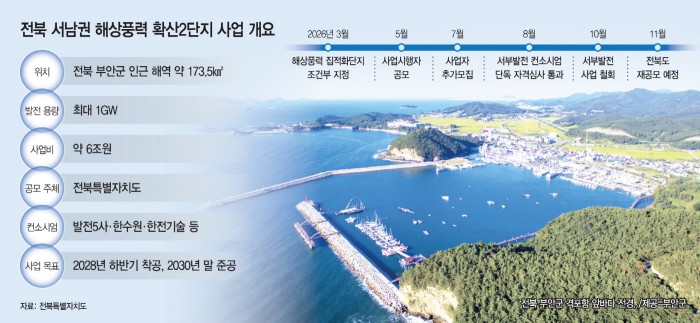 |
Korea Western Power has decided to withdraw from the 6 trillion won Southwestern Offshore Wind Power Expansion Complex 2 project in Jeonbuk Province, it has been confirmed. With the lead company of a consortium comprising seven public institutions halting its participation without the consent of the other members, the government-led development plan is at risk of falling through. Delays in signing the implementation agreement for Expansion Complex 1 have also caused a series of setbacks to the southwestern offshore wind power development project, valued at a total of 12 trillion won.
According to government and industry sources on Oct. 27, Korea Western Power has decided not to participate in the proposal evaluation process for Expansion Complex 2, a 1,000-megawatt (MW) project planned in waters off Buan, Jeonbuk Province. The consortium, comprising seven public institutions — Korea Western Power, Korea Midland Power, Korea South-East Power, Korea Southern Power, Korea East-West Power, Korea Hydro & Nuclear Power (KHNP) and KEPCO Engineering & Construction — had been the sole bidder to pass the qualification screening in August and had already submitted its second-stage business proposal.
Korea Western Power and the Ministry of Climate, Energy and Environment (MCEE), which oversees offshore wind power cluster complexes, have offered differing explanations for the withdrawal. Korea Western Power maintains that it determined the project would be difficult to pursue after reviewing unresolved project conditions, including consultations on military operational requirements. The ministry, however, has raised the possibility that concerns over project profitability stemming from changes to the Renewable Portfolio Standard (RPS) and other factors may have influenced the decision.
Korea Western Power reportedly decided not to participate in the proposal evaluation without obtaining prior consent from the other consortium members and merely notified them of its decision afterward. The bidding guidelines for Expansion Complex 2 stipulate that a project proposal can be withdrawn only by submitting a withdrawal document signed and sealed by both the lead company and all participating companies. However, Korea Western Power only verbally informed Jeonbuk Province, the implementing authority, of its intention to withdraw and has been asked to submit an official written notice.
Under the bidding guidelines, a bidder that withdraws its project proposal cannot participate in the same tender again, leaving the government-led development plan, which sought to pool the financial resources and business capabilities of Korea Electric Power Corporation (KEPCO) subsidiaries, on the verge of collapse. With even public institutions suspending their participation because of uncertain project conditions, it remains unclear whether the project can achieve commercial viability even if new private developers are recruited.
Jeonbuk Province is seeking to issue a new tender announcement in late November to select a developer for Expansion Complex 2. However, delays are expected as the government is also considering revoking the project's designation as an offshore wind power cluster complex. Expansion Complex 2 was designated in March on the condition that consultations on military operational requirements be completed by the end of the year. Depending on the outcome of those consultations, the power generation capacity and project area could be reduced or adjusted, meaning that the project's scale and location could change even before a new developer is selected.
An official from the ministry's Offshore Wind Power Promotion Task Force said, "We do not plan to rush the tender announcement," adding, "If the designation conditions are not met by the end of the year, we will have no choice but to consider revoking the designation." If the designation is revoked, the project could be converted into a conventional power generation project or shifted to the planned-site development system under the Offshore Wind Power Act. However, failure to complete consultations on military operational requirements could also result in the project being suspended for an extended period.
Expansion Complex 1, also valued at 6 trillion won, is facing delays in signing its implementation agreement, originally scheduled for August, because of disagreements among participating companies over the allocation of responsibilities and risks. The KHNP-led consortium, comprising 10 companies — KHNP, Korea East-West Power, KEPCO KPS, KEPCO Engineering & Construction, Hanwha Ocean, Doosan Enerbility, IBK Financial Group, KB Financial Group, Samil C&S and Jungang Marine Heavy Industries — has yet to reach an agreement on liability provisions concerning construction delays and contract cancellations since being selected as the preferred bidder. While Expansion Complex 2 is at risk of being halted at the developer selection stage, Expansion Complex 1 is also encountering difficulties at the agreement stage.
Eight offshore wind power cluster complexes that must fulfill their designation conditions by the end of the year are also at risk of losing their designations. According to the ministry, all eight complexes, including Southwestern Expansion Complex 2, have yet to complete necessary procedures, including consultations on military operational requirements, and the government is reviewing whether they have fulfilled the conditions. Restrictions arising from military facilities or training zones have emerged during consultations after the project areas were designated. If the designations are revoked, changes to project plans, reselection of developers and investment delays could follow.
Industry observers have raised concerns that setbacks in large-scale projects at an early stage could affect subsequent developments, given the lack of project experience and specialized personnel at public institutions. An offshore wind power industry official said, "Even if we bring together all the domestic expertise and financial and technical capabilities available, it is not easy to undertake even a few large-scale projects," adding, "The initial projects must succeed for subsequent projects to proceed and for a domestic market to develop. If major projects collapse, other projects will inevitably be affected."
Jeong Soon-young
Most Read
-
1
Celltrion nears additional contract with major U.S..

-
2
Putin proposes trilateral U.S.-China-Russia summit..

-
3
U.S. weighs dropping MOAB, world's most powerful n..

-
4
"Aren't those foreigners on welfare?": M..

-
5
Attention centers on APEC for possible Trump-Xi-Pu..

-
6
U.S., Israel plan to resume strikes on Iran after..

-
7
China tightens grip on boosting domestic demand an..

PEOPLE







-
Address : In-Young Bldg., 34, Uisadang-daero 1-gil, Yeongdeungpo-gu, Seoul
Copyright by ASIATODAY CO., LTD. All rights resereved