



German president visits China to ease strained bilateral and EU ties
Oct 27, 2026, 04:26 pm


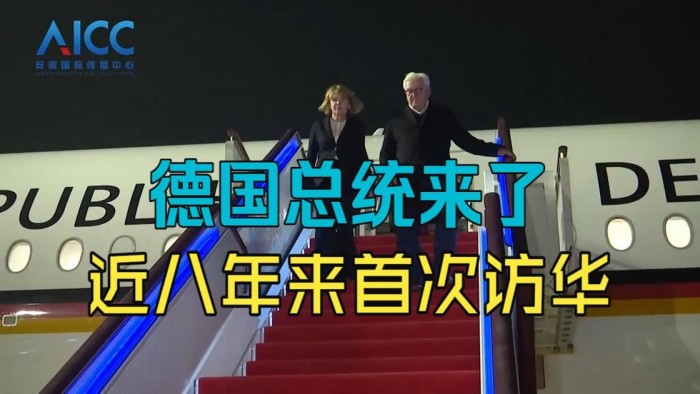 |
| German President Frank-Walter Steinmeier is visiting China for five days, returning to the country for the first time in eight years. He is scheduled to hold talks with Chinese President Xi Jinping on bilateral issues. / Anhui International Communication Center |
German President Frank-Walter Steinmeier began a five-day visit to China on Oct. 27, drawing attention to whether the trip will provide an opportunity to improve bilateral relations and China-EU ties, both of which have recently shown signs of deterioration. These issues are expected to be major topics during his summit with Xi Jinping, general secretary of the Communist Party of China (CPC) and president of China.
According to Beijing-based diplomatic sources familiar with relations between the two countries on Oct. 27, Steinmeier began his first visit to China in eight years since 2018 by traveling to Hefei, Anhui Province, that day. He may not be Germany's top political leader, given the country's parliamentary system of government. However, having served for more than three years each as parliamentary group leader of the Social Democratic Party (SPD), Germany's largest political party, and as foreign minister before becoming president, he is a prominent political figure whose influence is comparable to that of current Chancellor Friedrich Merz.
There is good reason why China has expressed subtle appreciation for his decision to schedule a visit lasting as long as five days and is making every effort to extend him a warm reception, beginning at the provincial level. This may also explain why Xi, his summit counterpart, Premier Li Qiang and Zhao Leji, chairman of the Standing Committee of the National People's Congress (NPC), are all scheduled to meet him and exchange views on matters of mutual interest.
During his meetings with Xi and other Chinese leaders, Steinmeier is expected to first seek solutions to trade disputes between China and Germany and the European Union (EU), which are struggling with a massive influx of Chinese-made products, including new energy vehicles. In particular, he is certain to express considerable concern over the immediate possibility that intense competition with China could hollow out key manufacturing industries in Germany and other EU countries.
In fact, Germany blocked a deal on Oct. 7 (local time) under which China's state-owned shipping group COSCO sought to acquire an 80% stake in German logistics company Zippel, citing security concerns. Five days later, on Oct. 12, Germany also joined France in spearheading the EU's decision to introduce safeguard measures limiting imports of Chinese-made hybrid vehicles to a maximum of 350,000 units annually. Indeed, it would be strange if Germany had not taken such steps when domestic automakers, including Audi, are struggling and facing a crisis amid a flood of Chinese-made vehicles.
Fundamentally, however, Germany, along with France, is considered one of the most China-friendly countries in the EU. In late February, when tensions between the United States and China over tariffs and trade disputes had intensified, Chancellor Merz hurried to visit China, determined not to be outdone by French President Emmanuel Macron, his counterpart from a rival EU country. The visit even angered U.S. President Donald Trump.
Given these circumstances, it would hardly be an exaggeration for Beijing-based diplomatic sources to describe Steinmeier's visit as an all-out effort to improve bilateral relations, which have shown signs of weakening. The same can be said of expectations that the visit will also have a positive effect on China-EU relations. This is especially true considering China's efforts to avoid antagonizing the EU, particularly Germany and France, as it seeks to counterbalance the United States.
Hong Soon-do
Most Read
-
1
Celltrion nears additional contract with major U.S..

-
2
Putin proposes trilateral U.S.-China-Russia summit..

-
3
U.S. weighs dropping MOAB, world's most powerful n..

-
4
"Aren't those foreigners on welfare?": M..

-
5
Attention centers on APEC for possible Trump-Xi-Pu..

-
6
U.S., Israel plan to resume strikes on Iran after..

-
7
China tightens grip on boosting domestic demand an..

PEOPLE






-
Address : In-Young Bldg., 34, Uisadang-daero 1-gil, Yeongdeungpo-gu, Seoul
Copyright by ASIATODAY CO., LTD. All rights resereved