



Israel holds general election on Oct. 27
Oct 27, 2026, 02:14 pm


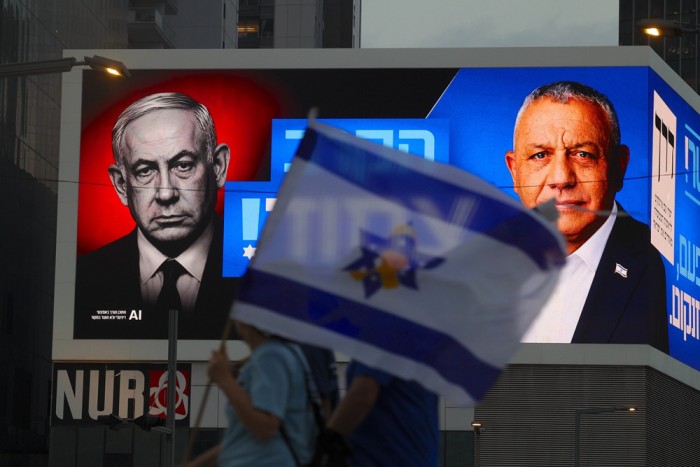 |
| People walk past election campaign billboards featuring photographs of Israeli Prime Minister Benjamin Netanyahu (left) and Gadi Eisenkot, leader of the Yashar party, in Tel Aviv, Israel, on Oct. 24 (local time). / EPA, Yonhap |
Attention is focused on how the political landscape in the Middle East may change as Israel holds its general election on Oct. 27 (local time), which will determine whether Benjamin Netanyahu, the country's longest-serving prime minister, remains in power.
This is the first nationwide election since the surprise attack by the Palestinian militant group Hamas on Oct. 7, 2023, which triggered the conflict in the Middle East.
Netanyahu, who has served as prime minister for 19 years, faces a test of his political survival amid accusations of security failures surrounding the Middle East conflict and an ongoing trial on corruption charges.
According to Reuters, voting in Israel's general election will take place from 7 a.m. to 10 p.m. local time on Oct. 27 (2 p.m. on Oct. 27 to 5 a.m. on Oct. 28, Korean time).
The Knesset, Israel's parliament, operates under a nationwide proportional representation system, with its 120 seats allocated to political parties according to the election results. Parties must secure at least 3.25% of the vote to win seats.
A total of 38 parties are participating in the election. Major parties include the right-wing Likud party led by Netanyahu and the left-wing opposition Yashar party led by Gadi Eisenkot, a former chief of staff of the Israel Defense Forces.
Recently released local opinion polls showed the ruling and opposition blocs each securing 51 seats, indicating an extremely close contest.
Once the results are announced on Nov. 4, the official election announcement date, President Isaac Herzog must nominate a candidate for prime minister within seven days.
The nominated candidate must submit a proposed government, including cabinet appointments, to the Knesset and will be confirmed as prime minister upon securing the approval of a majority in a parliamentary vote of confidence.
The president has traditionally nominated the leader of the largest party to help ensure that the candidate can successfully complete this process.
Kim Hyun-min
Most Read
-
1
Celltrion nears additional contract with major U.S..

-
2
Putin proposes trilateral U.S.-China-Russia summit..

-
3
U.S. weighs dropping MOAB, world's most powerful n..

-
4
"Aren't those foreigners on welfare?": M..

-
5
Attention centers on APEC for possible Trump-Xi-Pu..

-
6
U.S., Israel plan to resume strikes on Iran after..

-
7
China tightens grip on boosting domestic demand an..

PEOPLE







-
Address : In-Young Bldg., 34, Uisadang-daero 1-gil, Yeongdeungpo-gu, Seoul
Copyright by ASIATODAY CO., LTD. All rights resereved