



Vietnam's first chip plant remains unbuilt nine months after groundbreaking
Oct 27, 2026, 09:59 am


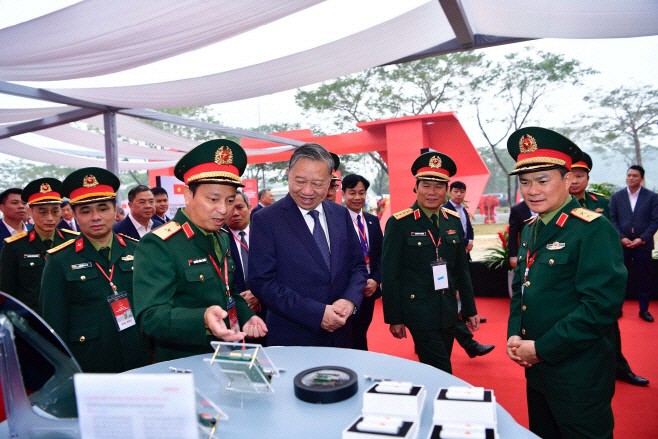 |
| General Secretary To Lam (center) tours the site while attending the groundbreaking ceremony for Viettel's semiconductor wafer fabrication plant at Hoa Lac Hi-Tech Park in Hanoi, Vietnam, on Jan. 16 (local time). / Vietnam Government Portal |
Vietnam's first semiconductor manufacturing plant, an ambitious project pursued by the government, has yet to see meaningful construction work nine months after its groundbreaking ceremony. There are also growing doubts about whether the plant can meet its target of beginning trial production in 2027.
Reuters reported on Oct. 26 (local time) that a visit to the factory site on the outskirts of Hanoi found it still abandoned and covered in weeds. A comparison of satellite images taken by satellite company Planet Labs in January, when the groundbreaking ceremony was held, and by Airbus in October showed that not a single building had been erected.
A source familiar with the project attributed the construction delays to the developer's limited capabilities and administrative procedures. Viettel, a telecommunications and defense group under the Vietnamese military, has no experience building semiconductor manufacturing plants and has encountered administrative obstacles in securing government funding quickly.
The source said it was virtually impossible to meet the 2027 trial production target, adding that although the government-led project was still moving forward, its future timeline remained highly uncertain.
Viettel, however, maintains that the project is on schedule. In a statement to Reuters, Viettel said the project was "progressing according to the established plan and schedule" and that it would disclose further details at an appropriate time as the project proceeds in stages in accordance with technical and implementation requirements. Vietnam's Ministry of Finance did not respond to a request for comment.
Earlier, on Jan. 16, Viettel held a large-scale groundbreaking ceremony on a 27-hectare site at Hoa Lac Hi-Tech Park in Hanoi, attended by senior leaders including Communist Party General Secretary To Lam and then-Prime Minister Pham Minh Chinh. At the time, Viettel announced plans to invest approximately $1.3 billion (about 1.7225 trillion won) to complete construction and technology transfer and begin trial production by the end of 2027, before commencing full operations in 2030. Chips produced at the facility were intended to be supplied to industries including aerospace, telecommunications and automotive manufacturing.
Negotiations to acquire key manufacturing equipment have also made little progress. According to multiple sources, Viettel has been negotiating for months with Dutch semiconductor equipment manufacturer ASML. The discussions reportedly include deep ultraviolet (DUV) lithography equipment used to etch fine circuit patterns onto silicon wafers. However, the specific DUV equipment models under discussion and the reasons for the delay in reaching an agreement could not be confirmed. ASML declined to comment on the negotiations.
There are also signs that the initial production target has been quietly scaled back. Viettel initially announced in a January press release that it would mass-produce chips using a 32-nanometer (nm) process, but subsequently removed the statement from its website. Even at the time, many considered it an overly ambitious plan for a company with no semiconductor manufacturing experience to move directly to a 32-nanometer process.
This contrasts with India's Tata Electronics, which is building a plant in partnership with Taiwan's PSMC at a cost of $11 billion (about 14.575 trillion won) and has announced plans to begin with older 55- and 90-nanometer processes before transitioning to a 28-nanometer process. Viettel has also not disclosed whether it is forming a joint venture with an established semiconductor manufacturer to obtain technology and expertise.
Industry observers say the Vietnamese government's plan to attract foreign investment to establish an advanced chip manufacturing plant has encountered difficulties. Vietnam has emerged as a global hub for relatively less capital-intensive back-end semiconductor processes, including assembly, testing and packaging (ATP), with Intel, Amkor Technology and Hana Micron operating large-scale facilities and Samsung Electronics also pursuing a chip testing facility. The Viettel plant was a centerpiece of Vietnam's ambition to move beyond an industry structure centered on back-end processes and establish a presence in wafer fabrication (fabs), the highest-value segment of the semiconductor value chain. However, the project appears to be encountering difficulties from the very outset.
|
Jeong Ri-na
Most Read
-
1
Celltrion nears additional contract with major U.S..

-
2
Putin proposes trilateral U.S.-China-Russia summit..

-
3
U.S. weighs dropping MOAB, world's most powerful n..

-
4
"Aren't those foreigners on welfare?": M..

-
5
Attention centers on APEC for possible Trump-Xi-Pu..

-
6
U.S., Israel plan to resume strikes on Iran after..

-
7
China tightens grip on boosting domestic demand an..

PEOPLE







-
Address : In-Young Bldg., 34, Uisadang-daero 1-gil, Yeongdeungpo-gu, Seoul
Copyright by ASIATODAY CO., LTD. All rights resereved