



S. Korea's GDP posts surprise 1.0% growth in Q3
Oct 27, 2026, 09:37 am


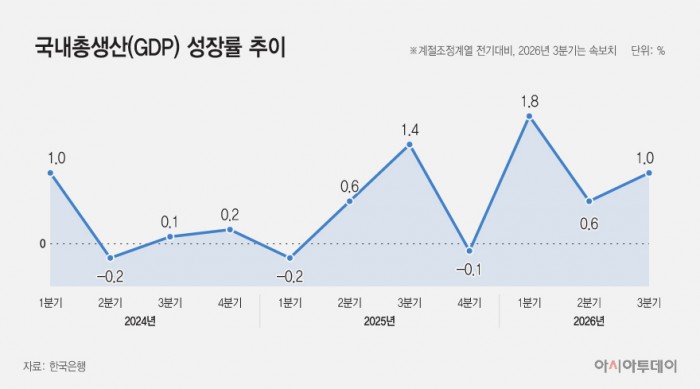 |
South Korea's economy grew 1.0% in the third quarter of this year, supported by strong semiconductor exports and captial expenditures. The growth rate was more than three times the 0.3% forecast by the Bank of Korea (BOK) in August. However, private consumption declined for the first time in three years and nine months, highlighting a divergence between exports and investment on one hand and household spending on the other. With growth proving stronger than expected, attention is turning to the BOK's annual growth forecast and key interest rate decision in November.
According to the BOK's advance estimate of real gross domestic product (GDP) for the third quarter, released on Oct. 27, real GDP grew 1.0% from the previous quarter. After rebounding from a 0.1% contraction in the fourth quarter of last year to 1.8% growth in the first quarter of this year, the economy continued to expand for a third consecutive quarter, following 0.6% growth in the second quarter. The year-on-year growth rate stood at 3.4%.
The latest growth rate exceeded the BOK's August economic forecast of 0.3% by 0.7 percentage points, reflecting stronger-than-expected momentum in the semiconductor industry. In its assessment of economic conditions released on Oct. 22, the BOK had also projected that economic growth this year and next year would significantly exceed its previous forecasts of 3.3% and 2.9%, respectively.
Exports and facilities investment were the main drivers of growth. Third-quarter exports rose 2.3% from the previous quarter and 8.6% from a year earlier, led by semiconductors and machinery and electrical equipment. The quarter-on-quarter growth rate was 1.0 percentage point higher than the 1.3% recorded in the second quarter. Facilities investment also increased 4.1%, mainly driven by machinery, including semiconductor manufacturing equipment, marking a sharp acceleration from the 0.2% increase in the previous quarter. Investment in intellectual property products rose 2.3%, supported by increased spending on research and development and software.
Government consumption also contributed to growth. It increased 1.9% from the previous quarter, driven by higher expenditures on goods and services and national health insurance benefits. This marked the fastest growth since the fourth quarter of 2022, when government consumption rose 2.3%. Construction investment also returned to growth, rising 0.7% after declining 0.1% in the previous quarter, supported by an expansion in civil engineering construction.
Household consumption, however, moved in the opposite direction. Private consumption fell 0.2% from the previous quarter as spending declined on both goods, including passenger cars and home appliances, and services, including financial and food services. This marked the first quarter-on-quarter decline in private consumption in three years and nine months, since the 0.1% contraction in the fourth quarter of 2022. It also ended the upward trend seen in the first and second quarters of this year, when private consumption grew 0.6% and 0.4%, respectively. In terms of contributions to growth, the government sector contributed 0.8 percentage points, while the private sector contributed 0.2 percentage points. Domestic demand contributed 0.9 percentage points, while net exports contributed 0.1 percentage points.
The pace of recovery also varied across industries. Manufacturing grew 2.0% from the previous quarter, supported by increased production of computers, electronic and optical products, and machinery and equipment. Construction also expanded 2.0%, led by civil engineering construction, recovering from a 1.9% contraction in the previous quarter. In contrast, growth in the services sector slowed from 1.0% in the second quarter to 0.2% in the third quarter. In particular, finance and insurance contracted 4.3%, while wholesale and retail trade, accommodation and food services declined 0.4%.
Real gross domestic income (GDI), which indicates the real purchasing power of the country's residents, increased 3.4% from the previous quarter, outpacing GDP growth by 2.4 percentage points. The year-on-year growth rate reached 18.8%, the highest since the fourth quarter of 1977, when it stood at 19.0%.
With the latest growth rate far exceeding the BOK's expectations, future economic growth forecasts are also likely to be revised sharply upward. In August, the BOK raised its growth forecast for this year from 2.6% to 3.3% and has since assessed that the recent semiconductor boom is spreading to other industries. In its October assessment of economic conditions released on Oct. 22, the BOK indicated the possibility of further upward revisions, saying economic growth this year and next year would significantly exceed its August forecasts.
Attention is also turning to next month's key interest rate decision. BOK Governor Shin Hyun Song has said he would decide whether to adjust the key interest rate in November after reviewing major economic indicators, including October consumer price inflation and third-quarter GDP. Against this backdrop, some analysts expect that the stronger-than-anticipated growth could provide grounds for the BOK to implement an additional rate hike next month.
Han Sang-wook
#GDP #Bank of Korea #Semiconductor
Copyright by Asiatoday
Most Read
-
1
Celltrion nears additional contract with major U.S..

-
2
Putin proposes trilateral U.S.-China-Russia summit..

-
3
U.S. weighs dropping MOAB, world's most powerful n..

-
4
"Aren't those foreigners on welfare?": M..

-
5
Attention centers on APEC for possible Trump-Xi-Pu..

-
6
U.S., Israel plan to resume strikes on Iran after..

-
7
China tightens grip on boosting domestic demand an..

PEOPLE







-
Address : In-Young Bldg., 34, Uisadang-daero 1-gil, Yeongdeungpo-gu, Seoul
Copyright by ASIATODAY CO., LTD. All rights resereved