



Indonesia could face two-notch MSCI downgrade
Oct 26, 2026, 03:51 pm


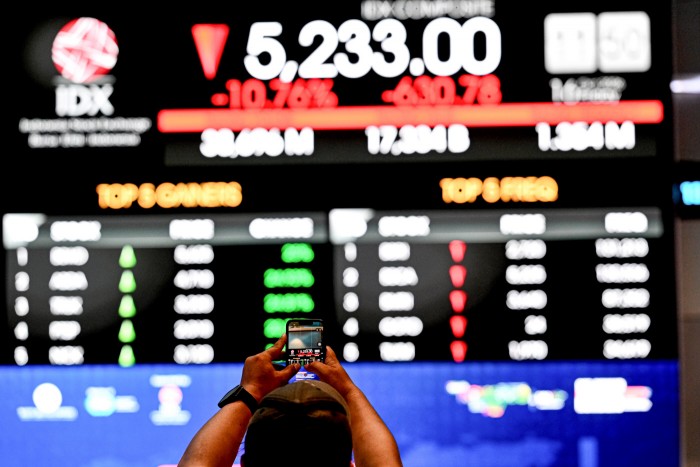 |
| A man photographs an electronic market display in the lobby of the Indonesia Stock Exchange (IDX) in Jakarta on Oct. 16, after news emerged that global index provider MSCI was considering downgrading Indonesia's stock market to standalone-market status. The Jakarta Composite Index plunged more than 11% that day. / Xinhua, Yonhap |
Indonesia's stock market is at risk of losing its emerging-market status under the classification system of global index provider MSCI, potentially skipping the intermediate frontier-market category and falling directly to standalone-market status, the lowest classification. As MSCI raises questions about whether the market is functioning properly rather than its size, fears are spreading that tens of trillions of won in foreign investment could flow out of the country in a short period.
The market reacted almost immediately with a sharp selloff. After MSCI announced on Oct. 15 that it was launching a consultation on a proposal to reclassify Indonesia's stock market, the Jakarta Composite Index plunged 11.6% the following day. It was the index's steepest one-day decline since January 1998, during the Asian financial crisis.
According to Channel News Asia (CNA), approximately $65 billion, or about 86 trillion won, in market capitalization was wiped out that day alone. The rupiah also plunged to 18,027 per U.S. dollar, equivalent to approximately 1,316 won, breaching the psychologically important level of 18,000 rupiah to the dollar.
The shock did not subside quickly. The index fell another 3.64% on Oct. 19, slipping below the 5,000 mark to 4,996. It subsequently rebounded and closed the week at 5,439 on Oct. 23, but foreign investors continued to sell Indonesian equities. According to local brokerage BRI Danareksa, foreign investors net sold approximately $6 billion, or about 8 trillion won, worth of Indonesian stocks from January through October this year.
What would a downgrade to standalone-market status mean?
MSCI is considered one of the world's three major index providers, alongside FTSE Russell and S&P Dow Jones Indices. Its announcements are also closely watched in South Korea, where the stock market has sought inclusion in developed-market indexes for years. Global fund managers use MSCI indexes as benchmarks when determining their investment allocations by country. Assets tracking its emerging-market indexes alone amount to approximately $10 trillion, or about 13 quadrillion won. As a result, whether a country is included in a particular index can significantly influence the movement of foreign investment capital.
MSCI classifies global equity markets into four categories: developed, emerging, frontier and standalone markets. In Asia, Vietnam, Pakistan, Sri Lanka and Bangladesh are among the countries classified as frontier markets. Standalone markets, by contrast, are excluded from the other three classifications and effectively stand outside the major market groupings. Countries in this category include Argentina, Lebanon, Nigeria and Ukraine, with no countries from the Asia-Pacific region currently included. If Indonesia is downgraded to standalone status, it would become the largest economy in that category, more than twice the size of Argentina, currently the group's second-largest economy.
If the downgrade materializes, Indonesian stocks would be removed from major emerging-market indexes, forcing global funds that track those indexes to sell their holdings. Major banks estimate that passive funds alone could see outflows of $3 billion to $6 billion, equivalent to approximately 4 trillion to 8 trillion won.
Investment bank UBS warned that an additional $15 billion, or about 20 trillion won, could leave actively managed funds, where portfolio managers select individual stocks. However, asset manager Eastspring Investments cautioned that the actual scale of capital outflows would depend on MSCI's final decision, how it is implemented and investors' responses.
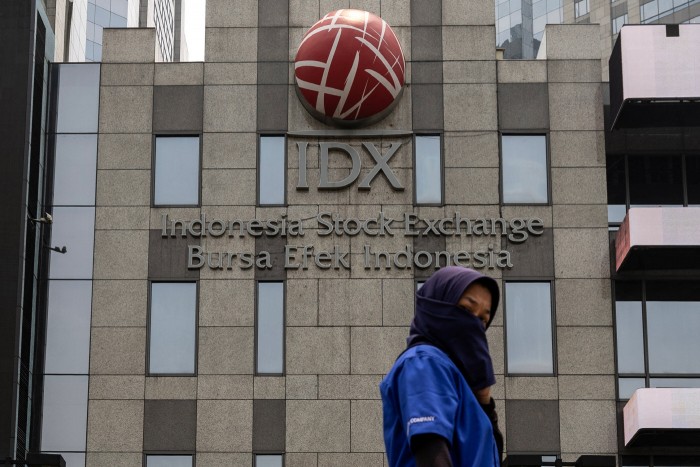 |
| A woman walks past the Indonesia Stock Exchange (IDX) in Jakarta on Oct. 21 as financial markets remain volatile following MSCI's announcement that it is considering downgrading Indonesia to standalone-market status. / Reuters, Yonhap |
Why does MSCI consider a frontier-market downgrade insufficient?
The main reason MSCI is considering a direct downgrade that would bypass the frontier-market category is a loss of confidence in Indonesia's stock market. Despite reform measures announced by Indonesian authorities, MSCI said concerns persist over market dysfunction, including suspected coordinated trading and a lack of evidence of meaningful enforcement. Gary Tan, a portfolio manager at Allspring Global Investments, also told Channel News Asia (CNA) that MSCI's main concerns center on market transparency, price formation and the credibility of regulatory enforcement.
In particular, the opaque ownership structures of listed companies have come under scrutiny. MSCI determines the weight of individual stocks in its indexes based on their free float, or the proportion of shares actually available for trading in the market. However, global institutional investors have repeatedly questioned the reliability of free-float figures and shareholder classification data provided by Indonesian companies. This means investors have difficulty determining how many shares are actually available for trading. Allegations have also emerged that the prices of some stocks were artificially inflated through market manipulation.
MSCI first formally raised these concerns in January this year, warning of a possible downgrade to frontier-market status. That same month, it froze certain index-related changes for Indonesian stocks, including increases in their index inclusion. In June, MSCI issued a further warning that it would consider launching a reclassification consultation if sufficient improvements were not made before its regular index review in November.
Although Indonesian authorities subsequently announced reform measures, MSCI stated in its latest announcement that a downgrade to frontier-market status would not "properly recognize the depth of the market problems." Tan suggested that MSCI may have been concerned that moving Indonesia to the frontier-market category would merely transfer unresolved problems to another MSCI index. He added that the market impact would be considerably greater because Indonesia would leave the emerging-market index without the offsetting inflows from funds tracking frontier-market indexes.
The proposed move is highly unusual even by historical standards. Of the eight countries downgraded to standalone-market status since 1997, only three were moved directly from emerging-market status. They included Argentina, which imposed capital controls in 2021, and Russia, which faced Western sanctions following its invasion of Ukraine in 2022. Angus Mackintosh, an ASEAN specialist at Aletheia Capital, said there was no precedent for a direct downgrade resulting from the actions of a small number of market participants or concerns over transparency. "Indonesia stands up well against its emerging market peers on most measures, which is what makes this latest move perplexing," he said.
High oil prices, populist policies and leadership changes fuel fears of worst crisis since 1998
While MSCI's warning focuses on the functioning of Indonesia's capital markets, the country also faces serious vulnerabilities in its real economy. The New York Times (NYT) reported that the latest economic turmoil has exposed structural weaknesses that remain unresolved under President Prabowo Subianto's administration.
According to the NYT, Indonesia is struggling with rising prices and fuel shortages in urban areas amid the war with Iran and the impact of U.S. tariffs. High oil prices and rising U.S. interest rates have contributed to dollar outflows, leaving Indonesia's import-dependent economy particularly vulnerable to the weakening rupiah. International credit rating agencies Moody's and Fitch also downgraded Indonesia's sovereign credit rating outlook from "stable" to "negative" in February and March, respectively.
Economic conditions have become even more difficult for ordinary Indonesians. The country's middle-class population has declined by approximately 19% from its peak, while youth unemployment stands at around 17%, among the highest rates in Asia. Nobri Putra, 28, who graduated last year with a degree in information technology, now works as a motorcycle taxi driver rather than a web developer, earning approximately $220, or about 290,000 won, a month. Nevertheless, the government has continued to expand populist policies that threaten fiscal sustainability. One flagship program providing free meals to more than 80 million students alone is estimated to cost as much as $30 billion, or about 40 trillion won, annually.
Repeated changes in the country's economic leadership have further unsettled financial markets. Last September, President Prabowo dismissed Finance Minister Sri Mulyani Indrawati, who had been credited with maintaining economic stability since the administration of former President Joko Widodo. In July this year, Bank Indonesia Governor Perry Warjiyo abruptly resigned for personal reasons. Purabaya Yudhi Sadewa, who succeeded Sri Mulyani as finance minister, was also dismissed on Sept. 14, making the current minister, Suahasil Nazara, the country's third finance minister in two years. In an interview with the NYT three days before his dismissal, Purabaya recalled meeting MSCI officials in March. "It was no use. They didn't believe me," he said.
Some experts are warning that Indonesia is experiencing its most unstable period since the 1998 economic collapse that brought down Suharto's authoritarian government. Ferry Latuhihin, a former chief economist at Bank International Indonesia who served on Prabowo's advisory team before the administration took office, likened the current situation to a "ticking time bomb." He warned that just as few people in 1997 expected an economic crisis to bring down Suharto's government, a similar outcome could occur under the current administration.
However, the prevailing assessment is that the crisis is unlikely to spread to financial markets in neighboring countries. Philip Wool, head of research and portfolio management at Rayliant, said the risks would likely remain contained because MSCI's concerns were specific to Indonesia and the country accounts for a relatively small share of most emerging-market investment portfolios.
The potential consequences for the real economy, however, could be different. As the world's largest producer of palm oil and nickel and a major exporter of coal, copper and natural gas, Indonesia plays an important role in global supply chains. The NYT reported that severe economic instability in the country could disrupt global electric vehicle production and drive up food, consumer goods and energy prices worldwide.
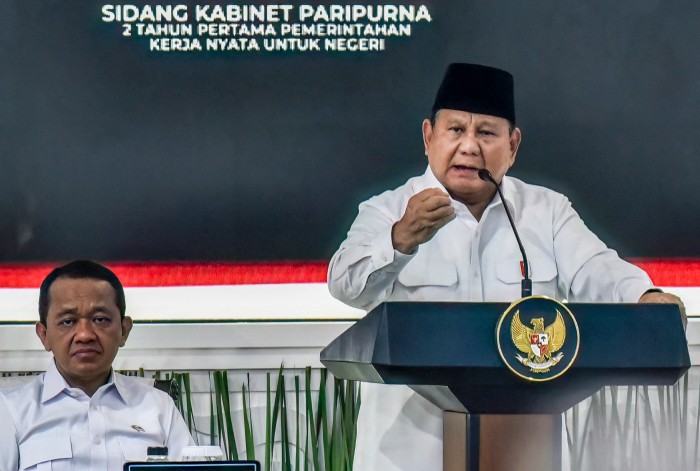 |
| Indonesian President Prabowo Subianto (right) speaks during a full cabinet meeting at the presidential palace in Jakarta on Oct. 21. At left is Investment Minister Bahlil Lahadalia. / AFP, Yonhap |
Can Indonesia avert a downgrade by next June? Strict enforcement, not cosmetic reforms, holds the key
Facing mounting pressure, the Indonesian government has responded with both defiant rhetoric and measures aimed at containing the crisis. At a cabinet meeting on Oct. 21, President Prabowo pushed back, saying, "MSCI is trying to intimidate us," adding, "We have the strength and courage, and we are prepared to make sacrifices." Some lawmakers also demanded that MSCI disclose its assessment methodology transparently. MSCI, however, told Reuters that its decisions followed a transparent, rules-based methodology.
Behind the scenes, Indonesian authorities are moving quickly to contain the fallout. Following the resignation of Mahendra Siregar, chairman of the Financial Services Authority (OJK), in January, the government replaced senior officials with figures regarded as more credible by financial markets and significantly tightened regulations against market manipulation. Notably, just hours after MSCI's announcement, the OJK imposed fines totaling 2.1 trillion rupiah (approximately 154 billion won) on parties involved in market manipulation and referred the cases to the police for investigation. The Indonesia Stock Exchange (IDX) also decided to exclude 84 stocks with ownership concentrated among a small number of shareholders from the Jakarta Composite Index, effective Nov. 2, shortly after meeting MSCI officials on Oct. 19.
MSCI plans to gather market feedback until April 30 next year before announcing its final decision by June 30. If clear evidence of substantial improvements in market governance is not established within that period, Indonesia will face the downgrade process.
Market experts believe that effective enforcement, rather than simply announcing a series of measures, will determine the outcome. Tan said, "Ultimately, Indonesia needs to convince MSCI that these measures will continue to deliver lasting results even after the current index freeze is lifted." Mackintosh also emphasized the importance of enforcement, saying, "While the authorities have introduced numerous policies, rigorous enforcement must now take priority. Those responsible for coordinated trading and stock price manipulation must face meaningful penalties, including fines or prison sentences."
Jeong Ri-na
Most Read
-
1
Celltrion nears additional contract with major U.S..

-
2
Putin proposes trilateral U.S.-China-Russia summit..

-
3
U.S. weighs dropping MOAB, world's most powerful n..

-
4
"Aren't those foreigners on welfare?": M..

-
5
Attention centers on APEC for possible Trump-Xi-Pu..

-
6
U.S., Israel plan to resume strikes on Iran after..

-
7
China tightens grip on boosting domestic demand an..

PEOPLE







-
Address : In-Young Bldg., 34, Uisadang-daero 1-gil, Yeongdeungpo-gu, Seoul
Copyright by ASIATODAY CO., LTD. All rights resereved