



Can Lula's win buck Latin America's rightward shift?
Oct 26, 2026, 03:40 pm


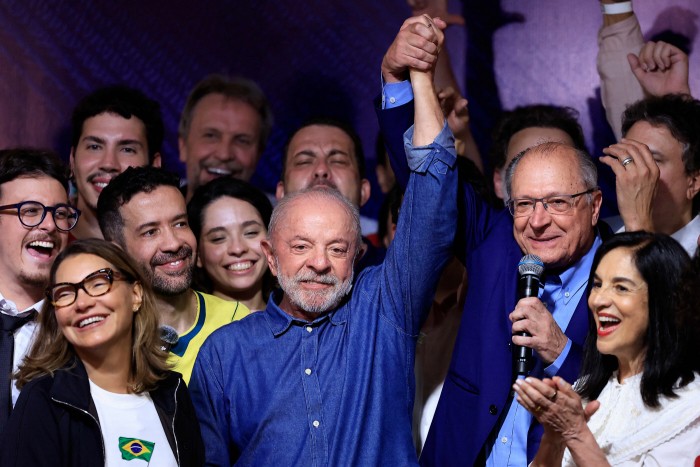 |
| Brazilian President Luiz Inácio Lula da Silva (front row, second from left) raises his clasped hands with Vice President Geraldo Alckmin in Brasília on Oct. 25 after winning the presidential runoff and securing a historic fourth term. / AFP, Yonhap |
Brazilian President Luiz Inácio Lula da Silva won the country's presidential runoff on Oct. 25, becoming the first president in Brazil's constitutional history to secure a fourth term.
According to Brazil's Superior Electoral Court, Lula won 51.79% of the vote, or 64,256,232 votes, defeating his opponent, Senator Flávio Bolsonaro, who received 48.21%, or 59,826,041 votes, with 100% of ballots counted.
The result defied expectations. In the first round of voting on Oct. 4, Lula finished second with 45.16% of the vote, trailing Bolsonaro, who secured 47.03%, by approximately 2.2 million votes.
It marked the first time since Brazil's return to democracy in 1985 that a candidate who finished second in the first round came from behind to win the runoff.
In his victory speech, Lula said, "We will change the way this country is governed so that people can participate more in the decision-making process," adding, "I will govern for all 215 million Brazilians." He also expressed a desire to meet with business leaders during the two months before forming his new government.
From poor tenant farmer's son to four-term president: A symbol of resilience
Born in 1945 in Pernambuco state to a poor tenant farmer, Lula spent his childhood in São Paulo, selling peanuts and shining shoes. At 14, he dropped out of school and began working at a metalworking factory in São Bernardo do Campo, near São Paulo.
While working as a lathe operator in 1964, at the age of 19, he lost the little finger on his left hand in an accident during an overnight shift. He suffered another personal tragedy in 1969 when his first wife, a textile worker, died during an emergency cesarean section after being diagnosed with hepatitis while pregnant. He subsequently became deeply involved in labor union activities.
After becoming president of the metalworkers' union, Lula led one of the largest strikes in Brazilian history in 1980, involving unions from three areas near São Paulo. Building on the prominence he gained through the strike, he founded the Workers' Party (PT) and entered electoral politics, winning a seat in the federal Chamber of Deputies in 1986.
Lula was first elected president in 2002 on his fourth attempt and won reelection in 2006. Although he was credited with driving economic growth, he faced a political crisis after leaving office amid corruption allegations.
He was charged in 2016 with bribery, money laundering and other offenses. The following year, a lower court sentenced him to nine years and six months in prison. An appeals court increased the sentence to 12 years and one month in 2018, and he spent approximately one year and seven months behind bars.
In 2021, his convictions were annulled on procedural grounds, allowing him to reemerge as a presidential contender. He returned to power after defeating then-President Jair Bolsonaro, a leading figure of the far right, in the 2022 presidential election. In this year's election, Lula prevailed in another closely contested runoff, this time against the former president's son.
Extended voting hours and dramatic shifts in vote count mark tight runoff
The presidential runoff remained highly competitive until the end, with Lula initially leading the count, falling behind and then regaining the lead.
Brazil's Supreme Federal Court accepted requests from both candidates' campaigns to extend voting hours from 5 p.m. to 7 p.m. Lula's campaign filed an emergency injunction request, alleging that major local governments, including São Paulo, had deliberately reduced public transportation services that day to prevent voters from reaching polling stations.
Bolsonaro's campaign also requested an extension from the Superior Electoral Court, arguing that severe weather, including heavy rain and landslides, had prevented voters from accessing polling stations. As a result, voting hours were extended nationwide by two hours. Confusion at some polling stations during the process also prompted allegations of electoral irregularities.
Lula initially led the vote count but lost his lead after more than 14% of ballots had been counted. As Bolsonaro's advantage widened to more than one percentage point, the race appeared to be shifting in the senator's favor. However, Lula regained the lead when the count passed approximately 48%, putting him on course for victory.
Bolsonaro refuses to accept election results
Senator Bolsonaro said he would not accept the election results, citing confusion on election day, according to The New York Times (NYT) and other media outlets.
"I cannot accept the voting results," he said at a news conference after the vote count. "I will request that this election be annulled."
Referring specifically to the decision to extend voting hours, Bolsonaro described it as "changing the rules in the middle of the game."
"There are many things that need to be clarified before Brazil accepts the irregularities that occurred in this election," he said.
 |
Left-wing government holds onto power amid South America's rightward shift
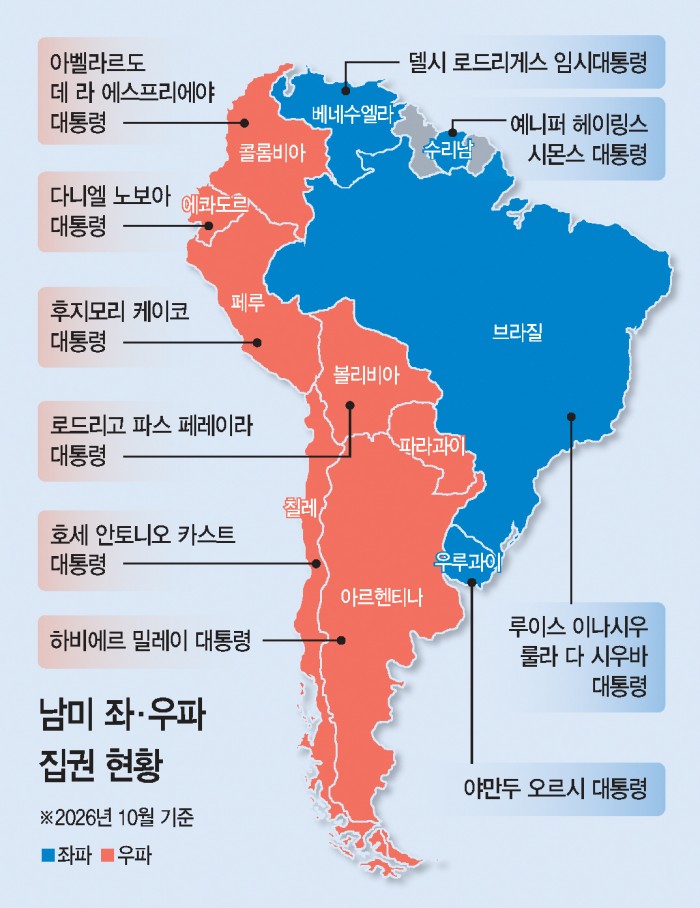
The election marked a victory for the left in Brazil amid a rightward shift across South America, often referred to as the "blue tide." Since U.S. President Donald Trump returned to office in January last year, the region has seen a growing trend toward the political right. Right-wing or center-right leaders have won presidential elections in Ecuador, Bolivia, Honduras, Chile, Costa Rica, Colombia and Peru.
According to a survey conducted by polling firm Datafolha in July, approximately 44% of Brazilians identified their political views as closer to the right, compared with around 39% who identified with the left. The findings marked a reversal of the balance between the two political camps recorded in a 2022 survey.
Brazil had also been widely expected to join the region's rightward shift in this election, but the result proved otherwise. One possible explanation is that more voters prioritized reducing social inequality and combating poverty.
Some voters appear to have concluded that the right's tough-on-crime policies, including aggressive law enforcement, would not address the underlying cycle of social inequality and crime. Analysts also suggest that concerns over right-wing policies promoting market liberalization and fiscal austerity, which could reduce public services and weaken social safety nets, may have influenced the result.
Tariff negotiations pose challenge amid tensions with Trump
Attention is now turning to how the election result could affect U.S. President Donald Trump's policy toward Latin America, which has helped fuel the region's rightward shift.
Lula's approach toward the United States is expected to combine resistance to U.S. pressure in defense of Brazil's sovereignty with diplomatic efforts to improve relations and secure economic benefits. His fourth-term victory has dealt a setback to the Trump administration's efforts to build alliances with right-wing governments across Latin America, but challenges remain over tariffs, critical mineral supply chains and other issues.
Brazilian daily Folha de S.Paulo identified negotiations over high tariffs as the most pressing issue in bilateral relations. The United States currently imposes a 37.5% tariff on Brazilian products. Brazil is expected to pursue negotiations aimed at easing the tariffs and reducing the burden on exporters while continuing to resist U.S. pressure.
Political tensions between the two countries are likely to persist for some time. During the election campaign, Lula stepped up his criticism of U.S. policy toward Latin America.
However, bilateral relations are not expected to deteriorate into outright confrontation. According to accounts from people familiar with the situation, while some U.S. State Department officials have taken a hostile stance toward Lula, many others in the Trump administration show little interest in Brazil and prioritize relations with countries more willing to cooperate with U.S. demands.
Kim Hyun-min
Most Read
-
1
Celltrion nears additional contract with major U.S..

-
2
Putin proposes trilateral U.S.-China-Russia summit..

-
3
U.S. weighs dropping MOAB, world's most powerful n..

-
4
"Aren't those foreigners on welfare?": M..

-
5
Attention centers on APEC for possible Trump-Xi-Pu..

-
6
U.S., Israel plan to resume strikes on Iran after..

-
7
China tightens grip on boosting domestic demand an..

PEOPLE






-
Address : In-Young Bldg., 34, Uisadang-daero 1-gil, Yeongdeungpo-gu, Seoul
Copyright by ASIATODAY CO., LTD. All rights resereved