



María Machado returns after 10 months, pushing for early election
Oct 26, 2026, 01:39 pm


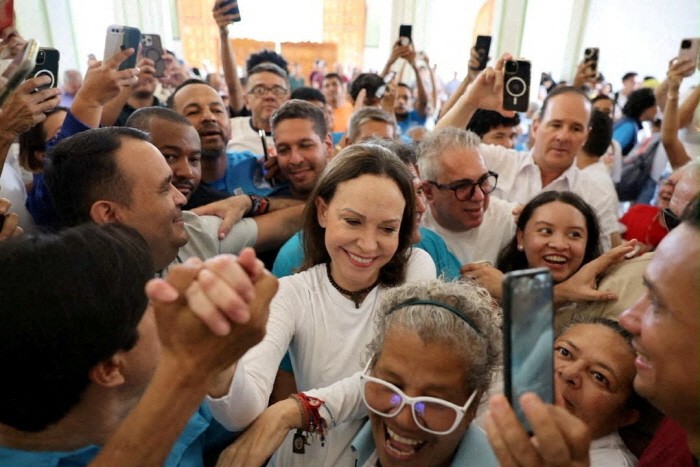 |
| Venezuelan opposition leader María Corina Machado arrives at a church in Lara state, Venezuela, on Oct. 25 after returning to the country following more than 10 months abroad. / Courtesy of Vente Venezuela, Reuters and Yonhap |
[Article summary]
1. Venezuelan opposition leader María Corina Machado secretly returned to the country on Oct. 25 after approximately 10 months abroad and is seeking to resume political activities aimed at securing an early presidential election.
2. Machado has called for a presidential election to be held by July 2027 at the latest and outlined plans to rebuild her political organization by visiting all 23 states.
3. U.S. President Donald Trump has emphasized cooperation with interim President Delcy Rodríguez and achievements in the oil sector, while the United States has secured access to as much as 65 billion barrels of oil reserves.
4. Machado leads Rodríguez by 52% to 19% in a hypothetical presidential election but is not participating in U.S.-backed political negotiations.
Nobel Peace Prize laureate and Venezuelan opposition leader María Corina Machado secretly returned to Venezuela on Oct. 25 after approximately 10 months in exile and headed toward the capital, Caracas. Machado plans to rally her nationwide support base and press for a presidential election to be held by July 2027 at the latest, while U.S. President Donald Trump has emphasized cooperation with interim President Delcy Rodríguez and achievements in the oil sector. Bloomberg reported that Machado's return could pose the biggest test yet of the Rodríguez government's willingness to pursue political reforms and the Trump administration's strategy toward Venezuela.
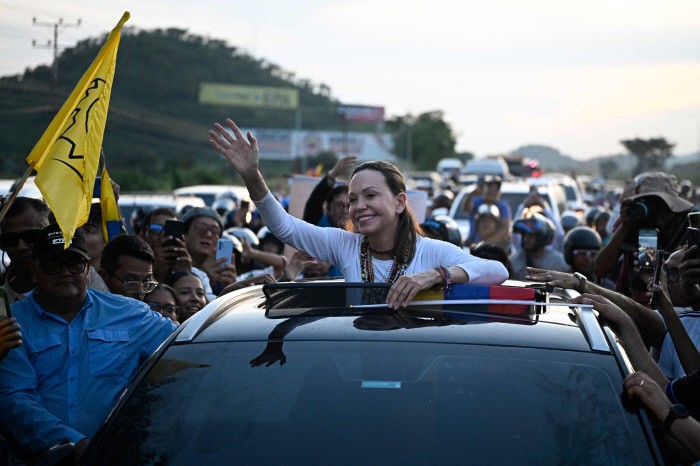 |
| Venezuelan opposition leader and Nobel Peace Prize laureate María Corina Machado greets supporters upon arriving in the capital, Caracas, on Oct. 25. Machado returned to Venezuela that day after more than 10 months in exile and was greeted by enthusiastic supporters at a church in Barquisimeto. / AFP, Yonhap |
Machado returns via Panama and Colombia, heads to Caracas amid cheers from supporters
Machado announced her return on social media platform X that day, writing, "I am here. With you all." She did not disclose her exact route back to Venezuela or her whereabouts in the post.
Machado left Panama on Oct. 22, then flew to Colombia aboard a private jet before entering Venezuela by land, The Wall Street Journal (WSJ) reported, citing a person familiar with her itinerary. She was accompanied by a team of American private security personnel during the journey and received assistance from the Colombian government, according to the WSJ. Reuters also reported, citing two sources, that Machado returned overland via Colombia after departing Panama.
Machado appeared at a church in Barquisimeto, in the western state of Lara, that day, where supporters sang the national anthem and chanted "Freedom." She then headed toward Caracas in a motorcade escorted by motorcycles. Supporters in Altamira, in eastern Caracas, also waved national flags to welcome her return.
Edmundo González, who ran as the opposition candidate in the 2024 presidential election, also said he would join her "very soon" from his place of exile in Spain. Machado secretly left Venezuela last December to receive the Nobel Peace Prize and subsequently made seven unsuccessful attempts to return.
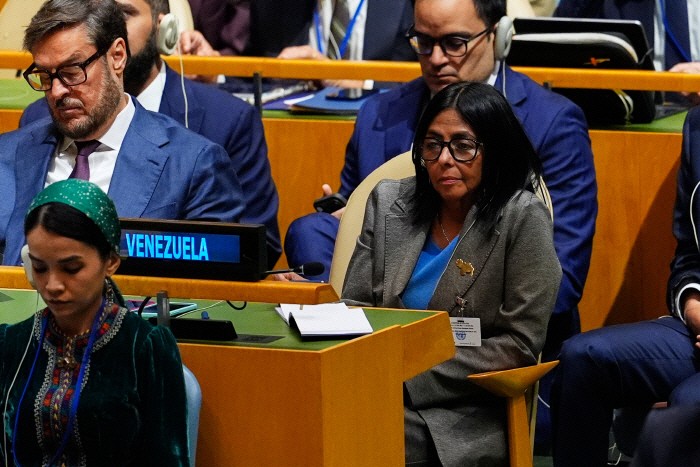 |
| Venezuela's acting President Delcy Rodríguez (right) listens to U.S. President Donald Trump's speech at the 81st session of the United Nations General Assembly at U.N. headquarters in New York on Sept. 22. / AP, Yonhap |
Opposition won more than twice Maduro's votes in 2024 election
After being barred from running in the July 2024 presidential election, Machado backed González as the opposition candidate. According to voting records obtained by the opposition and verified by international observers, González received more than twice as many votes as then-President Nicolás Maduro. However, the electoral council, controlled by the ruling party, declared Maduro the winner. More than 2,000 people were subsequently arrested in a government crackdown, according to the Associated Press (AP).
U.S. forces captured Maduro on Jan. 3 this year and transferred him to the United States. The Trump administration then recognized Rodríguez, who had served as vice president under Maduro, as interim president.
Venezuela's Supreme Court set Rodríguez's interim term at 90 days, allowing the National Assembly to extend it by another 90 days. However, no extension was approved. Despite having exceeded the legally permitted term, Rodríguez has yet to announce a date for the presidential election. At the U.N. General Assembly in September, Rodríguez said the Venezuelan people would determine the "appropriate time" for the next election.
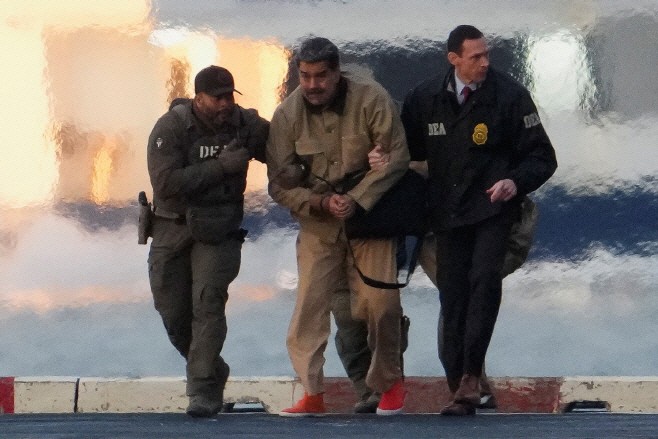 |
| U.S. Drug Enforcement Administration (DEA) agents escort Venezuelan President Nicolás Maduro and his wife, Cilia Flores, from a helicopter on Jan. 5 to appear before a federal court in Manhattan, New York. / Reuters, Yonhap |
Trump claims 'complete control' of Venezuela
Speaking at the White House that day, President Donald Trump said he was unaware of Machado's return. "She gave me her Nobel Prize. I hope she's safe. She's a very nice woman. But we're doing really well in Venezuela," he said. Machado presented her Nobel Peace Prize medal to Trump at the White House on Jan. 15.
In an interview with Fox News the same day, Trump said, "We have complete control of Venezuela," emphasizing that the United States was extracting millions of barrels of crude oil from the country every week.
The United States has signed an energy agreement with the Rodríguez government securing access to as much as 65 billion barrels of oil, equivalent to approximately one-fifth of Venezuela's crude oil reserves. Washington continues to cooperate with the Rodríguez government while pursuing the reconstruction of Venezuela's oil industry and increased investment.
U.S. Secretary of State Marco Rubio said on X that the conditions enabling Machado's safe return were a direct result of U.S.-backed reconciliation talks. He explained that the negotiations had led to the release of hundreds of political prisoners and allowed hundreds of opposition figures to return from exile.
Two U.S. officials told The New York Times (NYT) that Washington had neither directly assisted nor attempted to block Machado's return. The Wall Street Journal (WSJ), citing sources, reported that the United States had told Rodríguez not to obstruct Machado's return.
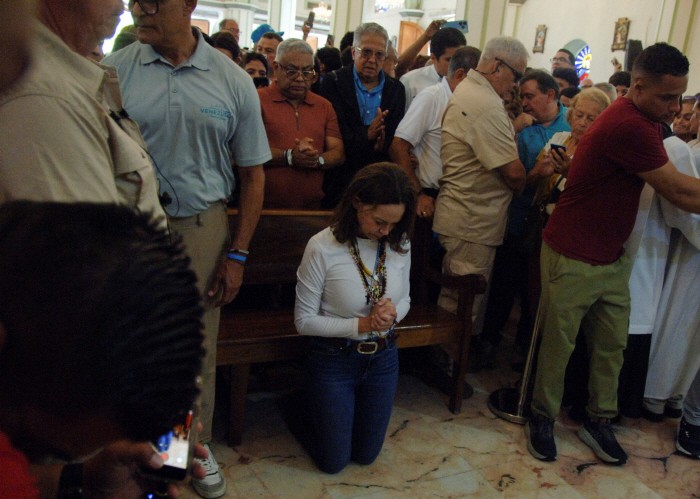 |
| Venezuelan opposition leader María Corina Machado kneels in prayer during Mass at a church in Barquisimeto on Oct. 25 after returning to Venezuela following more than 10 months abroad. / Reuters, Yonhap |
Machado plans presidential bid, tour of 23 states
In an interview with The New York Times (NYT), conducted in Panama before her return and published on Oct. 19, Machado outlined plans to rebuild her nationwide political organization and investigate human rights abuses committed under previous governments. The NYT also reported that day that Machado was willing to run for president herself.
Machado said she would establish thousands of small civic groups across the country and use artificial intelligence (AI) and digital platforms to gather public opinion.
In an August interview with The Wall Street Journal (WSJ), she outlined plans to tour all 23 states and rebuild grassroots organizations, emphasizing that "I cannot lead this process from abroad."
Machado's opposition political organization, Vente Venezuela, unveiled an app the day before her return to collect voter registration information from Venezuelans living abroad. Developed by 15 members of the organization over 18 months, the app is intended to gather information that will eventually be submitted to a reformed electoral council for inclusion in the official voter registry.
Machado also proposed establishing a truth commission to investigate human rights abuses committed under previous governments. "We are not driven by revenge or hatred," she told the NYT. However, she stressed that human rights violations, crimes against humanity and terrorism should not be eligible for amnesty. She explained that an independent commission should determine whether specific punishments are warranted, taking into account the severity of the crimes and the perpetrators' apologies and cooperation.
In an interview with the Financial Times (FT) on Oct. 9, Machado called for a presidential election to be held by July 2027 at the latest.
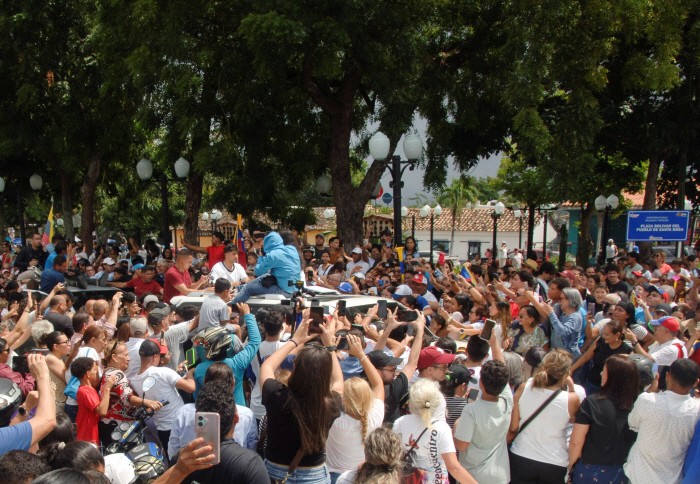 |
| Supporters of Venezuelan opposition leader María Corina Machado gather outside a church in Barquisimeto, Venezuela, on Oct. 25 to welcome her return after more than 10 months abroad. / Reuters, Yonhap |
Machado told The New York Times (NYT) that she supported the U.S.-proposed three-stage plan for stabilization, economic recovery and democratic transition, but acknowledged differences with the U.S. government over the timeline for its implementation. She criticized Rodríguez, saying she was "doing what she is told" and was "part of the criminal regime."
The United States is supporting political negotiations involving the Rodríguez government and some opposition groups. During their recent third round of talks, the two sides agreed to review restrictions on eligibility to run for office, laws governing political parties and public assemblies, and the judicial and electoral systems. However, they failed to set a date for the presidential election.
Dinorah Figuera, who participated in the negotiations on behalf of the opposition, told The Wall Street Journal (WSJ) that Machado had been offered a way to join the talks but rejected it after demanding a leading role. Machado, however, said the United States had determined how the negotiating team would be formed, adding that although she was not a member of the negotiating team, she would not obstruct the talks.
The Trump administration maintains that economic stabilization and the rebuilding of the courts and electoral council must precede elections. Machado, meanwhile, has proposed introducing a transparent tax system and an international arbitration framework, arguing that a democratically legitimate government could ensure long-term investment stability.
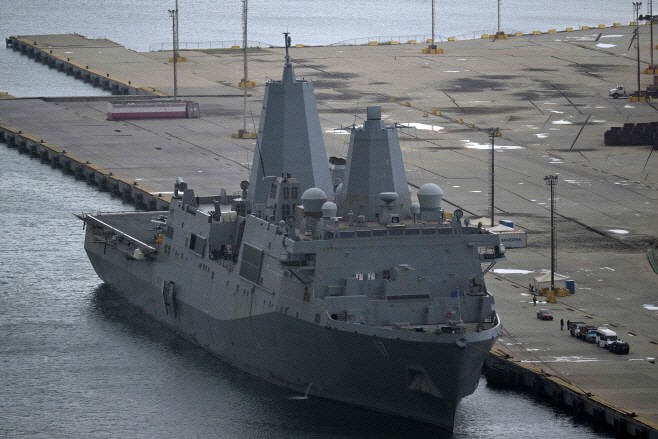 |
| The U.S. Navy amphibious transport dock USS San Antonio (LPD-17) is docked at the port of La Guaira in La Guaira state, Venezuela, on July 11. / AFP, Yonhap |
Machado leads Rodríguez 52% to 19% in hypothetical election
In a recent poll conducted by AtlasIntel for Bloomberg, Machado received a 61% favorability rating. In a hypothetical presidential election against Rodríguez, Machado led with 52% support, compared with 19% for Rodríguez.
According to another AtlasIntel-Bloomberg poll, President Donald Trump's approval rating in Venezuela fell to 28% from 53% in February. A separate survey found that two-thirds of Venezuelans disapproved of Rodríguez's handling of the country. Venezuela is facing 400% inflation and nationwide electricity shortages, The Wall Street Journal (WSJ) reported.
Machado's return came less than two weeks before the U.S. midterm elections. Republican lawmakers in Florida have supported her return amid concerns that sidelining Machado could provoke a backlash among Venezuelan American and Cuban American voters.
Meanwhile, some Trump administration officials are concerned that Machado's political activities could trigger a confrontation with Rodríguez, potentially threatening U.S. oil agreements and expanded investment in Venezuela.
Brian Fonseca, a professor at Florida International University, said Machado's return could amount to little more than a "symbolic gesture" without institutional changes. David Smilde, a professor at Tulane University, said her return could strengthen public mobilization and demands for a return to democracy.
David Smolansky, Machado's foreign policy adviser, said she planned to meet victims of the earthquake that struck in June, families of political prisoners and leaders of the pro-democracy movement. He said Machado would "actively work to secure a date for free and fair elections," Reuters reported.
Ha Man-joo
Most Read
-
1
Celltrion nears additional contract with major U.S..

-
2
Putin proposes trilateral U.S.-China-Russia summit..

-
3
U.S. weighs dropping MOAB, world's most powerful n..

-
4
"Aren't those foreigners on welfare?": M..

-
5
Attention centers on APEC for possible Trump-Xi-Pu..

-
6
U.S., Israel plan to resume strikes on Iran after..

-
7
China tightens grip on boosting domestic demand an..

PEOPLE






-
Address : In-Young Bldg., 34, Uisadang-daero 1-gil, Yeongdeungpo-gu, Seoul
Copyright by ASIATODAY CO., LTD. All rights resereved