



Japan unveils first long-range missile drill with U.S. forces
Oct 26, 2026, 01:12 pm


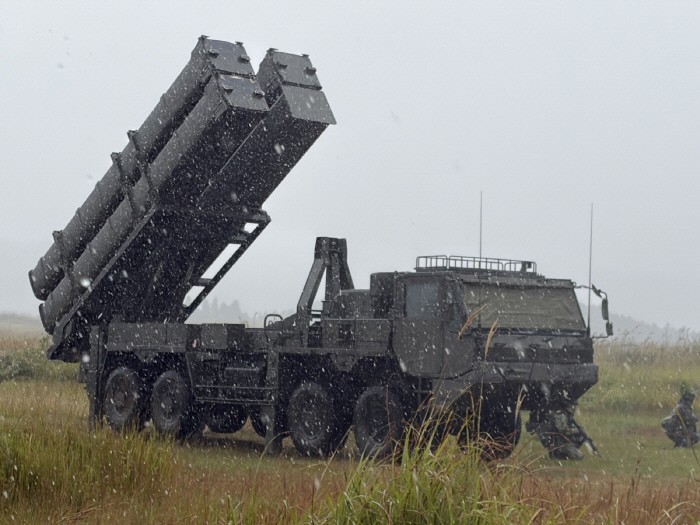 |
| Japan's Type-25 surface-to-ship guided missile system, which was deployed in an exercise for the first time. / Yonhap |
Japan has publicly demonstrated for the first time the deployment of a long-range missile system capable of reaching North Korea in an exercise with U.S. forces outside its home base. The drill showcased the deployment procedures for a missile that Japan considers a key component of its "counterstrike capabilities," as well as the sharing of targeting information between Japanese and U.S. forces. However, the target was a simulated enemy warship, and no live missiles were fired.
Japan's Ministry of Defense opened a Type-25 surface-to-ship guided missile drill to the media on Oct. 25 at the Onohara Maneuver Area, which spans Nagasaki and Saga prefectures. The missile system, first deployed to Camp Kengun in Kumamoto in March this year, was moved to another location for the Japan-U.S. joint military exercise Keen Sword 27. Japan's Self-Defense Forces positioned a vehicle-mounted launcher and carried out launch preparation procedures. The exercise also involved identifying the location of a simulated enemy warship using intelligence gathered by Japan and the United States.
The missile has an estimated range of more than 1,000 kilometers, potentially putting coastal areas of China and North Korea within reach, depending on its launch location in Japan. It is a surface-to-ship missile designed to strike enemy vessels from long distances. However, Japan's Self-Defense Forces regard their long-range missile capabilities as part of their counterstrike capability to prevent further attacks by an adversary. The fact that North Korea is within the missile's range does not mean it was targeted during this exercise.
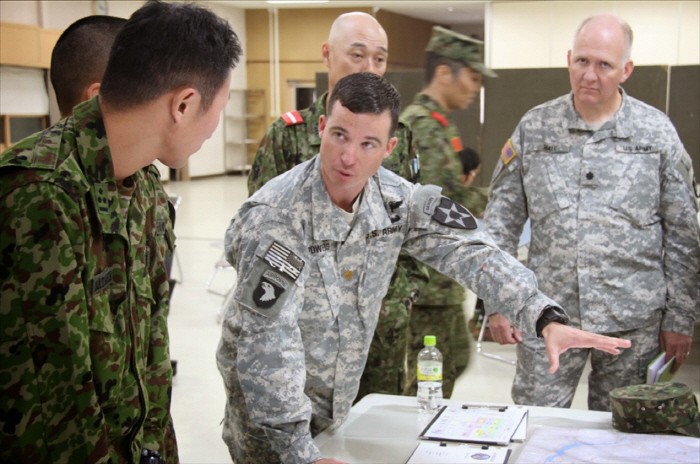 |
| Japanese Self-Defense Forces and U.S. Forces Japan personnel take part in a joint military exercise. / Courtesy of Japan's Ministry of Defense |
Japan is also emphasizing the missile system's mobility. The aim is to ensure that missiles stationed at Camp Kengun can be relocated and launched from other locations. Ahead of the exercise, Arai, chief of staff of the Japan Ground Self-Defense Force, explained that units must be able to carry out missions from different deployment locations depending on the circumstances. He said the relocation exercise was important for strengthening deterrence.
Japan's use of long-range missiles has direct implications for South Korea's security. Since December 2023, South Korea, the United States and Japan have been sharing North Korean missile warning data in real time to counter the North's missile threats. However, sharing warning information about a missile launch is different from sharing targeting information identifying where to strike. There has been no announcement that South Korean forces participated in the latest Japan-U.S. exercise or that the three countries shared information on potential strike targets.
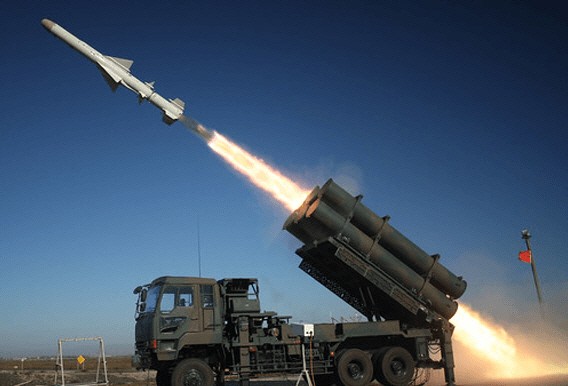 |
| A Type 88 surface-to-ship guided missile operated by the Japan Ground Self-Defense Force. / Courtesy of Japan's Ministry of Defense |
Japan's government has established strict conditions for exercising its counterstrike capabilities. Under its stated policy, counterstrikes against targets in an adversary's territory would be permitted only as a minimum necessary measure of self-defense to prevent further attacks following an armed attack against Japan. Therefore, the fact that North Korea falls within the missile's range should not be interpreted as an indication that Japan intends to strike targets in North Korea. Rather, the latest exercise demonstrated that Japan is developing the long-range weapons and mobile deployment capabilities needed to carry out such operations if necessary.
However, concerns have also emerged in areas where the missiles are deployed. Some residents near Camp Kengun in Kumamoto fear that the base could become a target in the event of a conflict. Japan's Ministry of Defense has said it will ensure safety during the exercises and provide explanations to local residents. As Japan expands the deployment and operation of long-range missiles, it faces the challenge of balancing the government's goal of strengthening deterrence with local residents' concerns about their safety.
Choi Young-jae
Most Read
-
1
Celltrion nears additional contract with major U.S..

-
2
Putin proposes trilateral U.S.-China-Russia summit..

-
3
U.S. weighs dropping MOAB, world's most powerful n..

-
4
"Aren't those foreigners on welfare?": M..

-
5
Attention centers on APEC for possible Trump-Xi-Pu..

-
6
U.S., Israel plan to resume strikes on Iran after..

-
7
China tightens grip on boosting domestic demand an..

PEOPLE







-
Address : In-Young Bldg., 34, Uisadang-daero 1-gil, Yeongdeungpo-gu, Seoul
Copyright by ASIATODAY CO., LTD. All rights resereved