



One in four U.S. visitor visa applications from S. Koreans rejected
Oct 26, 2026, 10:57 am


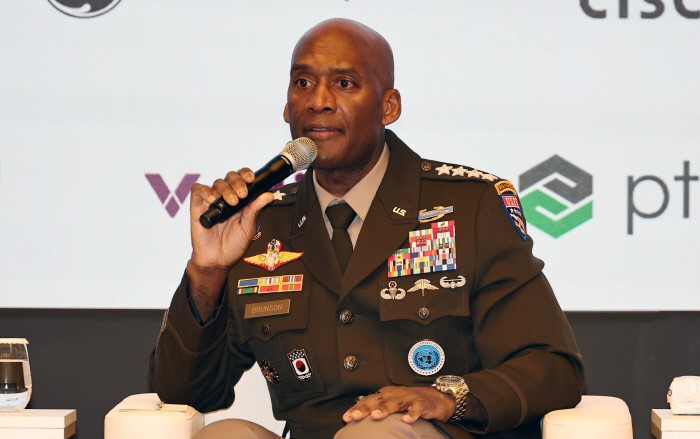 |
| Gen. Xavier T. Brunson, commander of U.S. Forces Korea, speaks at a luncheon hosted by the American Chamber of Commerce in Korea (AMCHAM) at Mondrian Seoul Itaewon in Yongsan District, Seoul, on Oct. 21. / Yonhap |
Nearly one in four U.S. visitor visa applications by South Korean nationals was rejected last year, according to government data. South Korean diplomatic authorities suggested that the increase may have been driven by immigration becoming a politically contentious issue in the United States. However, the refusal rate for Japanese nationals declined over the same period.
According to data submitted by the Ministry of Foreign Affairs to Rep. Kim Dae-sik of the People Power Party (PPP), the adjusted refusal rate for B visas (B1 and B2) among South Korean nationals stood at 24.73% last year, up 9.76 percentage points from 14.97% the previous year. The adjusted refusal rate for South Koreans had generally hovered between 14% and 18% from 2021 to 2024, making last year's sharp increase particularly notable.
Regarding the reasons for visa refusals, the Foreign Ministry told Kim's office that "it is difficult to determine the exact reasons in detail because the U.S. side does not disclose them." However, the ministry added, "It is presumed that immigration becoming a highly contentious domestic political issue in the United States may have contributed to tighter visa screening policies."
By contrast, Japan's adjusted refusal rate stood at 5.68%, slightly lower than the previous year's 5.76%. Japan's adjusted refusal rate had remained in the 4–6% range from 2021 to 2024.
The sharp increase in visa refusals among South Korean nationals alone has prompted questions about whether strained relations between Seoul and Washington may have played a role. Some have suggested that bilateral ties have deteriorated amid prolonged tariff and security negotiations, the Coupang personal data breach controversy, and certain restrictions on intelligence sharing following remarks by Unification Minister Chung Dong-young concerning "Gu Seong."
Calls for urgent improvements in South Korea-U.S. relations have also intensified following a recent incident during the National Assembly's Foreign Affairs and Unification Committee audit. Rep. Chung Chung-rae of the Democratic Party (DP), who was assigned to the committee's U.S. affairs inspection team, was reportedly unable to obtain a U.S. visa and had to be reassigned at short notice to the European affairs team.
Rep. Na Kyung-won of the PPP said, "The cancellation of Democratic Party leader Kim Min-seok's visit to the United States, the hold on Rep. Chung's visa, the suspension of U.S. intelligence sharing, visa delays involving the National Intelligence Service, exclusion from meetings, and expressions of frustration by South Korea's ambassador to the United States all illustrate the current state of South Korea-U.S. relations."
"President Lee Jae-myung and the ruling party should take this rejection as an opportunity to first consider measures to restore the alliance to normal," she added.
Lee Han-sol
Most Read
-
1
Celltrion nears additional contract with major U.S..

-
2
Putin proposes trilateral U.S.-China-Russia summit..

-
3
U.S. weighs dropping MOAB, world's most powerful n..

-
4
"Aren't those foreigners on welfare?": M..

-
5
Attention centers on APEC for possible Trump-Xi-Pu..

-
6
U.S., Israel plan to resume strikes on Iran after..

-
7
China tightens grip on boosting domestic demand an..

PEOPLE





-
Address : In-Young Bldg., 34, Uisadang-daero 1-gil, Yeongdeungpo-gu, Seoul
Copyright by ASIATODAY CO., LTD. All rights resereved