



Samsung Electronics, SK Hynix expected to post combined Q3 operating profit of 184 trillion won
Oct 26, 2026, 10:49 am


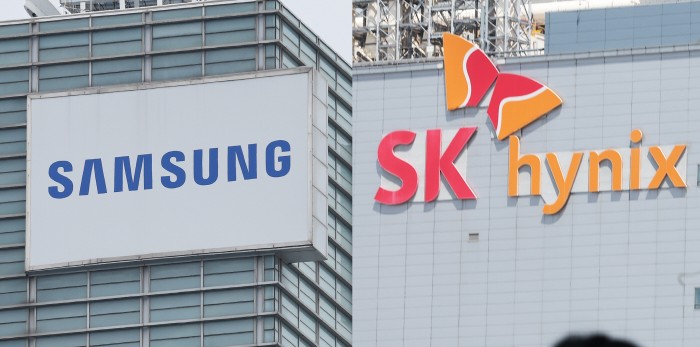 |
| Samsung Electronics and SK Hynix are scheduled to announce their third-quarter earnings this week. Industry observers expect their combined operating profit to exceed 180 trillion won. / Yonhap |
Expectations are growing that Samsung Electronics and SK Hynix will report combined operating profit well above 180 trillion won for the third quarter. Expanded supplies of fourth-generation high-bandwidth memory (HBM4) and rising conventional memory prices are expected to support earnings, while differences in the companies' product mixes could affect how much each benefits. Samsung Electronics also faces the challenge of restoring competitiveness in its non-memory semiconductor business and improving profitability in its finished-product businesses, even as it benefits from the memory chip boom.
According to industry sources on Oct. 25, SK Hynix is scheduled to announce its third-quarter earnings on Oct. 28, followed by Samsung Electronics on Oct. 29. Samsung previously reported preliminary revenue of 195 trillion won and operating profit of 107.4 trillion won. According to FnGuide, the consensus estimate for SK Hynix's third-quarter operating profit stood at 76.964 trillion won as of Oct. 19. Combined with Samsung's preliminary results, the two companies' operating profit would reach approximately 184.4 trillion won.
The results are expected to reflect expanded supplies of HBM4 for Nvidia's next-generation Vera Rubin AI accelerators. In a report released last month, Counterpoint Research projected that while HBM3E accounted for most HBM revenue through the second quarter, HBM4 shipments would begin ramping up in earnest in the second half of the year. By revenue, SK Hynix held a 50% share of the HBM market in the second quarter, followed by Samsung Electronics at 33%, with the two companies dominating the market.
Prices of both HBM and conventional memory are expected to remain strong. Market research firm TrendForce projected that contract prices for conventional DRAM would rise 10–15% in the fourth quarter from the previous quarter. The firm explained that production capacity is increasingly being allocated to AI server products, tightening supplies of memory for other applications. It also forecast that average selling prices (ASPs) for HBM would rise 121% next year compared with this year. The projection reflects not only price increases for individual products but also a growing share of higher-priced products in the sales mix.
Expectations are also rising for improved earnings in the NAND flash segment, particularly enterprise solid-state drives (SSDs). TrendForce forecast that NAND contract prices would increase 15–20% quarter on quarter in the fourth quarter. It also projected that enterprise SSD demand, measured in bits, would grow by more than 80% year on year in 2026, driven by the expansion of AI inference infrastructure. Enterprise SSDs were the only memory product category for which price increases were expected to accelerate from the previous quarter.
As a result, the impact of rising prices could vary depending on each company's product mix. Samsung Electronics is expected to benefit from both higher conventional DRAM prices and increased HBM4 shipments. By contrast, SK Hynix, which has a relatively high proportion of HBM products, may benefit less from conventional memory price increases. A similar analysis emerged in the second quarter, when SK Hynix's higher HBM sales proportion, the largest among the three major memory chipmakers, was cited as a factor limiting growth in its overall average selling prices.
Despite expectations of record earnings, some analysts believe SK Hynix's results may fall short of earlier forecasts. Its latest operating profit estimate is 5.6% lower than three months ago. The downward revision has been attributed to the stronger Korean won and the timing of shipments and revenue recognition during the transition between HBM generations.
Samsung Electronics also faces the challenge of restoring competitiveness in its non-memory semiconductor operations. Its Exynos 2700 mobile application processor (AP), designed by the System LSI Business, reportedly outperformed Qualcomm's latest flagship chip in recent internal testing by Samsung's Mobile eXperience (MX) Business. However, turning that performance into business results will depend on the chip's actual power efficiency and thermal management, as well as broader adoption in Galaxy devices. Meanwhile, Samsung's foundry business is seeking to improve earnings by pursuing mass production of second-generation 2-nanometer mobile chips.
Samsung's Device eXperience (DX) Division must also reduce the cost pressures arising from higher prices for components such as memory chips. The division posted an operating loss of 800 billion won in the second quarter. Although smartphone revenue increased year on year, operating profit declined because of rising component costs. The company expects cost pressures to persist in the second half of the year and is pursuing increased sales of high-value-added products and structural improvements to its operations.
Lee Ji-sun
Most Read
-
1
Celltrion nears additional contract with major U.S..

-
2
Putin proposes trilateral U.S.-China-Russia summit..

-
3
U.S. weighs dropping MOAB, world's most powerful n..

-
4
"Aren't those foreigners on welfare?": M..

-
5
Attention centers on APEC for possible Trump-Xi-Pu..

-
6
U.S., Israel plan to resume strikes on Iran after..

-
7
China tightens grip on boosting domestic demand an..

PEOPLE







-
Address : In-Young Bldg., 34, Uisadang-daero 1-gil, Yeongdeungpo-gu, Seoul
Copyright by ASIATODAY CO., LTD. All rights resereved