



S. Korea's home value gap between richest and poorest 20% hits record 290-fold
Oct 26, 2026, 10:42 am


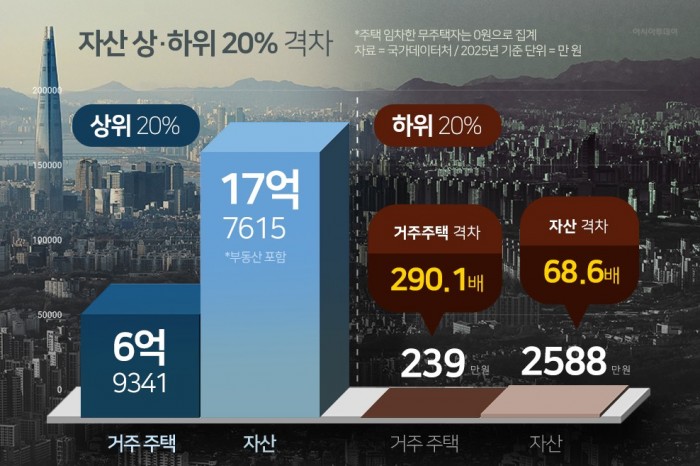 |
| Source: Ministry of Data and Statistics / Graphic by Park Jong-kyu |
The gap in the average value of owner-occupied homes between South Korea's wealthiest and poorest 20% of households approached 300-fold last year. While the income gap between the two groups narrowed, their wealth disparity widened as property prices surged, particularly for high-end homes in Seoul.
According to the Korean Statistical Information Service (KOSIS) of the Ministry of Data and Statistics (MODS) on Oct. 26, the average value of owner-occupied homes among households in the bottom 20% by assets, or the first quintile, stood at 2.39 million won last year. By comparison, the average value of owner-occupied homes among households in the top 20%, or the fifth quintile, reached 693.41 million won.
The figures are based on homes that households actually owned and occupied at the reference date. Households that did not own their homes and lived in rented accommodation were assigned a value of zero. For households owning multiple properties, only the value of the home in which they actually lived was included.
The average value of owner-occupied homes in the bottom asset quintile fell 9.1% from a year earlier, reaching its lowest level since 2017, when the current statistical series began. The homeownership rate among these households also declined by 0.8 percentage points to 6.6%, marking another record low.
By contrast, the average value of owner-occupied homes among households in the top asset quintile rose 7.7% over the year, reaching its second-highest level since 2022 under the current statistical standards.
Although the proportion of households in the top quintile that owned their homes fell 1.2 percentage points from a year earlier to 82.5%, the average value of their owner-occupied homes increased as property prices rose. In fact, the median home value among homeowners in the top quintile climbed 2.9% to 720 million won.
With the average value of owner-occupied homes declining among households in the bottom asset quintile and rising among those in the top quintile, the gap between the two groups widened further last year. The average home value in the top quintile was 290.1 times that of the bottom quintile, the largest disparity recorded since 2017.
The ratio stood at around 146 times in 2017 and 2018 before widening to 245.5 times in 2022, reflecting a generally growing gap over the period. It narrowed to 215.1 times in 2023 but widened again to 244.9 times in 2024, before expanding further last year.
The disparity in total assets, including owner-occupied housing, also reached a record high last year. Assets held by households in the bottom quintile fell 2.9% year on year to 25.88 million won, while those of households in the top quintile rose 7.5% to 1.77615 billion won. As a result, households in the top quintile held 68.6 times as much wealth as those in the bottom quintile, surpassing the previous record of 64 times set in 2022.
The widening disparity is attributed to a sharp rise in housing prices in recent years, particularly for expensive apartments in Seoul. In a report titled Asset Inequality and Medium- to Long-Term Property Tax Reform, Lee Sun-hwa, a senior research fellow at the National Assembly Futures Institute, explained, "In South Korea, where approximately 70% of household assets are concentrated in real estate, rising property prices can have an even greater impact on widening wealth disparities across regions and generations."
Meanwhile, the income gap between the two groups appears to be narrowing. According to a survey conducted last year using income data from the previous year, current income among households in the top income quintile was 11.2 times that of households in the bottom income quintile, while the disposable income gap stood at 9.8 times. The current income gap narrowed from around 12 to 13 times between 2017 and 2019, while the disposable income gap also declined somewhat from approximately 11 to 12 times.
Seo Byeong-ju
Most Read
-
1
Celltrion nears additional contract with major U.S..

-
2
Putin proposes trilateral U.S.-China-Russia summit..

-
3
U.S. weighs dropping MOAB, world's most powerful n..

-
4
"Aren't those foreigners on welfare?": M..

-
5
Attention centers on APEC for possible Trump-Xi-Pu..

-
6
U.S., Israel plan to resume strikes on Iran after..

-
7
China tightens grip on boosting domestic demand an..

PEOPLE






-
Address : In-Young Bldg., 34, Uisadang-daero 1-gil, Yeongdeungpo-gu, Seoul
Copyright by ASIATODAY CO., LTD. All rights resereved