



Number of foreign students overstaying visas tops 30,000
Oct 23, 2026, 10:20 am


 |
| / Courtesy of Rep. Kim Hee-jung's office |
The number of foreign students overstaying their visas in South Korea has exceeded 30,000, with the overstay rate among language training visa holders approaching 30%. In particular, the number of foreign students who became overstayers at universities in Seoul this year increased 48.5% from last year, prompting calls for urgent measures to address universities' indiscriminate recruitment of international students and inadequate management of their immigration status.
According to data submitted by the Ministry of Justice to Rep. Kim Hee-jung of the People Power Party, chair of the National Assembly's Education Committee, on Oct. 23, a total of 31,665 foreign nationals holding student (D-2) or language training (D-4) visas were classified as overstayers as of August this year. Of these, 9,946 were enrolled in degree programs and 21,719 in language training programs.
In particular, 21,719 of the 74,450 language training visa holders were overstayers, accounting for 29.2%. This was more than eight times the overstay rate of 3.6% among students enrolled in degree programs.
The overstay rate among language training students declined from 42.2% in 2022 to 34.8% in 2023, 29.0% in 2024 and 25.3% last year, but rose again this year. By contrast, the overstay rate among degree program students steadily declined from 7.0% to 3.6% over the same period.
By nationality, Vietnamese nationals accounted for 26,220 overstayers, or 82.8% of the total. They were followed by nationals of Uzbekistan with 2,033, Mongolia with 1,353, China with 731 and Nepal with 316. In particular, the overstay rate among Vietnamese nationals holding language training visas reached 39.7%.
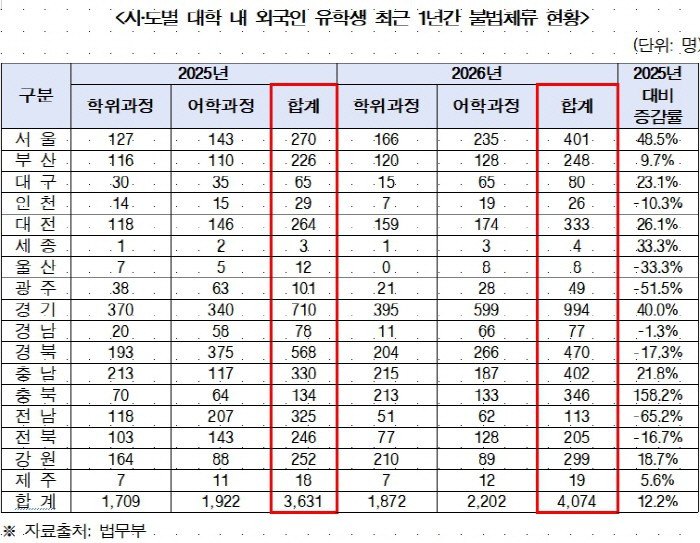
The number of foreign students who newly became overstayers at universities nationwide also increased. The figure rose by 443, or 12.2%, from 3,631 last year to 4,074 this year. The number among degree program students increased from 1,709 to 1,872, while that among language training students rose from 1,922 to 2,202.
By region, universities in Gyeonggi Province recorded the highest number at 994, followed by North Gyeongsang Province with 470, South Chungcheong Province with 402, Seoul with 401 and North Chungcheong Province with 346.
In particular, the number of students who became overstayers at universities in Seoul increased 48.5%, from 270 last year to 401 this year. Over the same period, the figure in North Chungcheong Province surged 158.2%, from 134 to 346, while Gyeonggi Province saw a 40% increase, from 710 to 994.
Some universities were also found to have cases in which a significant proportion of foreign students admitted during a particular period became overstayers. At University A in South Jeolla Province, 207 of the 690 language training students newly admitted last year, or 30%, were classified as overstayers. University B in Gyeonggi Province also recorded 442 foreign students who became overstayers over the two years covering last year and this year.
The management of international students at individual universities is also raising concerns. Of the 344 universities nationwide last year, 182 recorded overstayers among degree program students, while 186 recorded overstayers among language training students. This year, the respective numbers increased to 190 and 208. However, this year's statistics may be adjusted because universities are still undergoing an appeals process.
As foreign students continue to overstay their visas, critics argue that the government must strengthen its management system throughout the entire process, from admission screening and academic management to immigration status checks, alongside its policy of expanding international student recruitment.
"Unless we fundamentally overhaul universities' indiscriminate competition to recruit international students and their inadequate immigration status management systems, confidence in the entire international student policy will inevitably be undermined," Kim said.
"The Ministry of Education should not simply shift responsibility for management onto individual universities. It must work with the Ministry of Justice and other relevant ministries to conduct a comprehensive review of the entire process, from visa screening and admission to residency and follow-up management," she added.
"Universities must also shift their approach to international student recruitment from 'quantitative expansion' to 'qualitative management,'" Kim emphasized.
Park Ji-sook
Most Read
-
1
Celltrion nears additional contract with major U.S..

-
2
Putin proposes trilateral U.S.-China-Russia summit..

-
3
U.S. weighs dropping MOAB, world's most powerful n..

-
4
"Aren't those foreigners on welfare?": M..

-
5
Attention centers on APEC for possible Trump-Xi-Pu..

-
6
U.S., Israel plan to resume strikes on Iran after..

-
7
Saudi Arabia, Iran hold first diplomatic talks to..

PEOPLE







-
Address : In-Young Bldg., 34, Uisadang-daero 1-gil, Yeongdeungpo-gu, Seoul
Copyright by ASIATODAY CO., LTD. All rights resereved