



U.S. prepares for war with China but hesitant to arm Taiwan
Oct 22, 2026, 02:30 pm


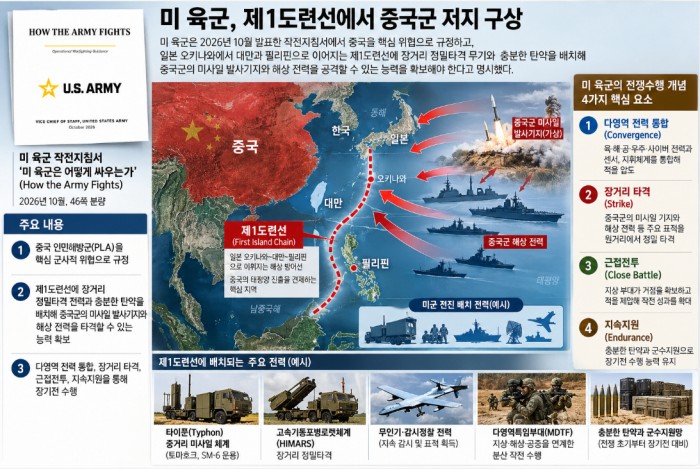 |
| An infographic summarizing the key points of How the Army Fights, operational guidance released by the U.S. Army in October 2026. / AI-generated image, source: U.S. Army |
The United States is detailing its warfighting plans in the Western Pacific in preparation for a possible Chinese invasion of Taiwan, while remaining cautious about additional arms sales to Taiwan. Critics warn that the gap between military preparations and diplomatic actions could raise doubts about Washington's willingness to defend Taiwan. There are also concerns that growing distrust of U.S. security commitments could lead China and North Korea to make military miscalculations, placing an additional burden on security on the Korean Peninsula.
In its operational guidance How the Army Fights, released this month, the U.S. Army identified China's People's Liberation Army (PLA) as its primary threat. In particular, the guidance specified the need to deploy long-range precision-strike weapons and sufficient ammunition along the First Island Chain, which stretches from Okinawa, Japan, through Taiwan to the Philippines, to ensure the capability to strike Chinese missile launch sites and naval forces.
The First Island Chain is a key passageway for the Chinese navy's access to the Pacific Ocean. The United States plans to combine missiles, drones, cyberwarfare and electronic warfare capabilities in the region to block Chinese military attacks and prepare for a prolonged conflict.
The question is whether military preparations will be backed by an actual willingness to intervene. The United States approved approximately $11 billion in arms sales to Taiwan last December but has remained cautious about additional proposed sales worth approximately $14 billion. If the perception spreads that arms sales to Taiwan are being used as a bargaining chip in U.S.-China negotiations, China could misjudge U.S. military warnings as threats that will not translate into actual action.
Such signals also have significant implications for South Korea's security. Unlike Taiwan, South Korea has a mutual defense treaty with the United States. However, if military crises occur simultaneously in the Taiwan Strait and on the Korean Peninsula, the allocation of U.S. military forces and the possible deployment of U.S. Forces Korea (USFK) for operations outside the Korean Peninsula could become contentious issues. The possibility that North Korea could view the burden of U.S. intervention in the Taiwan Strait as an opportunity for provocations cannot be ruled out.
The fact that the United States has developed military plans to fight China does not necessarily guarantee that it will make the political decision to intervene in an actual war. South Korea must maintain its alliance with the United States while examining how U.S. extended deterrence, including its nuclear umbrella, would operate in a real crisis. At the same time, South Korea must strengthen its independent intelligence and reconnaissance, missile defense and precision-strike capabilities to prepare for situations in which U.S. support is delayed.
 |
| The cover of How the Army Fights, new operational guidance released by the U.S. Army in October 2026. In the guidance, the U.S. Army identifies China's People's Liberation Army (PLA) as a key threat and outlines plans to strengthen long-range precision-strike capabilities and sustained warfighting capabilities within the First Island Chain in preparation for contingencies involving Taiwan and other potential conflicts. / U.S. Army |
Koo Pil-hyun
Most Read
-
1
Celltrion nears additional contract with major U.S..

-
2
Putin proposes trilateral U.S.-China-Russia summit..

-
3
U.S. weighs dropping MOAB, world's most powerful n..

-
4
"Aren't those foreigners on welfare?": M..

-
5
Saudi Arabia, Iran hold first diplomatic talks to..

-
6
Attention centers on APEC for possible Trump-Xi-Pu..

-
7
Saudi airport in Riyadh struck again, leaving at l..

PEOPLE







-
Address : In-Young Bldg., 34, Uisadang-daero 1-gil, Yeongdeungpo-gu, Seoul
Copyright by ASIATODAY CO., LTD. All rights resereved