



[Exclusive] Korea National Railway rams through Daejeon North link despite low-impact assessment
Oct 22, 2026, 09:24 am


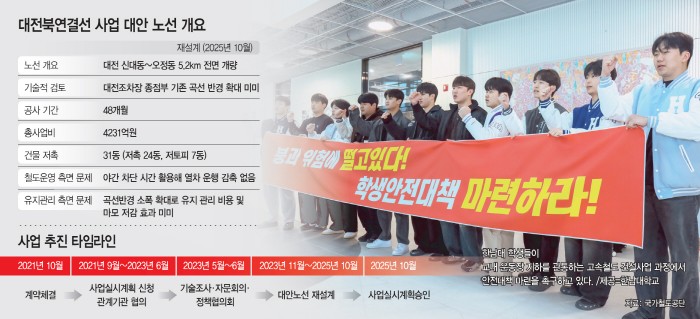 |
The Korea National Railway (KR) has reportedly concluded in its internal assessment that the partial track improvement effect of a redesign route passing underneath the campus of Hannam University—part of the 423.1-billion-won Gyeongbu High-Speed Railway Daejeon North Connection Line project—is "minimal." Even as it pushes ahead with the current route despite encroachment on campus facilities and concerns over student safety, the Ministry of Land, Infrastructure and Transport (MOLIT), which approved the project, is also failing to present concrete verification data comparing alternative alignments against the damage inflicted on the university.
According to Hannam University on the 21st, the institution filed an administrative lawsuit against the authority, arguing that the project—aimed at improving sharp curves and moving the 5.2-kilometer high-speed rail section between Shindae-dong and Ojeong-dong underground in Daejeon—encroaches on university land and threatens student safety as well as the learning environment. As its demand for an alignment detour bypassing the university was rejected, the dispute escalated into legal action, with the first hearing scheduled for December 2.
According to documents submitted by the rail authority to the office of Representative Heo Young of the Democratic Party of Korea, a member of the National Assembly's Land, Infrastructure and Transport Committee, the curve radius at the Daejeon Marshalling Yard terminal point in the route redesigned in October of last year was expanded from the existing 660 meters to 710 meters. The authority evaluated this as a "minimal expansion of curve radius," specifying that its effects in reducing maintenance costs and track abrasion compared to the comprehensive improvement plan (Option 1) reviewed during the 2019 technical study are likewise "minimal."
The authority's comparative documentation also included an alternative route that would not require consultations with Hannam University. That connection route through the Daejeon Marshalling Yard was eliminated on the grounds that sharp curves remained at the terminal end, failing to satisfy high-speed rail construction design standards. The authority explained that the current alignment secures a curve radius exceeding 700 meters and maintains the existing four tracks without reducing train operations during construction. However, it acknowledged that it did not separately review measures to further improve the sharp curves at the terminus of the alternative route that avoids campus property.
The current alignment encroaches on Hannam University's tennis court grounds and approaches within 5.56 meters and 1.98 meters of its main athletic stadium and Innovation Park, respectively. Across the entire project section, 31 structures are affected, broken down into 24 directly encroached buildings and 7 situated over shallow soil-cover sections above the underground tunnel. Hannam University is expressing concern over ground stability during construction, noise, vibration, and impacts on students' learning environments, including access to sports facilities.
However, setting aside these student safety issues, the rail authority has maintained the stance that excessive compensation demands by the university pose the real roadblock to project progress. While the authority claims that Hannam University demanded the construction of an alternative replacement building spanning more than 500 pyeong (approx. 1,650 square meters), the university counters that it never made any formal compensation request. A Hannam University official said, "We have never officially requested compensation," adding, "No such matter was ever discussed even in the trilateral consultations attended by the ministry and the rail authority."
The ministry approved the detailed implementation plan for the Daejeon North Connection Line, including the Hannam University parcel, in October of last year. However, during the reporting, it did not specify how it reviewed the limitations of track improvement effects shown in the authority's internal assessment or the facility encroachment issues during the approval process. Because this lawsuit could serve as a legal precedent regarding the safety and route appropriateness of railway projects cutting through higher-education facilities, it may also impact similar projects down the road.
While acknowledging deficiencies in consultations with the university and stepping in to mediate the dispute directly, the ministry is focusing on separately discussing student safety measures rather than reexamining the route itself. An official from the Railway Construction Division at the ministry said, "We suggested that even if litigation proceeds, let us discuss student safety issues separately," adding, "If there are areas the authority failed to reflect sufficiently, we plan to correct them through supervision and guidance."
The rail authority submitted response materials in June regarding a public-interest audit petition Hannam University filed with the Board of Audit and Inspection. With the first court hearing of the administrative lawsuit approaching in December, the alignment dispute is expected to become protracted. The rail authority cited "securing long-term train operational safety and improving residential environments through undergrounding" as the rationale for selecting the alignment, explaining that "it comprehensively considered enhancements to train operational performance, the relocation and layout of the Daejeon Marshalling Yard, and the need for additional reviews of regional development plans."
Jeong Soon-young
Most Read
-
1
Celltrion nears additional contract with major U.S..

-
2
Putin proposes trilateral U.S.-China-Russia summit..

-
3
U.S. weighs dropping MOAB, world's most powerful n..

-
4
"Aren't those foreigners on welfare?": M..

-
5
Attention centers on APEC for possible Trump-Xi-Pu..

-
6
Saudi Arabia, Iran hold first diplomatic talks to..

-
7
Saudi airport in Riyadh struck again, leaving at l..

PEOPLE







-
Address : In-Young Bldg., 34, Uisadang-daero 1-gil, Yeongdeungpo-gu, Seoul
Copyright by ASIATODAY CO., LTD. All rights resereved