



Trump gambles as GOP faces risk of losing House and Senate majorities
Oct 21, 2026, 10:39 am


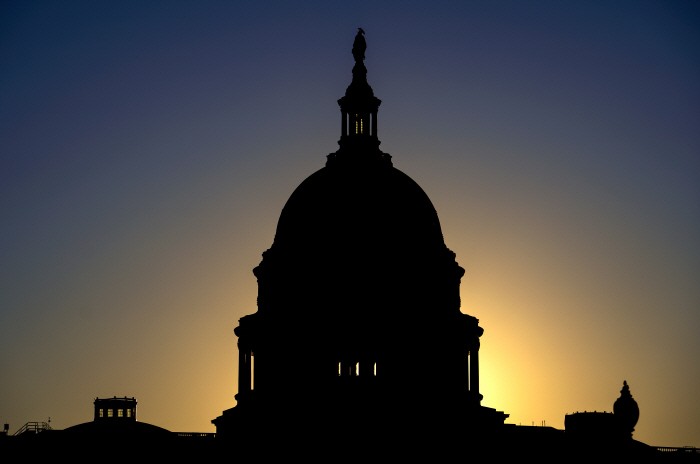 |
| The sun rises behind the Capitol dome in Washington, D.C., on the 20th (local time), two weeks ahead of the U.S. midterm elections. These midterms will decide which party holds the majority in the federal Senate and House. / AP, Yonhap |
[Article Summary]
1. President Trump's job approval rating dropped to 31%, hitting the lowest level across his two terms, while Democrats led Republicans by 12 percentage points in congressional voting intent.
2. Democrats lead polls in 9 of 11 Senate battleground races, but most margins remain within 3 percentage points, leaving open the possibility that Republicans retain their Senate majority, The Wall Street Journal analyzed.
3. President Trump announced he would spend over $400 million through Election Day, unveiling an $8 billion aid plan at a Kansas rally for farmers hurt by rising diesel costs.
4. Conditioned on Republicans holding majorities in both the Senate and the House, President Trump promised payments of $5,000 per adult citizen, though questions are mounting over funding and feasibility.
Reuters reported on the 19th (local time) that U.S. President Donald Trump's job approval rating fell to 31%, the lowest mark across his two terms, while Democrats led Republicans by 12 percentage points in party voting intent for the November 3 midterm elections.
With Democrats aiming to flip a Senate seat even in Kansas, traditionally a Republican stronghold, President Trump announced on the 20th that he would spend more than $400 million (530.72 billion won) through Election Day. He announced $8 billion (10.6144 trillion won) in farm aid and promised to distribute $5,000 (6.634 million won) to every adult U.S. citizen if Republicans maintain their majorities in both the Senate and the House.
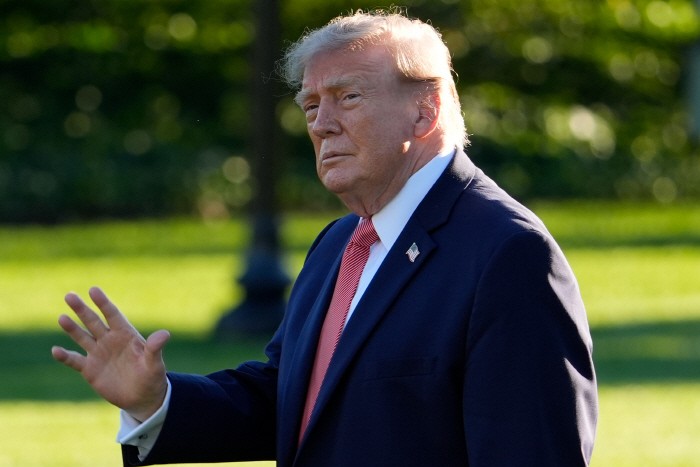 |
| U.S. President Donald Trump waves as he walks across the South Lawn of the White House in Washington, D.C., to board Marine One on the 20th (local time). / AP, Yonhap |
Trump approval rating sinks to all-time low of 31% while Democrats hold 12-point lead in congressional ballot
In a Reuters/Ipsos joint poll completed on the 19th, President Trump's job approval rating dropped 1 percentage point from two weeks ago, registering at 31%.
On the generic congressional ballot asking registered voters about their party vote choice, Democrats led Republicans 47% to 35%, a 12-percentage-point margin. This marks the widest gap of this election cycle, expanding by 5 points compared to the previous poll two weeks ago, which had Democrats at 44% and Republicans at 37%.
Shifts in voting intent among female voters were a significant factor driving down poll numbers for Republican congressional candidates. Among female respondents, 50% favored Democrats compared to 32% for Republicans, an 18-percentage-point gap.
Negative appraisals of President Trump's handling of the economy reached 68%. Even among Republican supporters, 37% evaluated his economic policies negatively. When asked which party would better manage the economy, 40% picked Democrats and 33% chose Republicans.
The poll was conducted online among 1,679 U.S. adults, including 1,279 registered voters. The margin of error was plus or minus 2 percentage points for all respondents and plus or minus 3 percentage points for registered voters.
Reuters explained that nationwide generic ballot polling does not fully capture the state-by-state and district-by-district races where Republicans hold structural advantages in certain areas.
Fatigue over political polarization also surfaced in Greenwich, Connecticut, a prominent affluent enclave and political fundraising hub in the U.S.
Reporting by The Wall Street Journal on Greenwich residents and political donors revealed sentiments across both Democratic and Republican supporters that the political parties have drifted too far toward extremes.
Moderate figures such as Republican Senator Susan Collins of Maine and Democratic Senator Jon Ossoff of Georgia were mentioned as preferred politicians among Greenwich donors. Some residents stated they halted political donations after growing exhausted by partisan strife, with concerns also raised over the widening wealth gap.
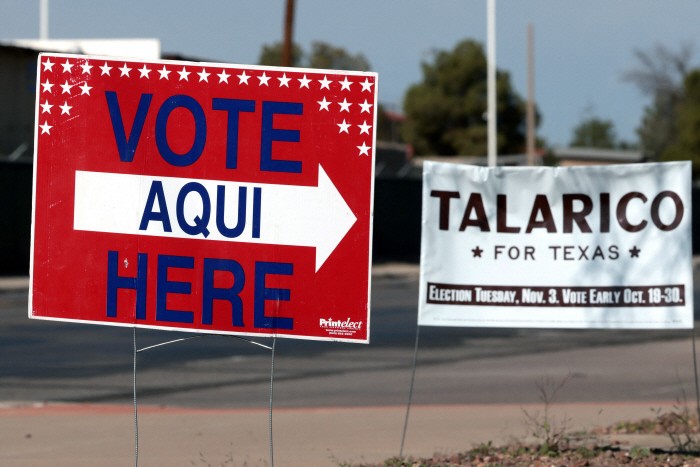 |
| A directional sign guiding voters to an in-person early voting location is set up in El Paso, Texas, on the 19th (local time), as early voting for the U.S. midterm elections gets underway. / Reuters, Yonhap |
Democrats lead in 9 of 11 Senate battlegrounds, but WSJ notes "most leads remain within 3 percentage points"
In the Senate elections, Democrats hold an advantage in the polls, but the possibility remains that Republicans retain their majority. The Wall Street Journal reported, citing polling averages from RealClearPolitics (RCP), that Democratic candidates lead in 9 of 11 Senate battleground races. Republicans lead in Florida and Kansas, but the margin in Kansas was narrow.
The WSJ analyzed that if Democrats sweep all of these battleground races, they could secure the Senate majority. Currently, the Senate stands at 53 seats for Republicans and 47 seats for the coalition of Democrats and Democratic-leaning independents. Democrats must achieve a net gain of four seats to recapture the majority.
However, the WSJ cited narrow polling margins, historical midterm election outcomes, and voter turnout as grounds suggesting Republicans could hold the Senate. Excluding Georgia and New Hampshire, the lead for Democratic candidates in every race is within 3 percentage points, meaning outcomes could diverge depending on polling margins of error and actual voter turnout.
In the 2018 midterms during the first Trump administration, Democrats gained 41 seats to retake the House majority, yet Republicans actually picked up two additional seats in the Senate.
The WSJ analyzed that for Democrats to secure Senate seats through candidates such as Abdul El-Sayed in Michigan and James Talarico in Texas, active participation from young independent voters—who typically exhibit lower turnout rates—will be essential.
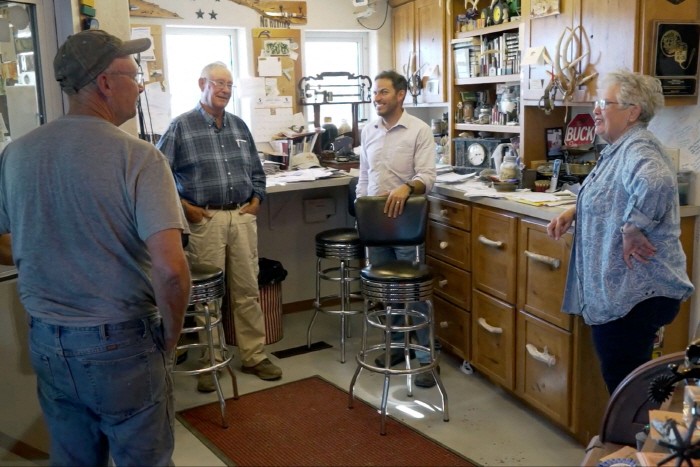 |
| Kansas wheat farmers Louis Ehmke and Vance Ehmke speak with a customer and an employee at a farm near Scott City on the 8th (local time). / Reuters, Yonhap |
Kansas bids to elect first Democratic senator in 94 years
Even in Kansas, a traditional Republican stronghold, the incumbent senator is locked in a tight race with a Democratic challenger. Democratic nominee Adam Hamilton, a megachurch pastor, is running neck and neck with incumbent Republican Senator Roger Marshall in New York Times/Siena College and Emerson College polls.
Kansas is a state where President Trump won with more than 57% of the vote in the 2024 presidential election. The state last elected a Democratic U.S. senator in 1932, meaning a victory for Hamilton would mark the state's first Democratic senator in 94 years.
Senator Marshall won by an 11-percentage-point margin in the 2020 election, but in this cycle he is tied with or trailing Hamilton across most polls.The primary factors driving up burdens on rural voters are surging fuel and fertilizer costs. Following the outbreak of the war involving Iran in February, diesel prices for agricultural machinery jumped by roughly 70%. Vance Ehmke, who operates a wheat farm in western Kansas, said fuel expenses nearly doubled over the past year, resulting in an unexpected cost of $50,000 (approx. 66.34 million won).
These burdens are also affecting agricultural heavyweights Iowa and Nebraska. In Iowa, Republican Representative Ashley Hinson and Democratic candidate Josh Turek are in a close contest in the Senate race. In Nebraska as well, Republican Senator Pete Ricketts faces a challenge from independent candidate Dan Osborn.
The Trump administration's immigration crackdowns have also emerged as a variable in the Kansas election. U.S. Immigration and Customs Enforcement (ICE) arrested 104 people late last month across Dodge City, Garden City, and Liberal. As some workers stayed home out of fear of enforcement actions, operations at major meatpacking companies including Cargill and National Beef slowed.
Alexandra Middlewood, a researcher at Wichita State University, noted that new voter registrations surged significantly in September in counties where immigration raids were conducted. Oscar Soto, a grocery store operator in Dodge City, said he registered to vote for the first time at age 39 while participating in efforts to assist families following the crackdowns. He noted that he plans to vote for the Democratic nominee.
Conversely, farmer Ron Suppes, who backs Senator Marshall, noted that diesel prices had been high in the past as well, saying he was unsure whether the issue depends on which administration is in power.
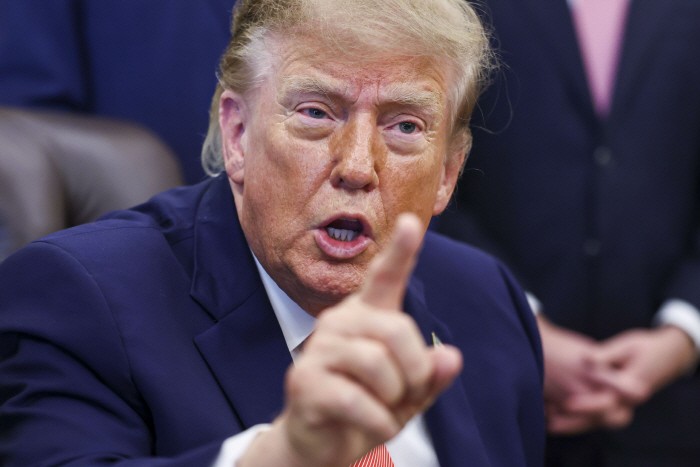 |
| U.S. President Donald Trump answers questions from reporters after delivering remarks on stepping up crackdowns on taxpayer fraud in the Oval Office at the White House in Washington, D.C., on the 20th (local time). / UPI, Yonhap |
Trump announces $8 billion in aid for farmers; Direct payments projected to reach $55.4 billion this year
President Trump announced an $8 billion "Harvest Fuel Relief Program" to reduce farmers' fuel cost burdens during a campaign rally supporting Senator Roger Marshall's reelection held in Park City near Wichita, Kansas, on the 19th.
The Department of Agriculture plans to compensate farmers for a portion of losses resulting from diesel price hikes and other factors, based on crop varieties and cultivated acreage. Funding will be drawn from the USDA's Commodity Credit Corporation (CCC). Payment criteria will be announced next month, with actual disbursements to follow, The New York Times reported.
The USDA last month projected direct payments to farmers this year at $47.4 billion (approx. 62.9 trillion won), up 70% from last year. Adding the newly announced $8 billion (approx. 10.616 trillion won) aid plan will bring the total to $55.4 billion (approx. 73.5047 trillion won), which The New York Times projected will account for roughly one-third of net farm income this year.
In most regions across the United States, average diesel prices recently exceeded $6 (approx. 7,961 won) per gallon (3.785 liters), up significantly from around $3.50 (approx. 4,644 won) in the fall of last year.
According to the American Farm Bureau Federation (AFBF), rising fuel costs increased production expenses by $6 (approx. 7,962 won) per acre for wheat and $52 (approx. 69,004 won) for rice. Zippy Duvall, president of the Farm Bureau, welcomed the assistance plan, noting that the administration acknowledged high diesel prices are squeezing farm profits.
Conversely, Rob Larew, president of the National Farmers Union, criticized the move, saying that as the second emergency aid package this year, repeated bailouts underscore the limits of the agricultural safety net in protecting family farms.
This aid package follows a $12 billion (approx. 15.924 trillion won) farm relief program announced by the Trump administration in December of last year. That assistance was a measure taken to respond to declining agricultural exports and dropping prices stemming from the tariff war with China.
President Trump credited Senator Marshall for the $8 billion aid package, saying, "Roger Marshall is the leader who fought for this". While stating he would also sign legislation allowing year-round sales of higher-ethanol blended fuel—long demanded by corn farmers—he made it contingent upon Senator Marshall's reelection, saying, "I will not do it if Adam Hamilton gets elected."
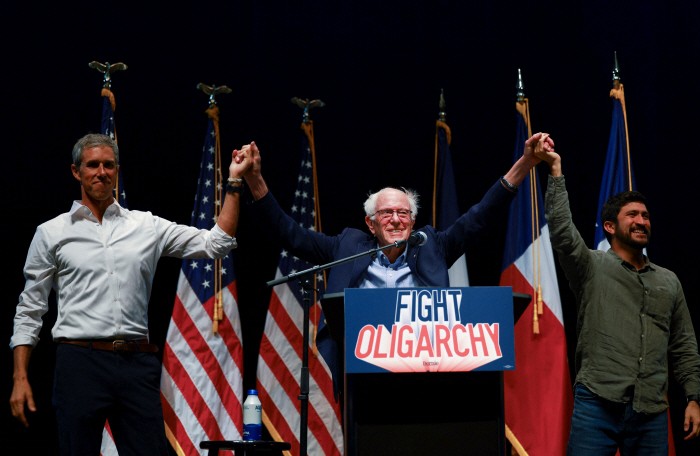 |
| U.S. Senator Bernie Sanders (Independent-Vermont, center) appears on stage alongside former U.S. Representative Beto O'Rourke (Democrat-Texas, left) and U.S. Representative Greg Casar (Democrat-Texas) during a nationwide "Fighting Oligarchy Tour" rally held ahead of the midterm elections in El Paso, Texas, on the 19th (local time). / Reuters, Yonhap |
Trump announces $400M campaign spending blitz, but supporters skeptical over $5,000 cash payment pledge
President Trump stated on social media platform Truth Social on the 20th that he has spent or plans to spend more than $400 million by Midterm Election Day. He explained that he has already used over $300 million (approx. 398.04 billion won) on advertising, voter outreach, rallies, phone banking, get-out-the-vote programs, and election integrity efforts. He plans to deploy an additional $100 million (approx. 132.7 billion won), bringing total campaign spending to over $400 million.
While President Trump did not specify the source of the funds, U.S. media believe he was referring to funds from MAGA Inc., a pro-Trump super PAC.Funding in support of Democrats is also growing. The camp of former New York City Mayor Michael Bloomberg announced plans to donate approximately $80 million (approx. 106.144 billion won) to support Democrats, The New York Times reported.
Along with pouring massive political funds into the races, President Trump is also putting forward a pledge to pay $5,000 to every adult American citizen on the condition that Republicans retain majorities in both the Senate and the House. At a campaign rally in Kentucky on the 17th, he said, "If Republicans win, each of you will have $5,000 in your pocket."
However, the Associated Press reported that the plan would require more than $1 trillion (approx. 1,326.8 trillion won), with concrete implementation mechanisms remaining unclear. The White House explained that trade deals, foreign investment commitments, government equity stakes in private companies, and energy and mineral contracts provide the basis for funding the disbursements.
The AP pointed out that no specific assessments have been presented regarding the impact such massive cash distributions would have on the fiscal deficit and inflation. When asked by the AP whether economic impact modeling was underway, Christopher Phelan, chairman of the White House Council of Economic Advisers, declined to comment.
President Trump previously floated a $2,000 dividend financed by tariff revenues and rebates resulting from spending cuts by the Department of Government Efficiency (DOGE), but neither promise materialized.
Reactions were mixed even among President Trump's supporters. Jaime Alvarez, who attended a rally in Alaska, said, "Votes should not be bought with money."
In contrast, Lucy Martinez, president of a Republican women's organization in Texas, stated that she believes President Trump will keep his promise.
In a September AP-NORC poll, roughly half of registered voters answered that President Trump does not keep his promises to the public. Republican candidates are not featuring the $5,000 payment pledge in TV or digital campaign ads, the AP reported, citing data from ad-tracking firm AdImpact.
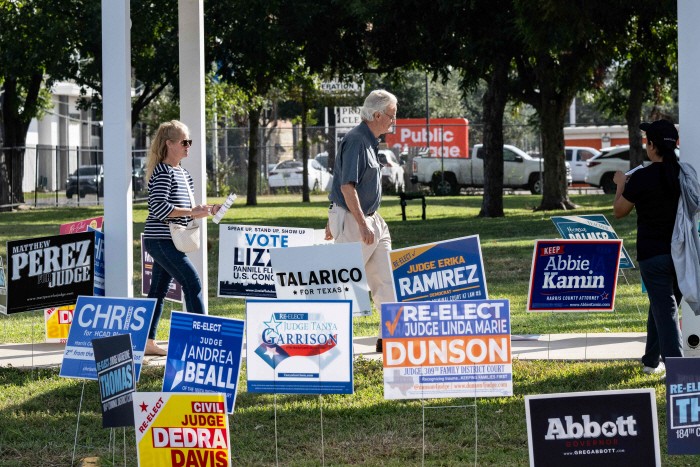 |
| U.S. voters enter to cast their ballots on the first day of in-person early voting for the midterm elections at a polling place set up at the West Gray Multi-Service Center in Houston, Texas, on the 19th (local time). In the Texas U.S. Senate race, Democratic candidate James Talarico faces off against Republican Texas Attorney General Ken Paxton. In heavily Republican Texas, no Democratic candidate has won a statewide election since 1994. President Donald Trump won Texas by a margin of about 14 percentage points in the 2024 presidential election. / AFP, Yonhap |
Trump warns of Great Depression if Democrats win
President Trump is also escalating warnings that economic and social turmoil will erupt if Democrats take control of Congress. U.S. online news outlet Axios reported on the 20th that President Trump is attempting to rally the Republican base by linking a Democratic takeover of Congress to national disaster.
At a campaign rally in Kansas, President Trump cited protests and violence in France, claiming that similar turmoil would break out in the United States if Democrats win. He remarked, "When you see the burning spires and billowing flames in France, remember that is exactly what the radical Democrats want to do to America."
At a rally in Tennessee, he claimed that an economic crisis akin to the Great Depression of 1929 would occur if Democrats win. In Arizona, attacking Democratic transgender policies, he made remarks to the effect that they are seeking to physically mutilate children.
Axios pointed out that while the U.S. unemployment rate spiked to roughly 25% during the Great Depression, it currently hovers around 4%. It also explained that the protests in France originated from grievances over the cost of living and public spending, with no evidence that American Democrats endorse similar violence.At a rally in Park City, Kansas, President Trump also attacked the religious convictions of Pastor Hamilton, the Democratic Senate candidate.
Citing Hamilton's stance on transgender issues, Trump claimed that he "openly mocks Jesus," The Washington Post reported.
Senator Marshall claimed that Hamilton failed to respond appropriately roughly 20 years ago to allegations of a church camp volunteer sexually abusing a minor. Hamilton explained that the church should have reported it to the police from the outset and subsequently amended relevant regulations. He countered that Marshall's camp is distorting the church's response at the time.
Tyson Brody, a spokesperson for Hamilton's campaign, asserted that President Trump's rally remarks cannot obscure Kansans' burdens over living and healthcare costs and their discontent with corruption in Washington.
In a video released ahead of President Trump's visit, Hamilton expressed a willingness to engage in a respectful dialogue with the president. He told Reuters, "It's not just that Kansas has become a battleground and that we can flip this seat; it's that people in an unwavering Republican stronghold are saying that what is happening in Washington is not right."
Ha Man-joo
Most Read
-
1
Celltrion nears additional contract with major U.S..

-
2
Putin proposes trilateral U.S.-China-Russia summit..

-
3
U.S. weighs dropping MOAB, world's most powerful n..

-
4
"Aren't those foreigners on welfare?": M..

-
5
Attention centers on APEC for possible Trump-Xi-Pu..

-
6
U.S., Israel plan to resume strikes on Iran after..

-
7
Saudi Arabia, Iran hold first diplomatic talks to..

PEOPLE







-
Address : In-Young Bldg., 34, Uisadang-daero 1-gil, Yeongdeungpo-gu, Seoul
Copyright by ASIATODAY CO., LTD. All rights resereved