



Hyundai Glovis participates in U.S. Port of Philadelphia expansion
Oct 19, 2026, 09:42 am


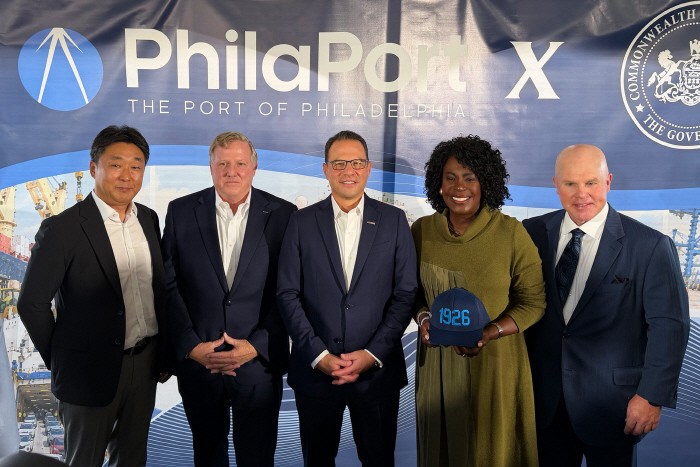 |
| Glovis America CEO Scott Cornell (second from left), Pennsylvania Governor Josh Shapiro, and Philadelphia Mayor Cherelle Parker pose for a commemorative photograph at an announcement ceremony for the expansion and development of the Port of Philadelphia held on the 13th. / Hyundai Glovis |
Hyundai Glovis is participating in the expansion project of the Port of Philadelphia in the U.S., seeking to enter the finished vehicle terminal operation business. The company plans to develop the site into a pivotal logistics hub on the U.S. East Coast by expanding its existing finished vehicle logistics grounds and securing dedicated berths for pure car and truck carriers (PCTC).
Hyundai Glovis announced on the 19th that it signed a memorandum of understanding (MOU) with the Port of Philadelphia (PhilaPort) in Pennsylvania and local developers to cooperate on port expansion development and the operation of a finished vehicle terminal.
The agreement includes securing new finished vehicle logistics grounds, developing dedicated berths for car carriers, and extending existing dedicated site contracts up to 2056.
PhilaPort is currently pursuing port development projects to expand finished vehicle and container terminals. Hyundai Glovis will participate as a private sector partner in the finished vehicle logistics segment, moving forward with plans to secure new berths and advance into terminal operations.
The announcement ceremony for the expansion and development of the Port of Philadelphia, held on the 13th, was attended by Pennsylvania Governor Josh Shapiro alongside state government and port authority officials. The event unveiled plans to expand container and finished vehicle terminals along with public-private partnership measures, with Hyundai Glovis introduced as a key private sector partner.
Hyundai Glovis has operated finished vehicle import and export logistics centered on the Port of Philadelphia since 2010. In 2019, it broadened its local business foundation by opening "Southport," a dedicated finished vehicle yard covering approximately 640,000 square meters (approx. 190,000 pyeong).
The finished vehicle logistics site currently operated at the Port of Philadelphia spans approximately 1 million square meters (approx. 300,000 pyeong), with a vehicle storage capacity of about 33,600 units.
Upon completion of the new site development, operating space will grow to approximately 340,000 pyeong and vehicle storage capacity is projected to expand to 37,600 units, allowing the port to accommodate roughly 4,000 additional vehicles compared to current levels.
The Port of Philadelphia serves as a primary hub where Hyundai Glovis handles finished vehicle logistics across the eastern region of the U.S. Its significance is also underscored by its ability to serve as an alternative logistics hub whenever operational disruptions arise at other East Coast ports in the U.S.
In fact, when operations at the Port of Baltimore were suspended in 2024 following the collapse of the Francis Scott Key Bridge in Maryland, Hyundai Glovis utilized the Port of Philadelphia as an alternative hub to process automotive logistics.
Through this port expansion project, Hyundai Glovis plans to broaden its business scope from its existing focus on finished vehicle transportation and storage to terminal operations.
Adding terminal operation capabilities to its established maritime transport network of car carriers and local vehicle storage facilities will make it possible to connect the entire logistics chain, spanning vessel berthing, vehicle stevedoring, storage, and inland transportation.
Through this, the company aims to reinforce end-to-end (E2E) logistics services integrating ocean shipping, port operations, and land transportation. The focus is placed on enhancing connectivity across logistics stages and broadening the operational foundation to meet client automotive shipping demands.
Business operations will not be limited solely to finished passenger vehicles. Hyundai Glovis plans to expand its handling portfolio to include "High & Heavy" cargo—such as commercial vehicles and construction machinery—and engineering, procurement, and construction (EPC) project logistics.
Because large and heavy cargo differs from standard finished vehicles in transportation and stevedoring methods, logistics services linking port infrastructure with transport networks are critical. Hyundai Glovis plans to explore related business opportunities by leveraging facility expansions at the Port of Philadelphia.
In addition, it will reinforce maritime logistics networks connecting eastern North America with other global regions by expanding transatlantic shipping services.
A Hyundai Glovis official said, "We plan to develop Philadelphia into a core hub within the logistics supply chain on the U.S. East Coast," adding, "We will deliver more stable and efficient integrated logistics services to our clients."
Nam Hyun-soo
Most Read
-
1
Celltrion nears additional contract with major U.S..

-
2
Putin proposes trilateral U.S.-China-Russia summit..

-
3
U.S. weighs dropping MOAB, world's most powerful n..

-
4
"Aren't those foreigners on welfare?": M..

-
5
Attention centers on APEC for possible Trump-Xi-Pu..

-
6
U.S., Israel plan to resume strikes on Iran after..

-
7
Saudi Arabia, Iran hold first diplomatic talks to..

PEOPLE







-
Address : In-Young Bldg., 34, Uisadang-daero 1-gil, Yeongdeungpo-gu, Seoul
Copyright by ASIATODAY CO., LTD. All rights resereved