



Top Korean battery makers ride AI data center boom with BBU expansion
Oct 19, 2026, 09:37 am


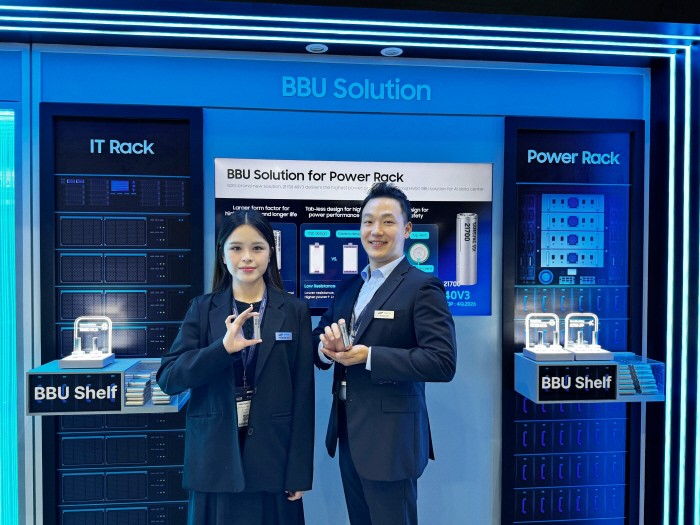 |
| An employee model from Samsung SDI introduces batteries for Battery Backup Units (BBUs). / Samsung SDI |
Artificial intelligence (AI) data centers are emerging as a new growth engine for the South Korean battery industry. Amid slowing growth in the global electric vehicle (EV) market, demand for batteries to ensure stable power delivery to AI servers is expanding rapidly.
Shifting away from an EV-centric business structure, Samsung SDI and LG Energy Solution are accelerating efforts to secure new revenue streams by broadening their product lineups for AI infrastructure, including Battery Backup Units (BBUs), Uninterruptible Power Supply (UPS) systems, and Energy Storage Systems (ESS). The strategy aims to diversify their customer base by extending the technological prowess and manufacturing capabilities accumulated in EV batteries into data center power infrastructure.
According to industry sources on the 18th, Samsung SDI plans to commence mass production of cylindrical lithium iron phosphate (LFP) batteries for AI servers as early as the second quarter of 2027. To this end, the company is moving forward with establishing production lines for BBU LFP positive electrode plates at its second plant in Seremban, Malaysia. The plan involves maximizing the use of existing ternary battery production facilities while adding select equipment to prevent cross-contamination of materials. This blueprint seeks to expand the product lineup to address customer cost and performance requirements while minimizing the burden of capital expenditures for new facilities.
Earlier, the company unveiled its next-generation cylindrical LFP battery for the first time at Data Centre World Asia (DCWA) 2026, which opened in Singapore on the 29th of last month. Applying proprietary structural technology, the product enhances safety while delivering increased power output and capacity. The strategy is to widen options tailored to specific customer needs by adding LFP offerings alongside its existing lineup of high-power, high-capacity ternary cylindrical cells.
The market for AI data center batteries places a premium on the stability and reliability of power supplies. BBUs immediately deliver power in close proximity to servers during electrical anomalies—such as blackouts or momentary voltage drops—ensuring that equipment operates without interruption. In contrast, UPS systems supply power for a designated period during outages to support the continuous operation of servers and primary facilities. As data center power infrastructure advances, the operational scope of batteries is widening from server-level BBUs to facility-wide UPS systems and utility-scale grid ESS.
The growth potential of the market is also drawing attention. According to market research firm Global Info Research, the global market for AI server BBUs is projected to expand from 349 million dollars in 2025 to 1.862 billion dollars by 2032. This represents an approximate 5.3-fold increase over seven years, reflecting a compound annual growth rate of 27.3%. As power demand in data centers climbs due to advancing AI models and higher server densities, the importance of batteries in backing up stable power delivery is growing in tandem.
LG Energy Solution is likewise quickening its push into the AI data center battery market. At InterBattery 2026 in March, it showcased an LFP-based next-generation JP6 UPS rack system alongside a BBU solution equipped with high-power cylindrical batteries. By presenting battery product lineups applied to both UPS and BBU applications, the company laid the foundation to address the data center power infrastructure market.
Following that, at ees Europe 2026 held in Munich, Germany, in June, it presented an integrated battery solution for AI data centers. A defining feature was its product portfolio spanning the entirety of data center power infrastructure, from grid-scale ESS to UPS and BBUs. Through grid ESS systems using LFP cells produced at its Wrocław plant in Poland, next-generation JP6 UPS rack systems, and 2170 BBUs for high-performance servers, the company is pursuing a strategy to cater to diverse power demands.
The two companies share common ground in their approaches. While leveraging cell design and manufacturing technologies developed in their EV battery businesses, both are segmenting their product portfolios according to data center use cases and customer specifications. Whereas Samsung SDI is focusing on expanding its mass-production base through the reuse of existing manufacturing facilities and the addition of LFP lines, LG Energy Solution is placing weight on widening its market coverage through a comprehensive portfolio encompassing ESS, UPS, and BBUs.
However, it is premature to conclude that growth in the AI data center battery market will immediately translate into improved profitability. Products must undergo customer certifications and performance validations, while securing high power output, stringent safety, and long-term supply stability. Additional capital investments and development expenditures may also arise in the process of adapting to different product specifications and operating environments compared to conventional EV batteries. This means that securing manufacturing efficiency and profitability is just as vital as gaining early market share.
The industry is watching closely to see whether batteries for AI data centers can firmly establish themselves as a new revenue stream mitigating the strain from slowing EV demand. An industry insider noted, "This demonstrates that customer demand in the battery market, previously formed around electric vehicles, is diversifying toward AI infrastructure," adding, "Securing investment efficiency through the use of existing facilities, diversifying products tailored to client demands, and establishing reliable supply capabilities are seen as key variables determining future market competitiveness."
Kim A-yoon
Most Read
-
1
Celltrion nears additional contract with major U.S..

-
2
Putin proposes trilateral U.S.-China-Russia summit..

-
3
U.S. weighs dropping MOAB, world's most powerful n..

-
4
"Aren't those foreigners on welfare?": M..

-
5
Attention centers on APEC for possible Trump-Xi-Pu..

-
6
U.S., Israel plan to resume strikes on Iran after..

-
7
Saudi Arabia, Iran hold first diplomatic talks to..

PEOPLE




-
Address : In-Young Bldg., 34, Uisadang-daero 1-gil, Yeongdeungpo-gu, Seoul
Copyright by ASIATODAY CO., LTD. All rights resereved