



N. Korea and China speed up trade revival as New Yalu River Bridge opens
Oct 19, 2026, 09:03 am


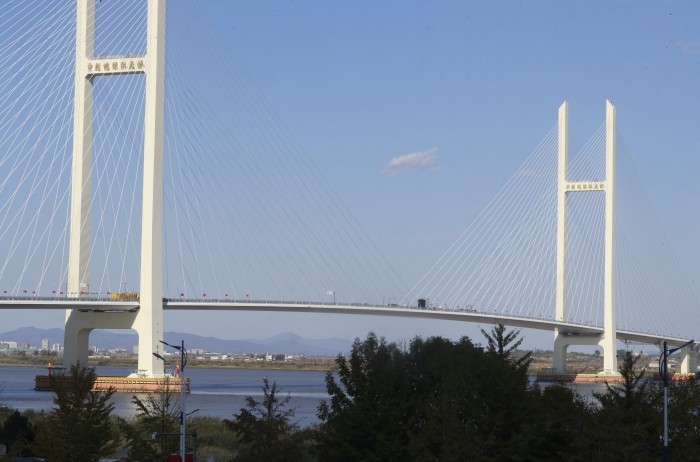 |
| A view of the New Yalu River Bridge on the 14th ahead of its opening, connecting Sinuiju, North Korea, and Dandong, Liaoning Province, China. / Yonhap |
Following the opening of the New Yalu River Bridge linking North Korea and China, a delegation from North Korea's Kangwon Province embarked on a visit to Jiangsu Province, China, with which it maintains friendly ties. Having accelerated the restoration of bilateral relations following Chinese President Xi Jinping's visit to North Korea in June, Pyongyang and Beijing appear to be fleshing out cooperation by expanding their trade base and local government exchanges.
The Korean Central News Agency (KCNA) reported on the 18th that a friendly delegation from Kangwon Province, headed by Hwang Man-bok, chairman of the Kangwon Provincial People's Committee, departed Pyongyang the previous day to visit Jiangsu Province, China.
This visit comes amid a trend of recovering North Korea-China relations, which had grown estranged due to COVID-19 border lockdowns and Pyongyang's alignment with Moscow. During President Xi's visit to North Korea in June, the two countries reaffirmed their commitment to enhancing strategic communication, expanding practical cooperation, and carrying forward their traditional friendship through a summit and joint statement. They also agreed to broaden exchanges across diverse fields, including economy and trade, agriculture, construction, science and technology, healthcare, education, culture and arts, tourism, and sports.
However, observers also point out that North Korea's logistical carrying capacity must be bolstered if the opening of the bridge is to lead to an actual expansion in trade.
Jeong Eun-lee, head of the North Korea Research Division at the Korea Institute for National Unification, remarked, "It seems unlikely that the opening of the bridge will easily process logistical demand comparable to the scale of North Korea-China trade in the short term, and the key lies in North Korea's handling capacity."
Lee Han-sol
Most Read
-
1
Celltrion nears additional contract with major U.S..

-
2
Putin proposes trilateral U.S.-China-Russia summit..

-
3
U.S. weighs dropping MOAB, world's most powerful n..

-
4
"Aren't those foreigners on welfare?": M..

-
5
Attention centers on APEC for possible Trump-Xi-Pu..

-
6
Saudi Arabia, Iran hold first diplomatic talks to..

-
7
U.S., Israel plan to resume strikes on Iran after..

PEOPLE







-
Address : In-Young Bldg., 34, Uisadang-daero 1-gil, Yeongdeungpo-gu, Seoul
Copyright by ASIATODAY CO., LTD. All rights resereved