



Doubts over AI profitability send Wall Street to steepest drop since July
Oct 15, 2026, 03:55 pm


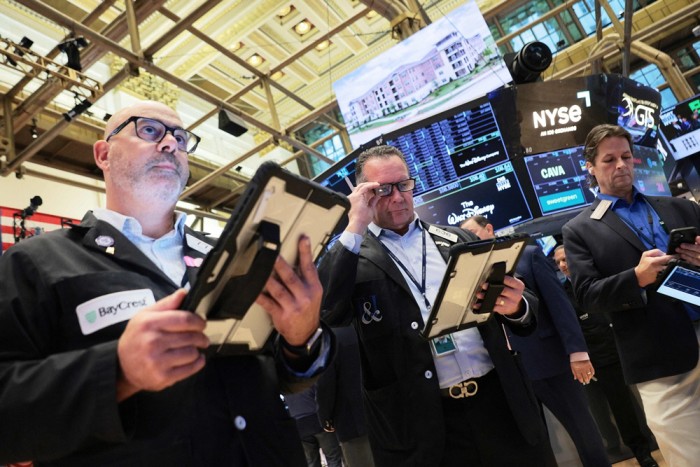 |
| Traders work at the New York Stock Exchange (NYSE) in New York City, U.S., on the 14th local time. / AFP, Yonhap |
All three major indexes on the New York stock market fell in unison on the 14th local time as concerns over interest rate hikes driven by higher-than-expected inflation and spreading skepticism over an "AI bubble" weighed on sentiment.
Locally, related tech shares plunged as doubts mounted over large-scale borrowing for AI data center construction and the profitability of such investments, prompting warnings against an over-reliance on a small handful of AI firms.
On the day, the Dow Jones Industrial Average dropped 48.62 points (0.09%) to finish at 51,621.48. The Standard & Poor's (S&P) 500 index shed 86.51 points (1.11%) to close at 7,718.94, while the tech-heavy Nasdaq Composite index tumbled 511.51 points (1.88%) to end at 26,692.87. Notably, both the Nasdaq and the S&P 500 recorded their steepest single-day declines since July.
The Wall Street Journal (WSJ) analyzed that the broader sector weakened as steep losses were seen across AI plays including cloud computing firm CoreWeave, Oracle, and Marvell Technology, adding that rising U.S. Treasury yields are fueling mounting anxiety over AI companies' plans to fund aggressive capital expenditures with heavy borrowing.
Reuters reported that the day's sharp selloff is the latest sign that markets confronting stubborn inflation have yet to fully digest the consequences of mounting leverage across AI-driven firms. Debt issuance by AI-related companies has been putting upward pressure on interest rates worldwide.
Investors broadly maintain an optimistic view of the AI sector. They perceive that despite debt concerns, major cloud players known as "hyperscalers" alongside Nvidia remain highly profitable and well-managed.
CoreWeave CEO Michael Intrator said in an internal memo on the 14th that "the market is acting irrationally" and that he "remains confident in CoreWeave's business prospects as an AI cloud company," Bloomberg reported.
However, higher interest rates drive up borrowing and construction costs, raising the likelihood that unprofitable or low-margin enterprises will bear the brunt. As inflation readings came in hotter than anticipated on the 14th, U.S. yields jumped, with the 30-year Treasury yield touching 5.63% at one point intraday before falling back in the afternoon.
Ross Mayfield, an investment strategy analyst at Baird, said in an interview with Reuters, "I think long-term rates pushing past 5% and nearing 6% is problematic for companies with weaker financing conditions," advising that "firms lacking the scale or competitive edge of the so-called big four hyperscalers will find it far more difficult to secure funding."
U.S. online outlet Axios pointed out as a risk that U.S. stock market earnings growth is excessively reliant on shares of a handful of AI chipmakers and large-scale cloud hyperscalers.
As an example, three semiconductor companies—Micron Technology, Nvidia, and Broadcom—are projected to account for roughly 40% of the entire S&P 500's third-quarter earnings growth.
Recently, investors and traders have grown increasingly cautious regarding massive expenditures pouring billions of dollars into the future of AI.
Broadcom CEO Hock Tan remarked at a conference in Singapore on the 12th that "a lot of investors have no idea what they're investing in," criticizing that "for a significant share of users, the actual gains derived from leveraging AI are not that great."
Kim Hyun-min
Most Read
-
1
Celltrion nears additional contract with major U.S..

-
2
"Aren't those foreigners on welfare?": M..

-
3
Houthis launch successive attacks on Saudi airport..

-
4
Saudi Arabia, Iran hold first diplomatic talks to..

-
5
Saudi airport in Riyadh struck again, leaving at l..

-
6
U.S. deploys carrier, 10,000 more troops to Middle..

-
7
Five ASEAN countries welcome Myanmar coup leader

PEOPLE







-
Address : In-Young Bldg., 34, Uisadang-daero 1-gil, Yeongdeungpo-gu, Seoul
Copyright by ASIATODAY CO., LTD. All rights resereved