



[Exclusive] U.S. defense undersecretary envisions pairing USFK readiness assessment with homeland defense strategy
Oct 15, 2026, 10:38 am


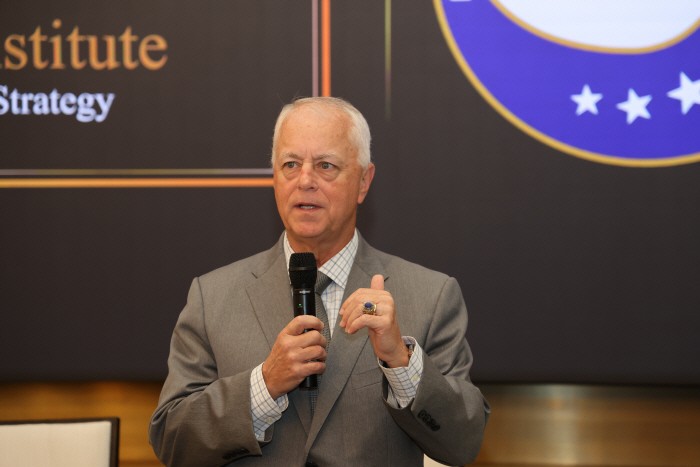 |
| Anthony Tata, U.S. Under Secretary of Defense (Department of War) for Personnel and Readiness, delivers a keynote address at the Indo-Pacific Summit co-hosted by the Gold Institute and the Korea-U.S. Alliance Foundation in Washington, D.C., U.S., on the 14th local time. / Washington Correspondent Ha Man-joo |
[Article summary]
1. The U.S. defense undersecretary stated that Western Hemisphere-focused homeland defense is the top priority of U.S. defense strategy.
2. He noted confirming that the 'Fight Tonight' readiness posture of USFK remains intact during his visit to South Korea in May.
3. He explained that the U.S. Department of Defense is pushing to recruit 250,000 personnel annually and paid a one-time bonus of $1,776 to service members ranging from private to colonel.
4. Undersecretary Tata did not provide a specific answer on South Korea-U.S. intelligence sharing, stating it was outside his policy jurisdiction.
Anthony Tata, U.S. Under Secretary of Defense (Department of War) for Personnel and Readiness, said on the 14th local time that while U.S. defense strategy prioritizes homeland defense centered on the Western Hemisphere, the 'Fight Tonight' readiness posture of U.S. Forces Korea remains intact.
Delivering a keynote address at the Indo-Pacific Summit co-hosted by the Gold Institute and the Korea-U.S. Alliance Foundation in Washington, D.C., that day, Undersecretary Tata recounted his visit to South Korea in May and explained that military resources including troops, equipment, and munitions are being managed in alignment with the priorities of President Donald Trump and Defense Secretary Pete Hegseth.
Undersecretary Tata calls homeland defense top priority and says USFK 'Fight Tonight' posture is alive and well
Undersecretary Tata said that the U.S. National Defense Strategy (NDS) focuses on the Western Hemisphere and sets homeland defense as its top priority. He explained that since the NDS frames internal Department of Defense policies, his role is to allocate resources in accordance with the priorities set by President Trump and Secretary Hegseth.
Recalling his visit to South Korea in May to tour USFK installations, including Osan Air Base and Camp Humphreys, Tata said that the philosophy of 'Fight Tonight' is "alive and well."
Undersecretary Tata noted that after serving alongside Gen. Xavier Brunson, commander of U.S. Forces Korea, in the 82nd Airborne Division, the two worked together on multiple occasions. Stressing their longstanding relationship, he praised Gen. Brunson, saying, "I couldn't think of a better person."
Tata also looked back on his time as a second lieutenant in the Army's 25th Infantry Division, when he traveled to South Korea twice with 35 platoon members to take part in Team Spirit exercises. He recalled boarding a helicopter piloted by a South Korean aviator to participate in large-scale air assault and river-crossing operations, assessing that the drill served as a display of force aimed at North Korea and marked the first time he directly experienced the military solidarity between South Korea and the U.S.
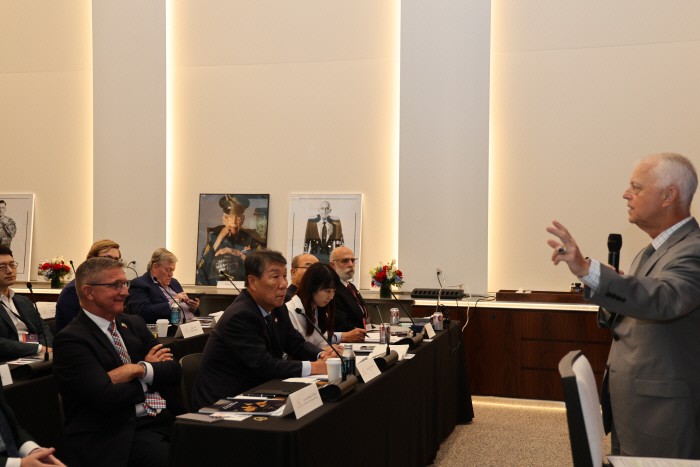 |
| Anthony Tata, U.S. Under Secretary of Defense (Department of War) for Personnel and Readiness, delivers a keynote speech at the Indo-Pacific Summit co-hosted by the Gold Institute and the Korea-U.S. Alliance Foundation in Washington, D.C., U.S., on the 14th local time. / Washington Correspondent Ha Man-joo |
U.S. defense undersecretary assesses force impact of troop movements
Undersecretary Tata stated that his responsibilities are directly linked to maintaining the readiness of U.S. forces deployed to the Indo-Pacific region. He explained that managing 235 military stores and 720 hospitals and clinics worldwide, 160 schools including those in South Korea, and 80 million active personnel records falls under his purview.
He noted that military stores must provide service members and their families with the 24% discount mandated by law, hospitals and clinics must operate 24 hours a day, and schools run by the Department of Defense Education Activity (DoDEA) serve 65,000 students, roughly one-third of whom are in the Pacific region.
Undersecretary Tata stressed that the Defense Manpower Data Center (DMDC) maintains roughly 80 million active records and around 40 million records related to deceased personnel, underscoring the need to ensure the security, accuracy, and accessibility of these records.
He said he tracks the status of personnel, equipment, munitions, and weapon systems through unit-level readiness reports, stating, "I know where we are taking risks and where we are not."
Undersecretary Tata explained that he evaluates the impact that decisions to relocate specific units to other regions have on overall military capability and readiness, adding that providing these assessments to the Secretary of Defense supports decision-making that synthesizes input from military and political leadership.
He noted that he works closely with Under Secretary of Defense for Policy Elbridge Colby, explaining that Colby can identify risk factors that might have otherwise been overlooked through his readiness assessments.
Tata also recounted his experience handling the duties of the undersecretary for policy toward the end of the first Trump administration. He contrasted the two roles, noting that while the policy portfolio involves designing policy in cooperation with allies and partner nations, the personnel and readiness post requires executing troop support and organizational operations on a daily basis.
Asked by Asia Today regarding South Korea-U.S. intelligence sharing, Undersecretary Tata replied, "I have no voice on policy."
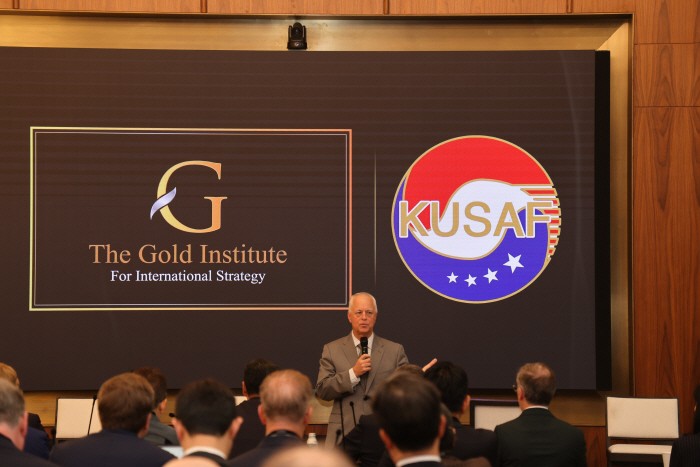 |
| Anthony Tata, U.S. Under Secretary of Defense (Department of War) for Personnel and Readiness, delivers a keynote address at the Indo-Pacific Summit co-hosted by the Gold Institute and the Korea-U.S. Alliance Foundation in Washington, D.C., U.S., on the 14th local time. / Washington Correspondent Ha Man-joo |
Undersecretary Tata stated that the military must bring in roughly 250,000 new service members each year while a comparable number of about 250,000 leave the ranks, outlining the Secretary of Defense's three core priorities as restoring the warrior ethos, rebuilding the military, and reestablishing deterrence.
Tata claimed that recruiting figures plummeted under the previous administration as individual identity and diversity, equity, and inclusion (DEI) were emphasized. He pointed out that the Army was forced to lower its end-strength goals at the time, assessing that recruiting performance improved significantly following President Trump's election in November 2024.
Undersecretary Tata stressed, "People want to be part of a winning team," emphasizing the need to focus on shared goals and missions over individual differences.
He cited as a best practice the Marine Corps' personnel policy where commanding a recruiting organization is a prerequisite to becoming the Commandant or advancing to two- or three-star general rank. He also explained that the Department is ramping up outreach geared toward influencers who shape enlistment decisions, such as parents, teachers, and coaches.
Tata explained that while more than 400,000 individuals show interest in enlisting and enter the screening process each year, roughly 150,000 fail to meet enlistment criteria. He announced the establishment of the "Patriot Pipeline" initiative to support their employment. The initiative aims to connect applicants who failed to qualify for enlistment—yet demonstrated a commitment to serve—to jobs across the defense industrial base, including supply depots, shipyards, and naval facilities.
Undersecretary Tata also underscored leveraging the careers of veterans who have completed their military service. Noting that transitioning service members often face hurdles securing the service records required for Department of Veterans Affairs (VA) disability ratings, he explained that a pilot program linking relevant records is underway and has yielded strong results to date.
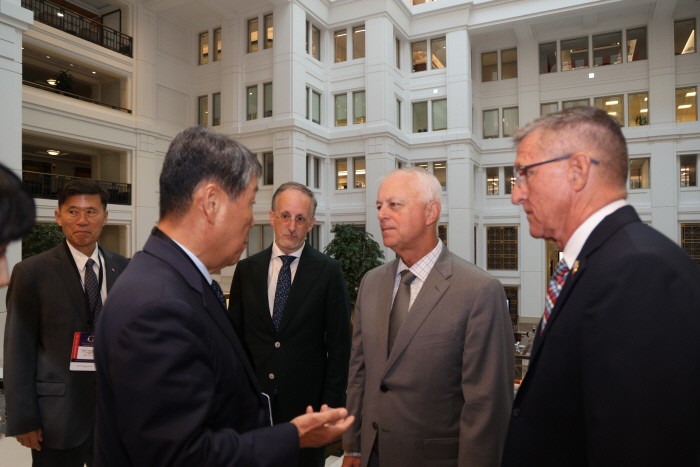 |
| Anthony Tata (second from right), U.S. Under Secretary of Defense (Department of War) for Personnel and Readiness, speaks with retired Gen. Im Ho-young, chairman of the Korea-U.S. Alliance Foundation, at the Indo-Pacific Summit co-hosted by the Gold Institute and the Korea-U.S. Alliance Foundation in Washington, D.C., U.S., on the 14th local time, as former U.S. White House National Security Advisor Michael Flynn (right) and others look on. / Washington Correspondent Ha Man-joo |
U.S. defense undersecretary cites $1,776 payouts from private to colonel
Undersecretary Tata stated that as more than $2 billion (approx. 2.6898 trillion won) was allocated for the basic allowance for housing in the "One Big Beautiful Bill," he discussed disbursement methods with the Department of Defense comptroller. He pointed out that temporarily raising monthly housing allowances could create issues where service members rent a home for $2,500 (3.36 million won) a month but can only afford $2,000 (2.69 million won) once the temporary support ends.
Undersecretary Tata explained that he consequently proposed a one-time lump-sum payment of the same amount for all personnel from private to colonel (O-6), brigade and naval ship commanders. He noted that while the initial payout was calculated at $1,775, President Trump suggested adding $1 to symbolize 1776, the year of American independence, setting the tax-free payout at $1,776 (2.39 million won). This lump sum was designated as the "Warrior Dividend."
He explained that initial training and education for a single new recruit costs approximately $150,000 to $200,000 (201.7 million to 269 million won), and when basic training and specialized skill instruction are factored in, total investment per service member can reach $1 million (1.345 billion won).
Undersecretary Tata said he is encouraging continued service among military personnel so that such investments can be leveraged over the long term. He explained that he restructured the system to provide more tuition assistance per course and semester for service members studying in strategically vital areas, such as master's degree programs in shipyard management.
Tata noted that even after completing at least 20 years of military service and retiring, he hopes service members continue their careers in defense-related sectors, including shipbuilding, aviation maintenance, healthcare, and education.
U.S. defense undersecretary says military spouse unemployment at 20% must drop to national 5% average
Undersecretary Tata stressed that supporting military families is a vital pillar of troop retention policies. Quoting the military adage, "You recruit the service member, you retain the family," he elaborated on the "Spouse Works" initiative.
Tata stated that the unemployment rate among military spouses stands at roughly 20%. While staff suggested a target of lowering it to 15%, he emphasized that the goal must be set to bring it down to the national average of around 5%.
Undersecretary Tata explained that frequent relocations and interstate license transfer barriers make it difficult for military spouses to secure employment. He cited the case of a dentist spouse he met at a U.S. military base in Bahrain this past February. While there was a vacancy at the base dental clinic, the spouse was unable to apply due to regulations governing the timing of job applications.
Pointing out regulations that permitted job applications only beginning one month prior to an overseas posting, Tata explained that he revised the policy to allow spouses to apply as soon as orders are issued, typically about nine months before taking up the post.
He also recounted meeting with President Trump in the Oval Office about 18 months ago, where the president asked him to take on the role of caring for service members. Tata shared that President Trump told him, "I want you to take care of these troops," underscoring the importance of his current duties overseeing troop health, welfare, and family support.
U.S. defense undersecretary defers intelligence-sharing question as outside policy purview while Flynn proposes hiring pipeline linking U.S. veterans to Korean firms
Regarding the adoption of innovative products from private enterprises, Undersecretary Tata explained that he meets with representatives from multiple companies every week to evaluate technologies offering cost savings and military utility.
He explained that he conveys proposals from private companies to relevant divisions, noting that based on his experience, roughly one out of ten proposals actually moves forward.
Michael Flynn, chairman of the Gold Institute who served as White House national security advisor during the first Trump administration, introduced a proposal urging South Korean companies operating in the U.S. to give hiring preference to U.S. military veterans who served in South Korea, stating he would submit the plan to Tata to connect such veterans with South Korean firms expanding stateside.
He emphasized, "What exists between South Korea and the United States today is an unbreakable relationship," adding, "We must continue to maintain that relationship, and we can do so through forums like this."
Ha Man-joo
Most Read
-
1
Celltrion nears additional contract with major U.S..

-
2
Houthis launch successive attacks on Saudi airport..

-
3
Saudi Arabia, Iran hold first diplomatic talks to..

-
4
Saudi airport in Riyadh struck again, leaving at l..

-
5
U.S. deploys carrier, 10,000 more troops to Middle..

-
6
Five ASEAN countries welcome Myanmar coup leader

-
7
32 Western nations condemn Iran over terror plot t..

PEOPLE







-
Address : In-Young Bldg., 34, Uisadang-daero 1-gil, Yeongdeungpo-gu, Seoul
Copyright by ASIATODAY CO., LTD. All rights resereved