



With New Yalu River Bridge, Pyongyang's economic gains, reliance on Beijing to grow
Oct 15, 2026, 01:21 pm


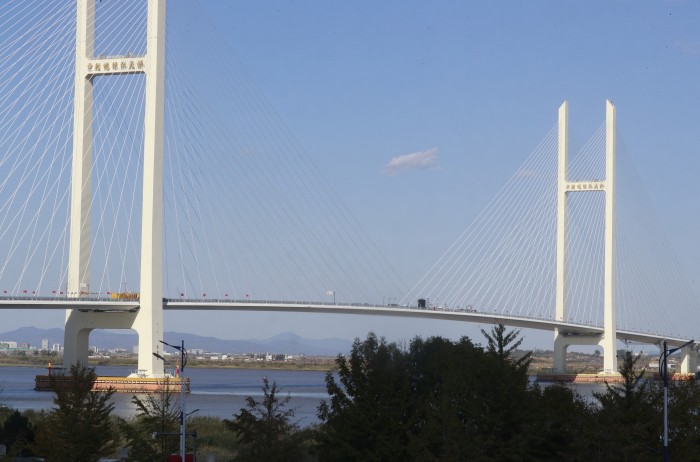 |
| A view of the New Yalu River Bridge connecting Sinuiju, North Korea, and Dandong in China's Liaoning Province on the 14th ahead of its opening. / Yonhap |
The New Yalu River Bridge connecting Sinuiju, North Korea, and Dandong in China's Liaoning Province officially opens on the 15th, 12 years after the bridge's completion. With the opening of a new artery for North Korea-China trade, North Korea—which has been closely aligning with Russia—has secured a foundation to strengthen economic cooperation with China as well. Experts analyzed the development as the result of growing mutual demand for exchange and cooperation, projecting that Pyongyang's economic gains and its reliance on Beijing will increase in tandem.
China's state-run Xinhua News Agency reported on the 14th, "Under consultations between China and North Korea, the China-North Korea New Yalu River Bridge will officially open on the 15th." Attendees of the event and specific customs clearance procedures were not disclosed. The bridge is a four-lane road bridge approximately 3 kilometers long; China financed the construction costs, completing the main structure in 2014. However, the opening was delayed due to the lack of connecting access roads and customs clearance facilities on the North Korean side. Tightened sanctions against North Korea and Pyongyang's border shutdown during the COVID-19 pandemic also contributed to the delay.
Experts took note of the reasons North Korea did not rush the opening even after bilateral ties with China improved, analyzing that expanding trade is not unilaterally beneficial to Pyongyang.
Kim Gyu-beom, an associate research fellow at the Institute for National Security Strategy (INSS), said, "While Chinese goods could flow in faster and in larger volumes, there is no guarantee that North Korea can sell more goods to China," adding, "There is no reason for North Korea to welcome a situation where its trade deficit and dependence on China only expand while relying on trade."
Kim analyzed that preparations for the opening and construction of facilities on the North Korean side accelerated following Chinese President Xi Jinping's visit to Pyongyang in June, suggesting a summit-level agreement was reached. He noted, "From North Korea's perspective, this could be seen as a bargaining chip with China that required no rush," forecasting that "trade volume and efficiency will increase following the bridge's opening."
Lim Eul-chul, a professor at the Institute for Far Eastern Studies at Kyungnam University, evaluated, "This will provide a material foundation allowing North Korea to seek practical economic gains and regime stability through the massive hinterland of China without relying on inter-Korean cooperation," adding that it is the result of growing practical necessity and strategic demand on both sides.
Professor Lim said, "North Korea aims to secure momentum to maintain its 'two hostile states' doctrine even more staunchly through close ties with China and Russia while excluding South Korea," adding, "While actively embracing economic benefits, Pyongyang is likely to maintain even more thorough ideological and social control over its domestic population."
Lee Han-sol
Most Read
-
1
Celltrion nears additional contract with major U.S..

-
2
Houthis launch successive attacks on Saudi airport..

-
3
Saudi Arabia, Iran hold first diplomatic talks to..

-
4
Saudi airport in Riyadh struck again, leaving at l..

-
5
U.S. deploys carrier, 10,000 more troops to Middle..

-
6
Five ASEAN countries welcome Myanmar coup leader

-
7
32 Western nations condemn Iran over terror plot t..

PEOPLE







-
Address : In-Young Bldg., 34, Uisadang-daero 1-gil, Yeongdeungpo-gu, Seoul
Copyright by ASIATODAY CO., LTD. All rights resereved