



Wary of China, Philippines moves to penalize foreign meddling ahead of presidential race
Oct 15, 2026, 01:17 pm


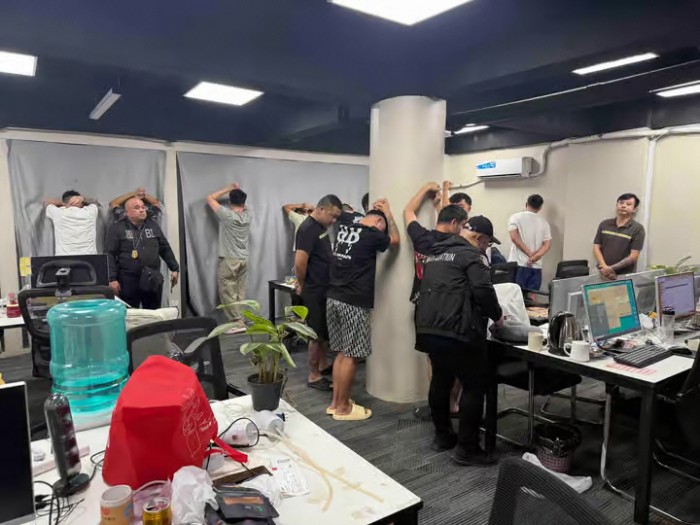 |
| The scene where the Philippine Bureau of Immigration raided a facility near a military installation in Quezon City and arrested 74 Chinese nationals and two Myanmar nationals on the 12th local time. / Philippine Bureau of Immigration |
Ahead of the 2028 presidential election, the Philippines is pushing to enact legislation that penalizes public opinion manipulation and political meddling by foreign forces. Amid mounting security concerns compounded by the arrest of 76 foreign nationals near military headquarters and allegations of Chinese funds flowing into a company linked to the vice president's family, critics also warn the proposed law could stifle legitimate dissent.
According to the South China Morning Post (SCMP) and local media on the 15th local time, Philippine immigration authorities and the military raided a facility in Quezon City in Metro Manila on the 12th, arresting 76 foreign nationals. The group comprised 74 Chinese and two Myanmar nationals. The facility sits along the same road as Camp Aguinaldo, home to the General Headquarters of the Armed Forces of the Philippines and the Department of National Defense.
Authorities suspect the facility operated as an online scam hub linked to Philippine Offshore Gaming Operators (POGOs). POGOs flourished during the tenure of former President Rodrigo Duterte, father of current Vice President Sara Duterte, and authorities have long suspected such operations were covertly utilized for illicit activities, including espionage.
Rear Adm. Roy Vincent Trinidad, military spokesperson for West Philippine Sea affairs (the name Manila uses for its waters in the South China Sea), told reporters, "Appropriate agencies must look into this matter. It has very serious implications for national security."
Trinidad explained that as the military recently shifted its focus toward external defense, new security challenges have emerged, such as attempts to manipulate public opinion through information warfare. Warning against foreign influence operations aimed at eroding trust in the government and public institutions, he stated, "The goal is not to make us believe them, but to make us believe nobody."
Authorities' vigilance extends toward the 2028 presidential election. Philippine officials have warned that external forces could back candidates viewed as pro-China in the upcoming race. Citing intelligence reports during a talk show last month, Interior and Local Government Secretary Jonvic Remulla claimed that "a superpower" is funding more than 40,000 bloggers, influencers, and commentators to spread fake news concerning the Philippines.
Adding weight to such warnings are allegations surrounding Kayle88 Foods, a food enterprise co-founded by Manases Carpio, husband of Vice President Duterte. The National Security Council (NSC) announced it would investigate reports alleging that entities from mainland China and Hong Kong remitted 319 million pesos (approx. 6.83 billion won) to the company. Carpio served as president and board chairman of the company at the time the transfers occurred.
Defense Secretary Gilberto Teodoro called for a "thorough investigation given its serious implications for national security." President Ferdinand Marcos Jr. stated on the 7th that the matter is "deeply concerning" and warned that if verified, it would constitute "the highest level of threat to the Republic."
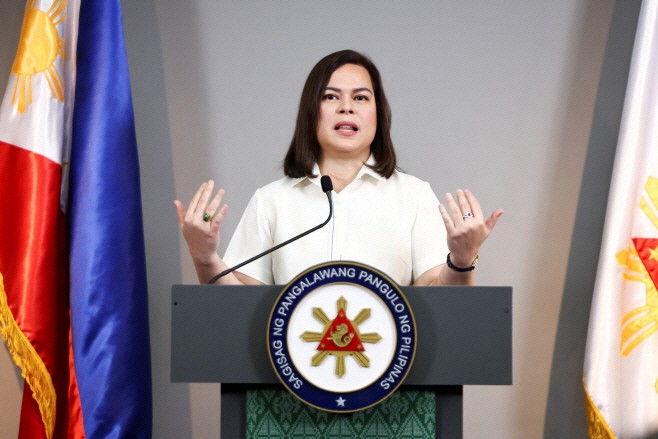 |
| Philippine Vice President Sara Duterte. / Reuters, Yonhap News |
Vice President Duterte and China pushed back. On the 12th, Vice President Duterte retorted, "Is doing business with China prohibited? Is it because of national security risks?" She then condemned the Marcos administration, saying it is "becoming a troublemaker in Southeast Asia." Earlier this month, the Chinese Embassy in the Philippines denounced claims that Beijing had funneled funds to certain political forces in the country, branding them as a "false narrative" and malicious. The embassy stated that it would take measures to defend China's "legitimate rights, interests, and dignity." In April of last year, the embassy similarly asserted that it had "no interest" in meddling in Philippine elections, arguing that certain politicians exploit such allegations for political gain.
What Philippine officials are calling for as a solution is new legislation. Former Supreme Court Senior Associate Justice Antonio Carpio urged Congress to expedite the passage of a foreign influence and interference bill. Aimed at bolstering the existing Foreign Agents Act—which mandates foreign agents to register and disclose funding sources, compensation, and activities—a working group is set to consolidate eight related bills into a single measure and submit it to the House of Representatives.
The legislation also targets online influence operations, including so-called "troll farms" and domestic and foreign proxies acting on behalf of foreign individuals or entities to manipulate public opinion for political ends. Actions such as financing political candidates could carry prison sentences along with fines of up to 20 million pesos (approx. $318,000).
However, criticism has also emerged that a law intended to curb foreign interference could chill legitimate political expression. Carlos Nazareno, an activist with digital rights group Democracy.Net.PH, pointed out that foreign institutions that have supported democracy and counter-disinformation projects in the Philippines—such as Germany's Konrad-Adenauer-Stiftung and the Friedrich Naumann Foundation—could be affected by the law.
Enrico Gloria, an assistant professor of political science at the University of the Philippines, said the bill must clearly delineate the boundaries of permitted activities for individuals connected to foreign entities and include safeguards to protect against unfounded accusations.
Jeong Ri-na
Most Read
-
1
Celltrion nears additional contract with major U.S..

-
2
Houthis launch successive attacks on Saudi airport..

-
3
"Aren't those foreigners on welfare?": M..

-
4
Saudi Arabia, Iran hold first diplomatic talks to..

-
5
Saudi airport in Riyadh struck again, leaving at l..

-
6
U.S. deploys carrier, 10,000 more troops to Middle..

-
7
Five ASEAN countries welcome Myanmar coup leader

PEOPLE







-
Address : In-Young Bldg., 34, Uisadang-daero 1-gil, Yeongdeungpo-gu, Seoul
Copyright by ASIATODAY CO., LTD. All rights resereved