



Samsung Electronics discusses future of AI, 6G communications in Silicon Valley
Oct 15, 2026, 09:30 am


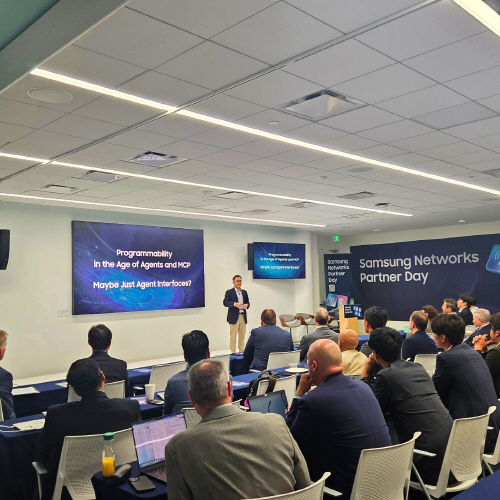 |
| Samsung Electronics hosted the "Silicon Valley Future Communications Summit 2026" in California on the 14th local time and discussed directions for 6G network evolution with partners. / Samsung Electronics |
Samsung Electronics is discussing the future direction of network evolution in the artificial intelligence (AI) and 6G era with the global telecommunications industry in Silicon Valley, U.S., while showcasing its achievements in next-generation communications technology. The company plans to realize 6G technology by expanding AI-based telecom cooperation while exploring new growth opportunities in the network business.
On the 14th local time, Samsung Electronics announced that it is hosting Partner Day and the Silicon Valley Future Communications Summit 2026 back-to-back from this day through the 15th in Mountain View, California, U.S. Around 100 telecom experts, including representatives from major mobile network operators, device manufacturers, government agencies, and academia, are attending to discuss the development direction of software-based networks and measures for ecosystem cooperation.
Partner Day featured discussions on network transformations in the AI era and ways to create value utilizing them. In its keynote speech, Samsung Electronics diagnosed that telecommunications networks are undergoing structural reorganization as AI expands beyond applications and services into overall infrastructure. In particular, it stressed that next-generation networks combining AI and virtualization will serve as a core driving force in realizing new forms of communication beyond the limitations of conventional telecom.
During panel sessions, telecom carriers shared the requirements and blueprints needed for AI-based future networks. Manufacturers shared experiences gained during the commercialization of AI and virtualized networks, discussing the future path of the telecom ecosystem. They also explored ways to move beyond mere connectivity services to discover new network-based services and turn them into business opportunities.
Park Jeong-ho, executive vice president and head of the Strategic Marketing Team at Samsung Electronics' Networks Business, said, "Networks in the AI era are evolving into intelligent infrastructure that reads the diverse needs of pouring new services, adapts flexibly based on virtualization, and delivers optimal solutions." He added, "Samsung Electronics has successfully achieved large-scale commercialization of virtualized networks alongside global partners. By adding advanced AI technology to this foundation, we will develop telecom infrastructure into a new growth engine and take the lead in paving the way for the industry to leap forward together."
The Silicon Valley Future Communications Summit 2026 addresses technologies and research outcomes that support such network evolution. The session on AI-native 6G networks discusses technical challenges and cooperation plans to enhance network performance and operational efficiency using AI. The satellite communications session examines the current status and future outlook of low Earth orbit (LEO) satellite constellations, while covering satellite communications standards and roadmaps under discussion at the 3rd Generation Partnership Project (3GPP).
In the hyper-connectivity session, participants explore the possibilities of new services utilizing integrated sensing and communication (ISAC) and physical AI. ISAC is a core 6G technology that performs communication and sensing simultaneously using the same frequency band and hardware, and it can be utilized to recognize physical space and connect it to digital services.
Samsung Electronics also showcases key 6G technologies jointly developed and verified with partner companies. It demonstrates technical achievements including AI-RAN, which combines AI with radio access networks, as well as extreme Multiple-Input Multiple-Output (X-MIMO), Distributed MIMO (D-MIMO), and ISAC.
Specifically, the company plans to disclose verification results on communication performance with AI applied across all radio access network layers and transmission performance in the 7GHz band, a candidate frequency for 6G. Perceived user performance at cell boundaries and sensing performance utilizing base station infrastructure will also be presented.
Cooperation with domestic and foreign telecom operators to realize 6G is also expanding. This year, Samsung Electronics initiated cooperation with LG Uplus to develop ISAC technology and conducted field tests with Verizon at a major sports event in Dallas, U.S. It is also strengthening research partnerships with SoftBank, NTT Docomo, KDDI Research, KT, and SK Telecom.
Jung Jin-gook, executive vice president and head of the Advanced Communications Research Center at Samsung Research, Samsung Electronics, stated, "Samsung Electronics is leading the development of core network technologies that will materialize 6G through close cooperation with telecom industry partners. We will pool our advanced research capabilities to advance next-generation communications technologies for both carriers and users."
Lee Ji-sun
Most Read
-
1
Celltrion nears additional contract with major U.S..

-
2
Kia Sportage outperforms Mazda CX-5 in German auto..

-
3
Houthis launch successive attacks on Saudi airport..

-
4
Saudi Arabia, Iran hold first diplomatic talks to..

-
5
Saudi airport in Riyadh struck again, leaving at l..

-
6
U.S. deploys carrier, 10,000 more troops to Middle..

-
7
Five ASEAN countries welcome Myanmar coup leader

PEOPLE







-
Address : In-Young Bldg., 34, Uisadang-daero 1-gil, Yeongdeungpo-gu, Seoul
Copyright by ASIATODAY CO., LTD. All rights resereved