



Warning signs emerge for Lee as centrists, voters in their 40s turn away
Oct 13, 2026, 09:07 am


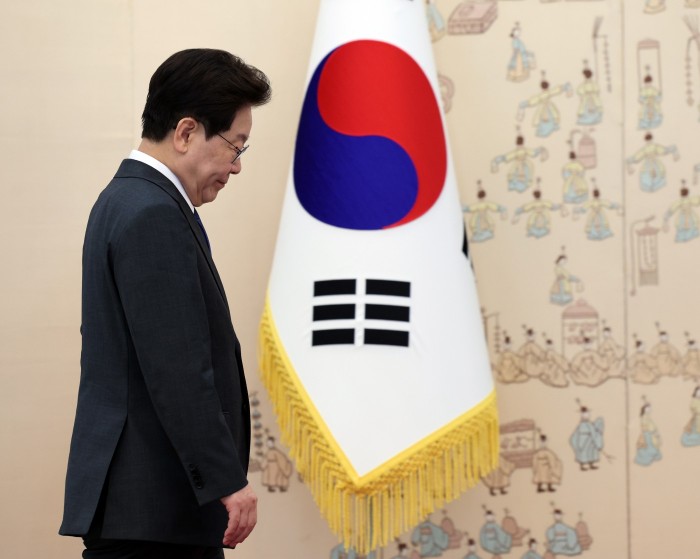 |
| President Lee Jae-myung enters the credential presentation ceremony for foreign ambassadors to South Korea held at Cheong Wa Dae on the 12th. / Yonhap |
Warning signs have emerged for President Lee Jae-myung's governing momentum as support from political centrists and voters in their 40s—key pillars propping up his approval ratings—shows signs of faltering. Amid an accumulation of unresolved issues spanning real estate, national security, and the judiciary, approval ratings for both President Lee and the ruling party fell in tandem into the 35% range. Observers note that the administration must rein in policy confusion and internal ruling camp strife, winning back public sentiment with tangible achievements that citizens can directly feel.
According to a survey conducted on October 6–8 by Realmeter commissioned by the Asia Business Daily, surveying 1,504 voters aged 18 and older nationwide and released on the 12th, positive assessments of President Lee's job performance slipped 2.2 percentage points (p) from the previous week to 35.2%. Negative assessments rose 1.6%p to 61.4%. Positive ratings have declined for two consecutive weeks.
Particularly notable is the decline in support among centrists and voters in their 40s. Positive ratings among centrists stood at 39.2%, dropping 3.5%p in just one week, while those in their 40s fell 5.1%p to record 37.3%. Approval also dropped by 2.9%p and 1.8%p among voters in their 50s and 60s, respectively, and plummeted 7.6%p among those aged 70 and older. Conversely, minor gains were recorded among voters in their 20s and 30s.
Support for the Democratic Party of Korea fell in lockstep. In a party support survey conducted on October 7–8, the Democratic Party logged 35.5%, tumbling 7.0%p from the prior week. The People Power Party rose 2.9%p to record 41.3%. While the gap between the two parties remains within the margin of error, the burden on the ruling bloc has mounted given that approval ratings for President Lee and the ruling party fell concurrently.
The People Power Party assessed that its parliamentary audit offensive against the administration proved effective. Speaking to reporters, Senior Spokesperson Park Sung-hoon stated, "This is the outcome of our party lawmakers uniting as one in the struggle against the administration," adding that "the highlighting of the DMZ landmine explosion incident and public livelihood issues during the parliamentary audit serves as the backdrop to the shift in support ratings."
Internal rifts within the ruling camp are adding further strain to state affairs. As hardliners including Gyeonggi Governor Choo Mi-ae and Democratic Party Lawmaker Kim Yong-min pushed back against the nomination of Kim Ji-yong to head the Serious Crimes Investigation Agency, President Lee and party leadership publicly called for restraint.
Representative Kim Min-seok stepped in to contain the fallout, stating that "internal attacks directed at the president and the party are inappropriate," yet discord surrounding the personnel pick shows no sign of abating.
Policy confusion is also cited as a factor behind the drop in approval. With consecutive policy adjustments surrounding a complete audit of agricultural land, single-stock leveraged exchange-traded funds (ETFs), and the Comprehensive and Progressive Agreement for Trans-Pacific Partnership (CPTPP), observers point out that the administration must demonstrate consistency and predictability in its policymaking.
Voices across the political spectrum emphasize that reversing the rating slide will require tangible achievements in areas directly felt by the public, such as real estate and everyday livelihoods. Reducing internal ruling camp disputes and message incoherence to project stability in governance is also seen as a pressing task.
A ruling camp insider noted, "Right now, rather than explaining away individual issues, delivering tangible outcomes that people can feel is critical, and the fact that centrists are shifting must be weighed with gravity."
The sampling error for the presidential job performance poll was plus or minus 2.5%p at a 95% confidence level with a response rate of 2.8%. The sampling error for the party support poll was plus or minus 3.1%p at a 95% confidence level with a response rate of 2.6%. More detailed information is available on the website of the National Election Survey Deliberation Commission.
Park Young-hoon
Most Read
-
1
Celltrion nears additional contract with major U.S..

-
2
Putin proposes trilateral U.S.-China-Russia summit..

-
3
U.S. weighs dropping MOAB, world's most powerful n..

-
4
"Aren't those foreigners on welfare?": M..

-
5
Attention centers on APEC for possible Trump-Xi-Pu..

-
6
Saudi Arabia, Iran hold first diplomatic talks to..

-
7
Saudi airport in Riyadh struck again, leaving at l..

PEOPLE





-
Address : In-Young Bldg., 34, Uisadang-daero 1-gil, Yeongdeungpo-gu, Seoul
Copyright by ASIATODAY CO., LTD. All rights resereved