



Republican candidates distance themselves from Trump ahead of U.S. midterm elections
Oct 08, 2026, 10:34 am


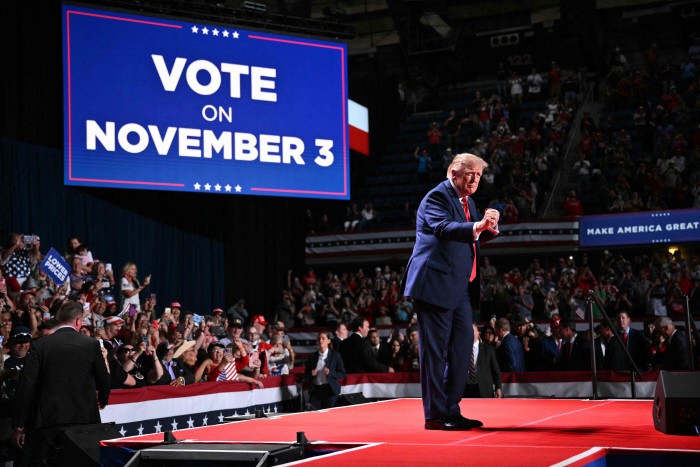 |
| U.S. President Donald Trump dances during a campaign rally at the Freeman Coliseum in San Antonio, Texas, on the 7th (local time). / AFP, Yonhap |
Ahead of the U.S. midterm elections on the 3rd of next month (local time), a significant number of Republican candidates running in key battlegrounds are distancing themselves from President Donald Trump on policy issues or scaling back campaign materials that link them to him.
Reuters reported on the 7th that an analysis of voting records, official statements, and campaign materials across 62 battlegrounds revealed candidates in 41 districts attempting to differentiate themselves from President Trump.
This trend is unfolding not through an outright rejection of President Trump's broader administrative agenda, but rather by voicing disagreements on individual policy issues.
Policy divergences between the president and candidates were confirmed in 23 districts, with military policy toward Iran emerging as a central issue in 12 of them. Candidates in these districts called for an end to conflicts, citing rising oil prices and household economic burdens, or voted in favor of measures limiting the president's war powers.
Over the pace of data center development, three candidates took stances opposing the administration's guidelines, calling for a measured rollout.
Experts evaluate this development as a strategic choice aimed at securing the votes of independent voters.
In a recent Reuters/Ipsos poll, President Trump's job approval rating stood at 32%, while preferences among independent voters showed Democrats (37%) leading Republicans (21%).
However, many candidates appear to balance this by maintaining cooperative ties with the administration to prevent alienation among their traditional conservative base.
Republican Senator Pete Ricketts of Nebraska criticized President Trump's push to expand beef imports, yet attended a joint local campaign rally in Nebraska and stated that he has "fought for the president in Washington."
Republican Representative Mariannette Miller-Meeks of Iowa criticized the beef import policy and voted to curb presidential war powers regarding Iran, but later attended a White House event announcing a major steel mill investment in Iowa.
Republican Representative Michael Lawler of New York voiced opposition on issues such as protections for Haitian immigrants and Turkey's procurement of F-35 fighter jets, while remarking at a party event in September that "we do not always agree with the president, and that is entirely natural."
The White House pushed back against the findings by highlighting the policy achievements of the Trump administration. White House spokesperson Davis Ingle stated that President Trump is the Republican Party's "clear leader, best messenger, and peerless motivator."
Lee Jeong-eun
Most Read
-
1
Trump shares map on social media labeling Strait o..

-
2
Kia Sportage outperforms Mazda CX-5 in German auto..

-
3
Houthis launch successive attacks on Saudi airport..

-
4
U.S. deploys carrier, 10,000 more troops to Middle..

-
5
Trump rejects Iran's offer to open Strait of Hormu..

-
6
N. Korea conducts first swarm attack drill with dr..

-
7
U.S.-China summit falls short on substance as Trum..

PEOPLE






HEADLINE NEWS
- Seoul dismisses Ukraine's claim of 'S. Korean support for Russia' as "inaccurate and inappropriate"
- S. Korea, Japan race to develop nuclear-powered submarines
- Henri Kagan, Kenso Soai win Nobel Prize in Chemistry for uncovering how mol..
- Vance says Alaska LNG cooperation will move forward with Seoul's current or..

-
Address : In-Young Bldg., 34, Uisadang-daero 1-gil, Yeongdeungpo-gu, Seoul
Copyright by ASIATODAY CO., LTD. All rights resereved