



U.S. troops in Okinawa suspend operations for 48 hours after robbery-murder case
Oct 08, 2026, 09:47 am


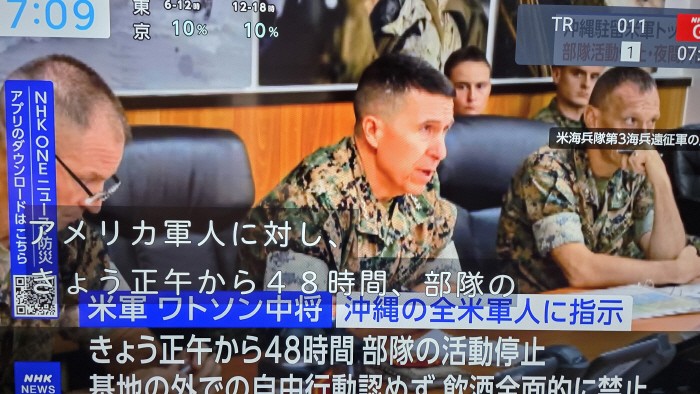 |
| An NHK news broadcast on the 7th reports on the 48-hour activity pause directive for U.S. forces stationed in Okinawa. Lieutenant General Benjamin Watson, shown in the center of the screen, ordered all U.S. military personnel in Okinawa to adhere to an off-base curfew and alcohol ban following the arrest of a Marine on charges of robbery and murder of a woman. / NHK broadcast capture |
Following the arrest of a U.S. Marine on charges of robbery and murder of a woman in Okinawa, Japan, local U.S. military forces have suspended activities for two days and prohibited all personnel from going off-base and consuming alcohol. After pledging full cooperation in the investigation amid protests from the Japanese government and Okinawa Prefecture, the U.S. moved to contain the situation through strict conduct controls.
According to the Yomiuri Shimbun on the 7th, U.S. forces stationed in Okinawa announced in a directive issued the previous day that all activities would be paused for 48 hours starting at noon that day until noon on the 9th. During this period, all service members are barred from leaving base, and alcohol consumption is prohibited both on and off military installations. For the subsequent 30 days, off-base liberty will be restricted from midnight to 5 a.m., with surveillance at base gates ramped up.
Lieutenant General Benjamin Watson, the Okinawa area coordinator for the four branches of the U.S. military, stated in a release that discipline forms the foundation of the U.S. armed forces, noting that any erosion of local community trust compromises the strength of the alliance and regional security. The operational pause is intended as a period for personnel to reflect on discipline and accountability. This measure follows the arrest on the 4th of Devin Ballard (20), a Marine stationed at Marine Corps Air Station Futenma, on charges of murdering a 39-year-old woman and stealing her purse at a hotel in Naha City on the 3rd. The suspect has denied the allegations.
The Japanese government pressed the U.S. through diplomatic and defense channels. Foreign Minister Toshimitsu Motegi summoned U.S. Ambassador to Japan George Glass to the Ministry of Foreign Affairs on the 4th to express deep indignation, demanding full cooperation with the investigation, the enforcement of military discipline, and preventative measures. Expressing profound regret over the loss of life, Ambassador Glass responded that the U.S. would fully cooperate with Japanese authorities' investigation and take every possible action to prevent similar incidents.
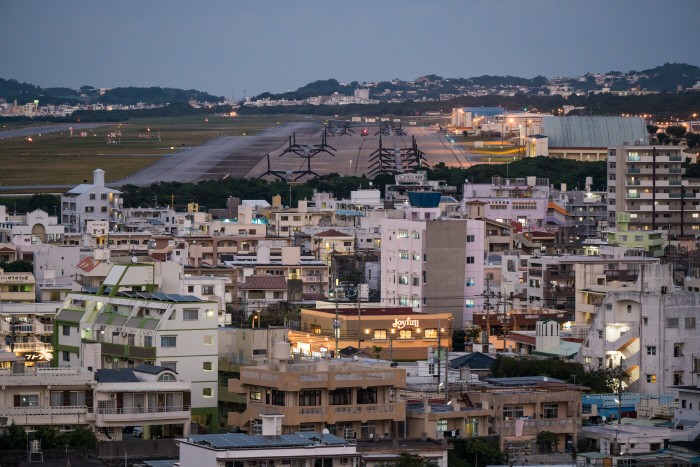 |
| An evening view of the U.S. Marine Corps Air Station Futenma and the surrounding residential neighborhood in Ginowan City, Okinawa Prefecture, Japan. Following a 48-hour ban on leaving base and consuming alcohol, U.S. forces stationed in Okinawa have decided to restrict off-base movement for service members from midnight to 5 a.m. for the next 30 days. / Getty Images Bank |
Defense Minister Shinjiro Koizumi also summoned Lieutenant General Stephen Jost, commander of U.S. Forces Japan, on the same day to demand appropriate measures toward the bereaved family and the enforcement of military discipline. Commander Jost stated that he views the incident with utmost seriousness and expressed commitment to cooperating with the investigation and preventing recurrences.
Local sentiment across Okinawa remains cold, however. Governor Kenta Koja lodged a protest with Coordinator Watson on the 5th, criticizing that the repeated occurrence of such incidents indicates military discipline and human rights education have failed to function effectively. Coordinator Watson stated that the highest standards of discipline would be enforced, but did not offer a direct apology. Governor Koja noted that local residents find this unacceptable, demanding an apology to both the bereaved family and the public if guilt is established.
The U.S. response has broadened from diplomatic expressions of regret and pledges of investigative cooperation to blanket conduct restrictions across all personnel. With Coordinator Watson directly citing the potential impact on the alliance and security, the measures are viewed as an effort to curb local distrust toward the U.S. military presence alongside preventing crime recurrence.
The key question is whether crime deterrence can be sustained once the temporary liberty and alcohol restrictions expire. Foreign Minister Motegi stated at a press conference on the 6th that Tokyo would consult with the U.S. to formulate effective measures. To ease residents' anxieties, authorities must demonstrate continuous disciplinary management and the execution of recurrence prevention measures extending beyond these temporary curbs.
Choi Young-jae
Most Read
-
1
Trump shares map on social media labeling Strait o..

-
2
Kia Sportage outperforms Mazda CX-5 in German auto..

-
3
U.S. deploys carrier, 10,000 more troops to Middle..

-
4
Trump rejects Iran's offer to open Strait of Hormu..

-
5
N. Korea conducts first swarm attack drill with dr..

-
6
U.S.-China summit falls short on substance as Trum..

-
7
Japan tracks Ukraine fiber-optic drones, bolsters..

PEOPLE





HEADLINE NEWS
- Seoul dismisses Ukraine's claim of 'S. Korean support for Russia' as "inaccurate and inappropriate"
- S. Korea, Japan race to develop nuclear-powered submarines
- Henri Kagan, Kenso Soai win Nobel Prize in Chemistry for uncovering how mol..
- Vance says Alaska LNG cooperation will move forward with Seoul's current or..

-
Address : In-Young Bldg., 34, Uisadang-daero 1-gil, Yeongdeungpo-gu, Seoul
Copyright by ASIATODAY CO., LTD. All rights resereved