



U.S. urges Russia to disclose information on death of plague research institute employee
Oct 07, 2026, 05:15 pm


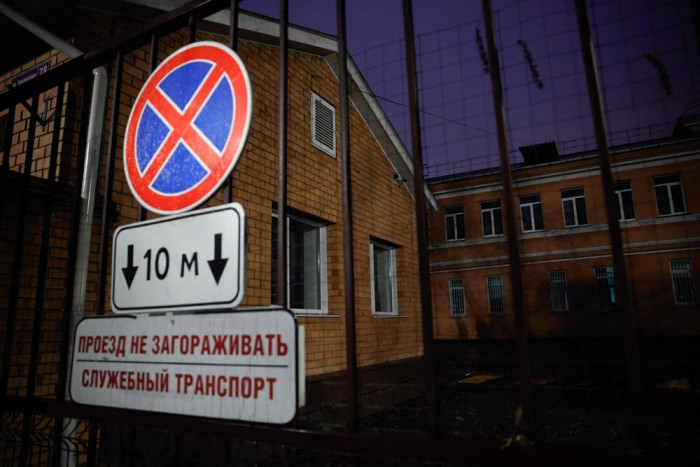 |
| The entrance to an infectious disease research institute in Irkutsk, Russia, is locked on the 7th (local time). On this day, Russian authorities denied implementing anti-epidemic preventive measures following reports that a laboratory researcher died from the plague, and countered a U.S. government offer of assistance by proposing instead to help the United States fight infectious diseases. / AFP, Yonhap |
The U.S. administration stated that it is closely monitoring the recent death of an employee at a plague research institute in Russia and urged the country to disclose more information regarding the incident.
U.S. Secretary of State Marco Rubio addressed the case while speaking to reporters during a visit to Iceland on the 6th (local time), saying, "We certainly believe that Russia should be sharing more information with the world," and adding, "We are monitoring this on an hourly basis, very closely," Reuters reported.
Rubio added, "If the situation turns out to be more serious than currently known, the United States has the means to assist Russia," while noting, "However, for the U.S. to get involved, we need more information than we currently have."
U.S. President Donald Trump told reporters on the same day that he had a phone call scheduled with Russian President Vladimir Putin soon.
Asked how much intelligence agencies have gathered on the matter, Trump responded, "Right now we are having very deep discussions, and we will probably be able to report on this by tomorrow or so."
The incident in question occurred on the 25th of last month at an anti-plague research institute in Irkutsk, Russia.
An accident occurred in which Daria Shipilova, a 28-year-old female researcher, broke a test tube containing plague pathogens. Four days later, she was admitted to a hospital in Shelekhov with severe pneumonia and passed away in an intensive care unit on the 2nd of this month.
Pneumonic plague can spread through respiratory droplets, carrying a fatality rate so severe that it can lead to death within one to six days if not treated early.
According to local media, approximately 200 people who had contact with Shipilova are quarantined at the hospital in Shelekhov, raising concerns about secondary transmissions.
Tedros Adhanom Ghebreyesus, director-general of the World Health Organization (WHO), stated on social media on the 6th, "We have requested additional information from Russia regarding the cause of the severe pneumonia, the pathogen, and media reports indicating another employee is suffering from pneumonia of unknown origin."
Director-General Tedros urged Russia to disclose information, emphasizing, "Timely, full, and transparent information sharing in accordance with the International Health Regulations (IHR) is essential to clarify conflicting reports and accurately assess public health risks."
The WHO stated that Shipilova's precise cause of death has not been officially confirmed. Russian authorities announced the cause of death as "pneumonia of unknown origin." Furthermore, they maintain that no work-related microorganisms were detected in samples and that no pathogen-related accident took place at the institute.
The State Department noted that much remains unknown about the incident and that it is working alongside multiple agencies—including the Centers for Disease Control and Prevention (CDC) and the Administration for Strategic Preparedness and Response (ASPR)—to understand the matter, the Washington Post (WP) reported.
U.S. online outlet Axios also pointed out the need to clarify whether the incident arose from legitimate research in Russia or involved an operational biological weapons development program.
Kim Hyun-min
Most Read
-
1
Trump shares map on social media labeling Strait o..

-
2
Kia Sportage outperforms Mazda CX-5 in German auto..

-
3
U.S. deploys carrier, 10,000 more troops to Middle..

-
4
Trump rejects Iran's offer to open Strait of Hormu..

-
5
N. Korea conducts first swarm attack drill with dr..

-
6
U.S.-China summit falls short on substance as Trum..

-
7
Japan tracks Ukraine fiber-optic drones, bolsters..

PEOPLE






HEADLINE NEWS
- Pyongyang calls DMZ explosion Seoul's fabrication and grave provocation
- U.S. Department of Defense completely halts use of blacklisted Anthropic AI
- 2026 Nobel Prize in Physics awarded to Francis Halzen for neutrino research
- French students take to streets, expressing frustration over economy, educa..

-
Address : In-Young Bldg., 34, Uisadang-daero 1-gil, Yeongdeungpo-gu, Seoul
Copyright by ASIATODAY CO., LTD. All rights resereved