



Light attack aircraft, military vehicles spotted at China-Laos joint training facility
Oct 07, 2026, 10:22 am


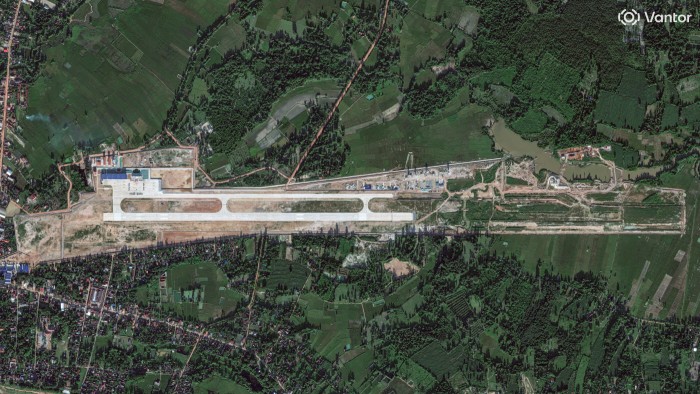 |
| A satellite image taken on the 30th of last month captures runway expansion work underway at a China-Laos joint military training facility in the Ban Keun area of Vientiane, Laos. / Reuters, Yonhap News |
Commercial satellite imagery has captured light attack aircraft and military vehicles stationed at a newly established China-Laos joint training facility near the Lao capital of Vientiane. The scene was photographed the day after China's defense ministry announced the creation of the facility.
According to Reuters on the 6th (local time), satellite images taken on the 30th of last month by commercial satellite operator Vantor show eight aircraft presumed to be light attack jets and more than two dozen support vehicles positioned on the runway of the Ban Keun facility outside Vientiane. At the time, the runway was still under construction, and extensive building work was also progressing across the surrounding area. China's Ministry of National Defense announced the establishment of the facility in Ban Keun a day earlier, on the 29th of last month.
Experts identified the aircraft in the satellite imagery as Hongdu JL-8s, a model operated by both the Chinese and Lao air forces. Also known as the K-8, the two-seat jet was jointly developed by China and Pakistan for export and is widely used as a trainer while possessing light attack capabilities. According to the annual Military Balance assessment by the International Institute for Strategic Studies (IISS) in Britain, Laos is currently known to possess four of the aircraft. Questions remain, however, over whether Laos can actively operate the airframes.
Some observers suggest the facility could become China's first full-fledged overseas military base in Southeast Asia. While China has pursued an intensive military modernization drive for more than two decades, outside of its presence in the South China Sea, access to Cambodia's Ream Naval Base, and a logistics support base in Djibouti, Africa, its overseas outpost network has been evaluated as limited.
For this reason, regional observers are watching closely to see if the facility will expand beyond training into a military hub. A key focus is whether additional construction will introduce air defense networks, ammunition and fuel storage depots, and surveillance installations, as the emergence of such infrastructure would signal the site is intended to serve broader military functions beyond training.
Alexander Neill, an adjunct fellow at the Hawaii-based think tank Pacific Forum, assessed that while the current airfield appears relatively short and non-threatening, it could eventually accommodate larger aircraft—such as signals intelligence or electronic surveillance platforms—to project Chinese influence across Southeast Asia. He noted that the airfield appears to have been designed with runway extension in mind so larger aircraft can operate there.
Alternative perspectives exist regarding the site selection. Rachel Vandenbrink, a senior analyst at the Australian Strategic Policy Institute (ASPI), viewed the choice of Ban Keun as likely more opportunistic than driven by a clear operational need. She noted, however, that because Laos borders China and is connected by infrastructure like railways, it holds a degree of geostrategic value as an accessible foothold into mainland Southeast Asia.
Ban Keun was also an airfield covertly utilized by the U.S. Central Intelligence Agency (CIA) during the height of the Vietnam War. In the 1970s, as the U.S. fought Lao communist forces, the Ban Keun airfield was known as Lima Site 44 and was operated by Air America, an airline secretly owned by the CIA. At the time, Air America reportedly carried out missions ferrying troops and supplies of the CIA-backed highland Hmong minority to rugged mountain airstrips.
Jeong Ri-na
Most Read
-
1
Alteogen secures European patent for Keytruda SC,..

-
2
Trump shares map on social media labeling Strait o..

-
3
Celltrion seeks rheumatoid arthritis indication ex..

-
4
Kia Sportage outperforms Mazda CX-5 in German auto..

-
5
U.S. deploys carrier, 10,000 more troops to Middle..

-
6
Trump rejects Iran's offer to open Strait of Hormu..

-
7
N. Korea conducts first swarm attack drill with dr..

PEOPLE






HEADLINE NEWS
- Pyongyang calls DMZ explosion Seoul's fabrication and grave provocation
- U.S. Department of Defense completely halts use of blacklisted Anthropic AI
- 2026 Nobel Prize in Physics awarded to Francis Halzen for neutrino research
- French students take to streets, expressing frustration over economy, educa..

-
Address : In-Young Bldg., 34, Uisadang-daero 1-gil, Yeongdeungpo-gu, Seoul
Copyright by ASIATODAY CO., LTD. All rights resereved