



End of the smog era brings stunning drop in Chinese air pollution
Oct 07, 2026, 09:41 am


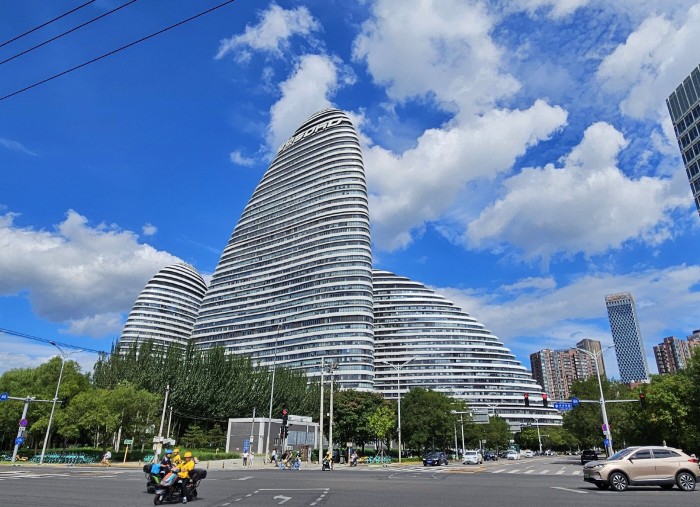 |
| Clear skies over Beijing, an unimaginable sight just a few years ago, seem to herald the imminent end of the smog era in China. / Xinjingbao |
Occurrences of China's yellow dust storms, known locally as shachenbao (sand and dust storms), have been plunging at a pace that could well be described as miraculous. If the trend holds, prospects are emerging that an end to the era of yellow dust—and by extension, smog—may actually be within reach.
Until recently, China's yellow dust wreaked havoc across South Korea as well, boasting what is quite literally a long history and tradition. The fact that records appear in the Shiji (Records of the Grand Historian), widely regarded as the oldest historical chronicle, says all that needs to be said. The text clearly documents a colossal dust storm blowing across Gaixia, the site where Xiang Yu met his demise after contending with Liu Bang for rule over China following the fall of the Qin dynasty. For the two millennia that followed, there were clear reasons why this persistent phenomenon tormented not only China but also Korea.
Now, however, frequencies are dropping so dramatically that speaking of the end of the smog era hardly feels premature. Reports frequently appearing in outlets such as the Xinjingbao, describing the decline as nothing short of staggering, are by no means an exaggeration. Looking at conditions in Beijing—a city whose historical frequency of dust storms more than lived up to its capital status—confirms this shift.
According to recent reports by outlets like the Xinjingbao, dust storms swept through Beijing almost every other day just a few years ago, to put it mildly. This year, however, Beijing was hit only three times: January 9, February 21, and April 2. Aside from the February 21 event, which reached notable severity, the impact remained relatively minor—almost negligible.
Beijing is not an isolated case. Conditions have also improved drastically across provinces neighboring Inner Mongolia and Gansu—the heartlands of yellow dust—including Hebei, Shaanxi, Jilin, and Liaoning. Liu Guoqing, a resident of Zhongguancun in Beijing's Haidian District, noted with satisfaction, "Last year, there were not many dust storms in Beijing or nearby regions. This year, they have been virtually nonexistent. I haven't heard of any damage back in my hometown in Shaanxi Province either, and folks back home keep reaching out in pleasant disbelief wondering what brought this about."
There are clear drivers behind this sharp drop in the frequency of China's historic dust storms. Foremost among them are the initiatives led by environmental authorities. Proactive afforestation policies aimed at curbing desertification across northern regions such as Inner Mongolia and Gansu appear to be yielding tangible results.
On top of this, projects restoring vegetation across source areas, alongside sweeping industrial modernization befitting a nation striving for global preeminence, have served as brakes on large-scale dust storms. These factors carry a very high likelihood of exerting an even greater positive impact moving forward. It would hardly be a stretch to declare that China's era as an epicenter of yellow dust is drawing to a close.
Hong Soon-do
Most Read
-
1
Alteogen secures European patent for Keytruda SC,..

-
2
Trump shares map on social media labeling Strait o..

-
3
Celltrion seeks rheumatoid arthritis indication ex..

-
4
Kia Sportage outperforms Mazda CX-5 in German auto..

-
5
U.S. deploys carrier, 10,000 more troops to Middle..

-
6
Trump rejects Iran's offer to open Strait of Hormu..

-
7
N. Korea conducts first swarm attack drill with dr..

PEOPLE






HEADLINE NEWS
- Pyongyang calls DMZ explosion Seoul's fabrication and grave provocation
- U.S. Department of Defense completely halts use of blacklisted Anthropic AI
- 2026 Nobel Prize in Physics awarded to Francis Halzen for neutrino research
- French students take to streets, expressing frustration over economy, educa..

-
Address : In-Young Bldg., 34, Uisadang-daero 1-gil, Yeongdeungpo-gu, Seoul
Copyright by ASIATODAY CO., LTD. All rights resereved