



340 whale calves found dead at world-renowned breeding ground in all-time record die-off
Oct 06, 2026, 03:04 pm


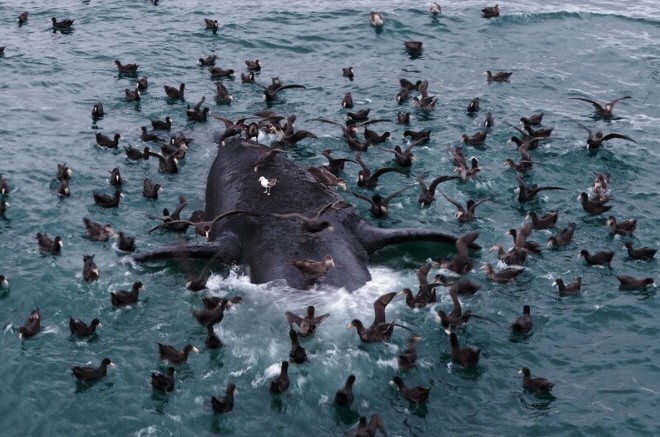 |
| Seabirds gather around the carcass of a whale found on a beach near Puerto Madryn, Argentina, on September 30. / AP |
The number of dead whale calves discovered in Argentina's Valdés Peninsula, a globally renowned breeding ground for whales, is projected to reach an all-time record.
Local broadcaster América TV reported on the 4th (local time) that dead southern right whale calves continue to be found across the Valdés Peninsula during this year's whale season, noting that unofficial preliminary counts indicate the death toll has already surpassed 340.
According to annual official records, the previous highest toll was 113 in 2012. As a mortality figure for southern right whales documented at a calving ground, this marks the highest on record not only for the Valdés Peninsula but globally.
The Whale Conservation Institute of Argentina (Instituto de Conservación de Ballenas, ICB) noted that determining whether mortality is exceptionally elevated compared to average years requires final confirmation of both total births and total deaths in the peninsula; however, it warned that if this unusual pace continues, mortality could hit an all-time peak.
According to the ICB, whale numbers documented at the Valdés Peninsula in 2025 reached a record 2,100 to 2,200 individuals—including 826 mother whales—while calf deaths stood at just 80.
With calf mortality rising sharply this year, Chubut Province, where the Valdés Peninsula is situated, launched an investigation to identify the underlying cause.
The provincial environmental agency is closely probing the possibility of Erysipelothrix rhusiopathiae bacteria. One leading hypothesis is that the pathogen, known to cause severe disease, enters calves through wounds inflicted by gulls pecking at them. Gulls routinely peck and feed on the skin and blubber of whales when they surface to breathe.
The environmental agency stated that the bacterium was detected in tissue samples from dead whales and that detailed laboratory analyses are underway at two research institutes in Buenos Aires, with findings expected by late October.
In connection with this, whale expert Víctor Fratto remarked, "There have been instances overseas where whales suffered mass die-offs from bacteria," emphasizing that investigations into infection pathways and the marine environment of the nursery grounds must run in parallel to pinpoint the exact cause of death.
Flocked to each year by southern right whales for reproduction, the Valdés Peninsula is South America's most famous whale breeding sanctuary and was inscribed as a UNESCO World Heritage site in 1999 in recognition of its marine mammal conservation value. The peak whale season runs annually from June through November.
During the season, tourists arrive in large numbers to observe the whales. Between 300,000 and 350,000 domestic and international visitors travel to the Valdés Peninsula each year, where eco-tours taking passengers out on boats for close-range viewings remain widely popular.
Son Young-sik
Most Read
-
1
Alteogen secures European patent for Keytruda SC,..

-
2
Trump shares map on social media labeling Strait o..

-
3
Celltrion seeks rheumatoid arthritis indication ex..

-
4
Kia Sportage outperforms Mazda CX-5 in German auto..

-
5
Chinese e-commerce giants AliExpress, Temu and She..

-
6
U.S. deploys carrier, 10,000 more troops to Middle..

-
7
Trump rejects Iran's offer to open Strait of Hormu..

PEOPLE







-
Address : In-Young Bldg., 34, Uisadang-daero 1-gil, Yeongdeungpo-gu, Seoul
Copyright by ASIATODAY CO., LTD. All rights resereved