



Three optogenetics pioneers win Nobel Prize in Physiology or Medicine for using light to control brain cells
Oct 06, 2026, 10:33 am


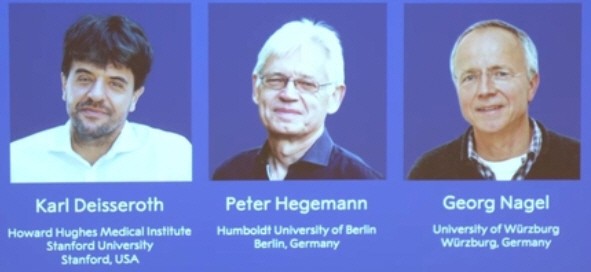 |
| The three laureates of the 2026 Nobel Prize in Physiology or Medicine / Screen capture from the Nobel Prize committee website |
Three scientists from Germany and the U.S. who pioneered "optogenetics"—a technique that uses light to control cells in living biological tissue—have jointly won this year's Nobel Prize in Physiology or Medicine.
The Nobel Assembly at the Karolinska Institute in Sweden announced on the 5th (local time) that Karl Deisseroth, professor at Stanford University in the U.S., Peter Hegemann, professor at Humboldt University of Berlin in Germany, and Georg Nagel, professor at the University of Würzburg in Germany, were selected as joint recipients of the 2026 Nobel Prize in Physiology or Medicine.
The committee cited their discoveries concerning light-gated ion channels and optogenetics as the basis for the award.
Optogenetics is a technology that uses light to control the activity of specific neurons. It has made it possible to investigate how nerve cells generate memories, emotions, and behaviors inside the living brain.
The starting point of this research was a protein named "channelrhodopsin," discovered by Hegemann and Nagel in single-celled algae. Subsequently, Deisseroth used this protein to create a kind of switch that controls neuronal activity with light.
The committee assessed that the three scientists' work laid the foundation for opening a new era in neuroscience. The methodology they developed is currently utilized in laboratories worldwide to unravel the working principles of the brain.
In particular, optogenetics opened the way to establish causal relationships between the activity of specific neurons and emotions, behaviors, and bodily functions. While it was previously possible to determine which brain regions were correlated with particular functions, proving direct causal links was limited.
The committee explained that how the brain regulates emotions, behaviors, and physical functions had long remained an enigma, but with the emergence of optogenetics, "now all of this is changing." Through this, creating a so-called "brain map" has become possible.
Among the co-laureates, Deisseroth was born in 1971 in the U.S., while Hegemann was born in 1954 and Nagel in 1953, both hailing from Germany.
The total prize money for this year's Nobel Prize in Physiology or Medicine is 12 million Swedish kronor (approximately 1.61 billion won). The three laureates will share the prize equally in one-third increments, receiving 4 million kronor (approximately 536 million won) each.
Following the announcement of the Physiology or Medicine Prize on that day, this year's Nobel Prize announcements will continue with Physics on the 6th, Chemistry on the 7th, Literature on the 8th, Peace on the 9th, and Economic Sciences on the 12th.
Nam Mi-kyung
Most Read
-
1
Trump shares map on social media labeling Strait o..

-
2
Kia Sportage outperforms Mazda CX-5 in German auto..

-
3
Houthis launch successive attacks on Saudi airport..

-
4
U.S. deploys carrier, 10,000 more troops to Middle..

-
5
Trump rejects Iran's offer to open Strait of Hormu..

-
6
N. Korea conducts first swarm attack drill with dr..

-
7
U.S.-China summit falls short on substance as Trum..

PEOPLE






HEADLINE NEWS
- Seoul dismisses Ukraine's claim of 'S. Korean support for Russia' as "inaccurate and inappropriate"
- S. Korea, Japan race to develop nuclear-powered submarines
- Henri Kagan, Kenso Soai win Nobel Prize in Chemistry for uncovering how mol..
- Vance says Alaska LNG cooperation will move forward with Seoul's current or..

-
Address : In-Young Bldg., 34, Uisadang-daero 1-gil, Yeongdeungpo-gu, Seoul
Copyright by ASIATODAY CO., LTD. All rights resereved