



Nepal ends search for flood victims after 40 days, moves on to reconstruction
Oct 06, 2026, 10:22 am


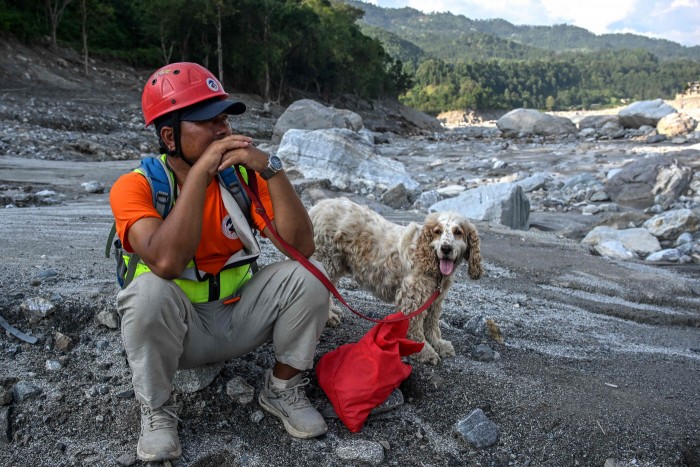 |
| A search and rescue worker sits with a search dog along the banks of the Trishuli River in Nuwakot District, Nepal, on the 30th of last month (local time). / AFP, Yonhap News |
Nepalese authorities have ended search and rescue operations 40 days after the massive flash floods in August, with more than 5,000 people still unaccounted for.
According to Reuters on the 5th (local time), Phanindra Paudel, head of the National Emergency Operation Centre (NEOC), told Reuters, "We are moving from the search and rescue phase to the search and rehabilitation phase".
The casualty toll rose steadily throughout the search period. The flooding, which originated on August 26 in the border region adjacent to Tibet, China, has left at least 1,455 dead and at least 5,285 missing to date. A total of 13,795 people have been rescued. In a situation report released on the 6th of last month by the National Disaster Risk Reduction and Management Authority (NDRRMA), the death toll stood at 1,342, with roughly 4,900 people missing or unaccounted for.
Search activities will not halt entirely. Dharam Raj Uprety, head of the NDRRMA, stated that while active searches for bodies will no longer take place, authorities will recover remains, property, and valuables uncovered during the reconstruction process. Emergency rescue operations will also continue if necessary.
For the missing who have yet to be found, legal declaration of death remains an unresolved issue. Chief Paudel noted that authorities are considering legally declaring the missing deceased so that bereaved families and relatives can complete legal procedures, including insurance claims and banking matters. He said, "We are initiating formal procedures to finalize the necessary legal steps."
According to the Ministry of Culture, Tourism and Civil Aviation of Nepal, 606 foreign tourists from 36 countries were among the missing. Indian nationals accounted for the largest group at 189, followed by 65 Americans, 55 Malaysians, 54 Ukrainians, and 37 Chinese nationals.
The destruction extended beyond human lives. The flood, triggered by the collapse of rock and ice in the high-altitude border region, swept downstream along the Bhotekoshi River to the Trishuli River, wiping out 12 hydroelectric projects along with roads, bridges, farmland, and villages.
Displaced residents who lost their homes also number in the thousands. Authorities announced that nearly 5 billion dollars (approximately 6.7175 trillion won) is needed for initial recovery and reconstruction.
The government's internal estimates reflect a similar magnitude. On the 10th of last month, the Office of the Prime Minister of Nepal estimated that recovery and reconstruction would cost 4.74 billion dollars (approximately 6.3682 trillion won). That figure is based on the Rapid Damage and Needs Assessment (RDNA) report jointly prepared by the National Planning Commission (NPC) and the NDRRMA. Infrastructure emerged as the most severely damaged sector, requiring an estimated 3.1 billion dollars (approximately 4.1648 trillion won), or roughly 75% of the total required funding.
Jeong Ri-na
Most Read
-
1
Trump shares map on social media labeling Strait o..

-
2
Kia Sportage outperforms Mazda CX-5 in German auto..

-
3
Houthis launch successive attacks on Saudi airport..

-
4
U.S. deploys carrier, 10,000 more troops to Middle..

-
5
Trump rejects Iran's offer to open Strait of Hormu..

-
6
N. Korea conducts first swarm attack drill with dr..

-
7
U.S.-China summit falls short on substance as Trum..

PEOPLE






HEADLINE NEWS
- Seoul dismisses Ukraine's claim of 'S. Korean support for Russia' as "inaccurate and inappropriate"
- S. Korea, Japan race to develop nuclear-powered submarines
- Henri Kagan, Kenso Soai win Nobel Prize in Chemistry for uncovering how mol..
- Vance says Alaska LNG cooperation will move forward with Seoul's current or..

-
Address : In-Young Bldg., 34, Uisadang-daero 1-gil, Yeongdeungpo-gu, Seoul
Copyright by ASIATODAY CO., LTD. All rights resereved