



Japan to transform 17 strategic industries with AI
Oct 01, 2026, 01:06 pm


 |
| A composite image showing an overview of industrial facilities overlaid with graphics representing artificial intelligence (AI) and data connectivity. The Japanese government plans to formulate an action plan within the year to expand the use of AI across 17 strategic sectors, including semiconductors. / Getty Images Bank |
The Japanese government is pushing a plan to transform its industrial structure by deploying high-performance artificial intelligence (AI) across 17 strategic sectors, including semiconductors. The plan envisions formulating concrete utilization roadmaps and regulatory reform directions within the year, backed by multi-year fiscal investments starting in fiscal 2027. This move aims to address labor shortages and secure growth drivers by diffusing AI across production and service operations.
According to a report by the Yomiuri Shimbun on the 1st citing multiple government officials, the Japanese government plans to establish an action plan within the year to accelerate the workplace adoption and diffusion of high-performance AI. Prime Minister Sanae Takaichi is scheduled to announce this policy at the Growth Strategy Council meeting later in the day and direct relevant cabinet ministers to take action.
At the core is the transformation of the industrial structure through the utilization of "trustworthy AI." Termed "AX" by the Japanese government, this initiative refers to altering corporate work practices as well as production and service frameworks through the use of AI. The Japanese government plans to outline concrete implementation measures within this year while simultaneously presenting directions for necessary regulatory reforms and institutional revisions.
The Takaichi Cabinet has established a policy of concentrating investments in 17 strategic areas, including semiconductors. Under the current plan, AI utilization will serve as a common foundation across all of these sectors. The AX initiative is reportedly positioned as the bedrock spanning all 17 fields.
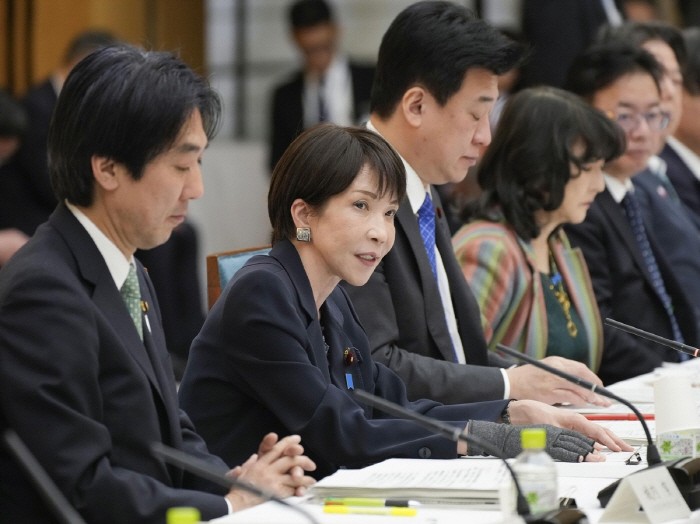 |
| Prime Minister Takaichi presides over the Growth Strategy Council meeting. / Yonhap News |
This policy trajectory was also evident in remarks by the prime minister during last month's cabinet reshuffle. According to transcripts of the September 17 press conference released by the Prime Minister's Official Residence, Prime Minister Takaichi cited labor shortages in sectors such as healthcare, nursing care, transportation, and construction, stressing the need to accelerate AI deployment. She also highlighted diffusion among small and medium-sized enterprises (SMEs) and micro-businesses, while appointing Minister Ryosei Akazawa to concurrently oversee the newly created portfolio for on-site AI deployment.
The scope of the policy thus encompasses not only high-tech manufacturing but also service industries underpinning daily life. A central challenge of the initiative lies in how widely AI can be diffused to understaffed workplaces and small businesses, moving beyond mere technological development by major corporations. Fiscal backing will draw on the "Strong and Affluent Japan" investment budget line item to be introduced in the fiscal 2027 budget. By committing large-scale fiscal resources over multiple years, the government also intends to encourage active private-sector investment. Specific figures for total AI investment, sectoral allocations, and individual support programs, however, have yet to be disclosed.
The Japanese government previously stated that it would also flesh out the action plan for its growth strategy during the year-end budget formulation process. According to Cabinet Office press briefing records from July 21, the action plan will be drawn up as a multi-year blueprint encompassing investment projects and budget programs for key policy areas. The latest AI action plan is being pursued in tandem with the implementation roadmap of this broader growth strategy.
Measures targeting labor shortages in the construction industry will be devised separately. The Japanese government plans to form a consultative body headed by Deputy Chief Cabinet Secretary Masanao Ozaki—with participation from the Ministry of Land, Infrastructure, Transport and Tourism and the Ministry of Economy, Trade and Industry—to compile comprehensive countermeasures by the end of the year. The goal is to establish an inter-ministerial collaborative system to tackle labor shortages alongside the AI adoption plan.
Japan's latest blueprint represents an effort to broaden the competitive front in AI from core technology development to application capabilities on the industrial front line. For South Korea, the key takeaway lies not merely in Japan's investment volume, but in the speed with which AI diffusion translates into tangible improvements in productivity and service competitiveness. Concrete details regarding support scale and regulatory realignment are expected to emerge in the year-end action plan and budget formulation.
Choi Young-jae
Most Read
-
1
Alteogen secures European patent for Keytruda SC,..

-
2
Trump shares map on social media labeling Strait o..

-
3
Celltrion seeks rheumatoid arthritis indication ex..

-
4
Kia Sportage outperforms Mazda CX-5 in German auto..

-
5
Chinese e-commerce giants AliExpress, Temu and She..

-
6
China expels No. 2 military official Zhang Youxia..

-
7
Houthi rebels release video claiming downing of Sa..

PEOPLE






-
Address : In-Young Bldg., 34, Uisadang-daero 1-gil, Yeongdeungpo-gu, Seoul
Copyright by ASIATODAY CO., LTD. All rights resereved