



Why Crocs is hooked on South Korea?
Oct 01, 2026, 10:07 am


 |
"More in South Korea than in China?"
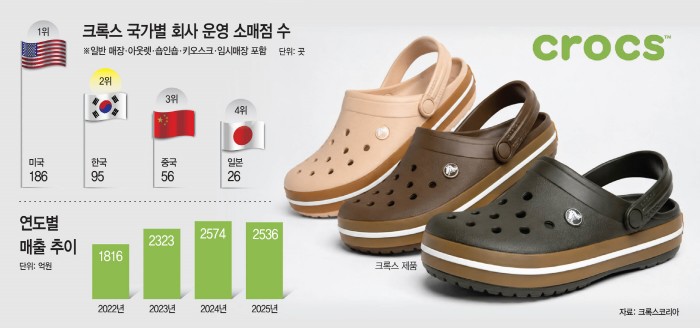
Global footwear brand Crocs is rolling out a dense retail network across the South Korean market. As of the end of last year, the number of company-operated retail locations Crocs runs directly in South Korea ranked second in the world behind only the U.S. It is nearly double the count in China. Looking at market size alone, the brand is placing an unusually heavy emphasis on South Korea.
Crocs views South Korea as a core market because of potential that goes well beyond just being a best-selling shoe. In South Korea, where consumers are trend-sensitive and fandom-driven purchasing runs deep, touchpoints with shoppers are created repeatedly as brand experiences merge with diverse cultural content, including character intellectual property and K-pop. Beyond expanding store footprints, Crocs is now accelerating a strategy centered on personalization and experiential spaces to drive repeat purchases among South Korean shoppers.
According to the 2025 annual report Crocs filed with the U.S. Securities and Exchange Commission (SEC) on the 30th, company-operated retail locations under the Crocs brand in South Korea stood at 95 as of the end of last year. That ranks second globally behind the 186 locations in the U.S. China had 56 locations and Japan had 26. This count encompasses outlet stores, shop-in-shops, kiosks, and pop-up locations alongside standard retail outlets. Crocs headquarters also classifies South Korea as one of its six Tier 1 core markets, alongside the U.S., China, Japan, India, and Western Europe.
The domestic subsidiary has also expanded its footprint rapidly. Revenue at Crocs Korea grew from 181.6 billion won in 2022 to 232.3 billion won in 2023, and reached 257.4 billion won in 2024. While 2025 revenue eased slightly year-on-year to 253.6 billion won, the figure represents roughly 40% growth compared to three years earlier.
Analysts say Crocs' rapid rise to mainstream popularity in South Korea stems from product attributes dovetailing with local consumer habits. A prime example is Jibbitz, the charms inserted into the ventilation holes of the footwear. Even when buying the same pair of Classic Clogs, consumers can combine character charms and initials to craft their own personalized pairs. Rather than ending with a one-time shoe purchase, the process of decorating and swapping charms establishes a cycle of recurring touchpoints between brand and buyer.
The domestic shoe decorating trend known as "shinku" also aligned with Crocs. The brand consistently rolled out Jibbitz charms and collaborative products leveraging popular characters and cultural properties, while scaling up promotional campaigns featuring K-pop artists. That push helped Crocs broaden its demographic beyond its initial image as functional children's footwear into an adult fashion statement and a vehicle for self-expression.
Physical stores are likewise evolving from plain sales floors into experiential spaces. In 2024, Crocs opened a 330-square-meter Mega Energy Store at Shinsegae Department Store's Hanam branch, outfitting it with oversized clog sculptures, photo zones, and dedicated stations where visitors can mix and match Jibbitz charms on the spot. Another hallmark of its domestic expansion is bringing sales points directly into shoppers' daily footpaths, blanketing department stores, outlet centers, big-box discount marts, and neighborhood commercial districts alike.
Challenges remain. With Crocs Korea's 2025 revenue dipping about 1.5% year-on-year, some observe that its steep growth momentum has plateaued. The number of company-operated retail stores also remained flat at 95 at the end of last year, unchanged from year-end 2024, following two openings and two closures over the past year. Consequently, Crocs' domestic business is shifting from a phase of asking how many new buyers it can reach to determining how frequently it can spur repeat purchases in a market where brand awareness is already high.
In response, Crocs plans to focus on personalization—inviting shoppers to style and customize products to match their individual tastes—as a core engine for future growth in South Korea. The company intends to let consumers project their preferred aesthetics and interests directly onto footwear using Jibbitz charms, while expanding customized shopping experiences across offline brand touchpoints such as marketing campaigns and pop-up venues.
A company official said, "South Korea is a market that responds rapidly to fashion and cultural trends, with strong fandom communities established across diverse fields including artists, sports, and characters." The official added, "Moving forward, we will continue introducing products and Jibbitz charms that reflect the varied tastes and interests of domestic consumers, while steadily expanding touchpoints where people can experience personalization both online and offline."
Jang Ji-young
Most Read
-
1
Alteogen secures European patent for Keytruda SC,..

-
2
Trump shares map on social media labeling Strait o..

-
3
Celltrion seeks rheumatoid arthritis indication ex..

-
4
Kia Sportage outperforms Mazda CX-5 in German auto..

-
5
Chinese e-commerce giants AliExpress, Temu and She..

-
6
China expels No. 2 military official Zhang Youxia..

-
7
Houthi rebels release video claiming downing of Sa..

PEOPLE






-
Address : In-Young Bldg., 34, Uisadang-daero 1-gil, Yeongdeungpo-gu, Seoul
Copyright by ASIATODAY CO., LTD. All rights resereved