



South Koreans live longer but stay healthy for fewer years
Oct 01, 2026, 09:17 am


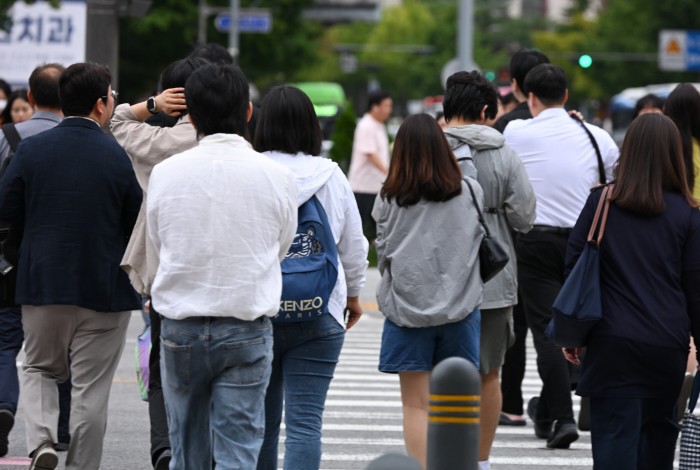 |
| Commuters make their way across the Sejong-daero intersection in Jongno-gu, Seoul, during the morning rush hour. / Reporter Jung Jae-hoon |
While life expectancy among South Koreans has increased, health-adjusted life expectancy—the years lived without illness or disability—declined for the third consecutive year. In 2023, the gap between life expectancy and health expectancy widened to 14.93 years. With disparities across income and regions also identified, experts proposed linking accumulated health data to prevention and health promotion policies, as well as budget allocation.
The Ministry of Health and Welfare and the Korea Health Promotion Institute held the 13th Future Health Strategy Forum at the EL Tower in Yangjae, Seoul, on the 30th under the theme "Health for All, Designed on Evidence." The forum discussed systems for calculating and managing health expectancy, linking national health surveys with health insurance data, Organization for Economic Cooperation and Development (OECD) health statistics, and policy utilization methods for health insurance data.
According to Lee Don-hyung, director of the Health Promotion Research Institute at the Korea Health Promotion Institute, life expectancy in 2023 rose to 83.49 years, up 0.75 years from 82.74 years the previous year, whereas health expectancy fell by 1.33 years, from 69.89 years to 68.56 years. Health expectancy, after peaking at 70.9 years in 2020, has dropped for three consecutive years.
Consequently, the "unhealthy period"—calculated by subtracting health expectancy from life expectancy—grew by 2.08 years, expanding from 12.85 years in 2022 to 14.93 years in 2023. This indicates that longer average lifespans do not correspond to longer periods of healthy living.
By gender, health expectancy stood at 66.36 years for men and 70.57 years for women, a gap of 4.21 years that widened by 0.46 years compared to 3.75 years the previous year. Health expectancy for the top 20% income bracket was 71.07 years compared to 62.94 years for the bottom 20%, showing an 8.13-year difference. While this narrowed from 8.35 years the previous year, it remained above eight years.
Regional disparities were also apparent. Health expectancy between the top 20% and bottom 20% regions showed a 2.03-year gap, at 69.34 years and 67.31 years, respectively. Among provinces and metropolitan cities, Sejong Special Self-Governing City posted the highest figure at 70.08 years, while South Jeolla Province recorded the lowest at 66.76 years, reflecting a 3.32-year divide. At the municipal level, the difference between Bundang-gu in Seongnam, Gyeonggi Province (72.84 years) and Yeonggwang County in South Jeolla Province (60.95 years) reached 11.9 years.
Shin Jeong-woo, head of the Center for Health Workforce Demand and Supply Estimation at the Korea Institute for Health and Social Affairs, explained structural characteristics of South Korea's healthcare system using OECD statistics. While South Korea's preventable mortality rate stood at 139.0 per 100,000 people, lower than the OECD average of 208.8, its suicide rate of 24.8 was among the highest in the OECD. He diagnosed that "medical resources exhibited a simultaneous doctor shortage and hospital bed surplus," noting that "as of 2024, practicing physicians per 1,000 population stood at 2.6, lower than the OECD average of 4.0, while hospital beds numbered 12.5, nearly three times the OECD average of 4.2." Annual outpatient visits per capita were also higher at 17.9, compared to the OECD average of 6.6.
Director Shin projected that "assuming the current upward trend persists, South Korea's current health expenditure as a share of GDP could exceed the OECD average and rise into the mid-10% range by 2032." However, he noted that this is a trend analysis based on recent growth rates and may vary depending on actual policy and shifts in healthcare utilization. He added, "Health behavior and prevention data confirmed through national health surveys must be linked with treatment and cost records from the national health insurance to inform policy priorities, budget allocations, and program performance evaluations." He also emphasized the necessity of a quality management framework to oversee calculation criteria, verification procedures, data definitions, and revision histories.
In addition, Kim Jae-yong, head of the Big Data Operations Office at the National Health Insurance Service, outlined current progress in establishing the National Health Information Database, which connects eligibility, premium, health screening, clinical treatment, and long-term care records. The corporation has built a database spanning 739 tables and 17.1 terabytes, holding roughly 609 billion data records as of late February 2024.
Son Young-rae, head of the Essential Regional and Public Medical Care Office at the Ministry of Health and Welfare, stated, "As the environment surrounding public life and health changes rapidly, the challenges health policy must address are becoming increasingly complex and diverse." He added, "Through the forum, we will identify core priorities for health policy moving forward and devise effective measures to realize 'Health for All' on that basis."
Lee Se-mi
Most Read
-
1
Alteogen secures European patent for Keytruda SC,..

-
2
Trump shares map on social media labeling Strait o..

-
3
Celltrion seeks rheumatoid arthritis indication ex..

-
4
Kia Sportage outperforms Mazda CX-5 in German auto..

-
5
Chinese e-commerce giants AliExpress, Temu and She..

-
6
China expels No. 2 military official Zhang Youxia..

-
7
Houthi rebels release video claiming downing of Sa..

PEOPLE







-
Address : In-Young Bldg., 34, Uisadang-daero 1-gil, Yeongdeungpo-gu, Seoul
Copyright by ASIATODAY CO., LTD. All rights resereved