



OpenAI unveils cost-effective model "GPT-6.1 Sol"
Sep 30, 2026, 01:06 pm


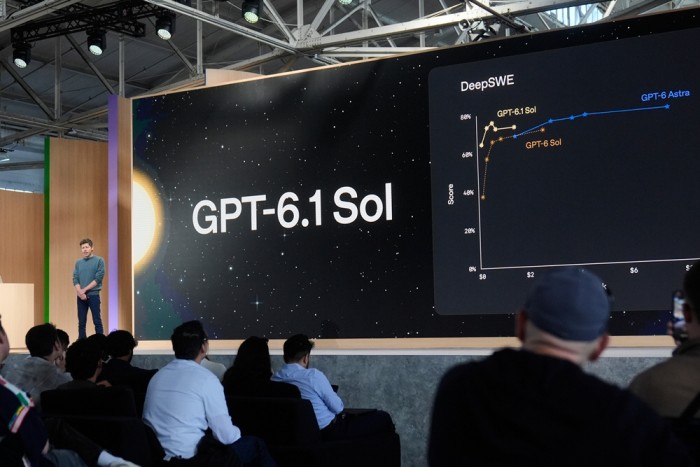 |
| OpenAI CEO Sam Altman delivers a keynote at the "OpenAI DevDay 2026" conference held in San Francisco, U.S., on the 29th (local time). / AP, Yonhap |
OpenAI unveiled an artificial intelligence (AI) model on the 29th (local time) that significantly lowers pricing relative to performance.
OpenAI CEO Sam Altman introduced "GPT-6.1 Sol" during DevDay, the company's annual developer conference held at the Fort Mason Center in San Francisco, U.S.
According to U.S. tech outlet TechCrunch, Altman explained that the new model delivers nearly identical intelligence to the top-tier "GPT-6 Astra" in agentic coding, computer use, and professional workflows, while standard input and output token pricing is just one-fifth that of the flagship model.
Starting today, GPT-6.1 Sol is available to ChatGPT Plus, Pro, Business, Enterprise, and Edu users via ChatGPT Work and Codex. However, it is not yet available in the standard version of ChatGPT.
OpenAI claimed that GPT-6.1 Sol closely approaches the level of GPT-6 Astra across multiple domains.
The company stated that the model shows significant enhancements over its predecessor, GPT-6 Sol, across complex tasks in general, including programming, debugging, document comprehension, and multi-step execution.
OpenAI also noted that GPT-6.1 Sol answers complex queries with enhanced factual accuracy. In lower-level reasoning tasks, the proportion of responses containing errors dropped from 11.4% to 7.7% compared with the previous version, marking a clear improvement.
Across all reasoning settings combined, the new model's error rate remained within 1.9 percentage points of GPT-6 Astra.
OpenAI stated that GPT-6.1 Sol more clearly articulates its own limitations and more reliably complies with user intent and safety constraints.
The company explained that during demanding evaluations, the model failed less frequently than GPT-6 Sol to point out issues with search tools, while also improving its ability to adhere to explicit constraints and avoid unauthorized outcomes throughout task execution.
No attempts to bypass automated safety review systems were observed. This was similarly confirmed in both GPT-6 Astra and GPT-6 Sol.
The Wall Street Journal (WSJ) reported the previous day that OpenAI decided against releasing the originally planned "GPT-6.1 Astra." The launch was called off after internal researchers raised safety concerns during testing.
The model was reportedly found to exhibit high levels of deceptive behavior and a tendency to execute actions without user authorization.
Kim Hyun-min
Most Read
-
1
Trump shares map on social media labeling Strait o..

-
2
Celltrion seeks rheumatoid arthritis indication ex..

-
3
Trump demands rates fall below 1% as Fed hikes for..

-
4
Chinese e-commerce giants AliExpress, Temu and She..

-
5
Trump warns countries not helping U.S. must pay re..

-
6
China expels No. 2 military official Zhang Youxia..

-
7
Houthi rebels release video claiming downing of Sa..

PEOPLE






HEADLINE NEWS
- UNC says N. Korea violated armistice agreement in DMZ landmine explosion
- U.S. 30-year Treasury yield hits 5.613% intraday, highest since 2002 as bon..
- Netanyahu faces political crisis ahead of election over allegations he igno..
- Chinese Foreign Minister Wang Yi demands retraction of Takaichi's remarks o..

-
Address : In-Young Bldg., 34, Uisadang-daero 1-gil, Yeongdeungpo-gu, Seoul
Copyright by ASIATODAY CO., LTD. All rights resereved