



Malaysia begins repatriation of 1,476 Myanmar nationals
Sep 30, 2026, 10:32 am


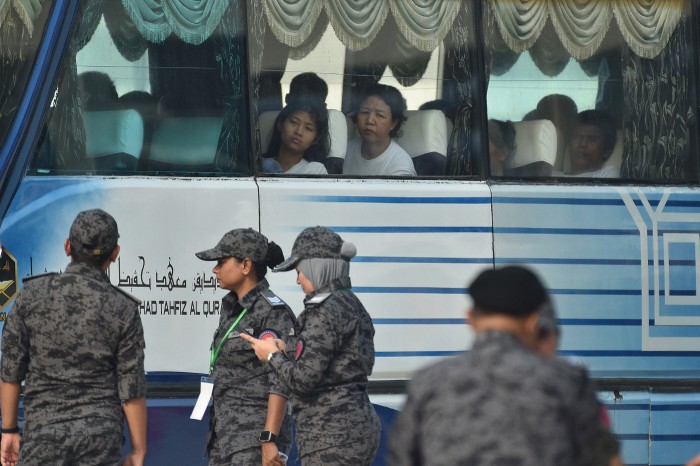 |
| Buses carrying Myanmar nationals being repatriated from Malaysia travel toward a naval base on the outskirts of Kuala Lumpur on the 29th (local time). / AFP, Yonhap News |
The Malaysian government has begun repatriating 1,476 Myanmar nationals held in immigration detention depots to their civil-war-torn homeland. The operation marks the first phase of a broader 5,000-person repatriation agreement between the two governments, proceeding despite warnings from the UN and human rights organizations that returnees could face persecution and forced conscription.
According to Malaysia's state-run Bernama news agency on the 30th (local time), the deportees assembled the previous day from 14 immigration detention centers nationwide at a stadium in Perak state to complete final health screenings and identity verification. They subsequently boarded 46 buses bound for the Lumut Naval Base and embarked onto three Myanmar vessels: one hospital ship and two naval craft. According to the Malaysian Ministry of Home Affairs, the group comprises 1,370 men, 79 women, 20 boys, and 7 girls, with ages ranging from 8 to 60.
The Malaysian Ministry of Home Affairs stated that it initiated the first-phase repatriation following a list submitted by Myanmar via diplomatic note on August 13. The ministry explained that the measure was grounded in the "acceptance agreement of the Myanmar government and the voluntary return consent of the individuals concerned." Officials maintained that they are enforcing the law resolutely to resolve protracted refugee issues while conducting the procedure humanely. Myanmar's Ministry of Foreign Affairs likewise cited a 2021 precedent in which undocumented detainees were repatriated via Myanmar naval ships, describing the operation as an effort to protect and receive nationals who violated immigration laws.
Human rights organizations, however, are questioning the authenticity of the government's claim of voluntary consent. Mahi Ramakrishnan, head of the refugee advocacy group Beyond Borders Malaysia, criticized authorities for entirely barring the UNHCR, the Human Rights Commission of Malaysia, and civil society groups from observing the proceedings, pointing out that there was no prior vetting due to a lack of transparency and accountability regarding who was on the list. She noted reports that many detainees actively resisted repatriation, emphasizing that the move violates the customary international law principle of non-refoulement and effectively pushes individuals into harm's way without safeguards.
Concerns were also raised regarding personal safety threats awaiting the returnees. Debbie Stothard, founder of the regional human rights group Alternative ASEAN Network on Burma (ALTSEAN-Burma), warned that returnees face a high risk of being forcibly conscripted into the junta's military or subjected to detention and torture over suspicions of anti-coup activities. Citing cases of deportees handed over to face conscription in Thailand, she stressed that none of the countries that have sent refugees back to Myanmar have secured channels to track or monitor the safety of returnees.
The UN Refugee Agency (UNHCR) also noted in a statement on the 1st of this month that it was not involved in the repatriation process, adding that the ongoing conflict on the ground prevents safe and dignified returns. The UNHCR highlighted that although Malaysia has not ratified the 1951 Refugee Convention, the prohibition against forcible return to situations where life and freedom would be threatened is a principle of customary international law binding on all nations. Last week, 166 civil society organizations and roughly 140 activists issued a joint statement demanding an immediate halt to repatriations until an assessment of local conditions is finalized.
It remains unclear whether the repatriated group includes members of the persecuted Rohingya Muslim minority. While Prime Minister Anwar Ibrahim previously discussed pursuing Rohingya repatriations, a Myanmar Foreign Ministry official told AP that the measure targets ordinary citizens and is unrelated to the repatriation of Rohingya. Domestically, anti-Rohingya sentiment has been intensifying in Malaysia, with an online petition demanding the deportation of Rohingya gathering over 420,000 signatures.
Controversy has also followed Prime Minister Anwar's decision to invite Min Aung Hlaing, head of the Myanmar junta, to Malaysia under the justification of cooperation on repatriation. In a recent podcast, Anwar defended the move, asking whom they should negotiate with if they avoid direct dialogue with Myanmar following ASEAN's approach. Min Aung Hlaing, the former military commander-in-chief who orchestrated the 2021 coup, assumed the presidency this past April through a general election, though ASEAN does not officially recognize the election results.
Jeong Ri-na
Most Read
-
1
Alteogen secures European patent for Keytruda SC,..

-
2
Trump shares map on social media labeling Strait o..

-
3
Celltrion seeks rheumatoid arthritis indication ex..

-
4
Trump demands rates fall below 1% as Fed hikes for..

-
5
Chinese e-commerce giants AliExpress, Temu and She..

-
6
China expels No. 2 military official Zhang Youxia..

-
7
Houthi rebels release video claiming downing of Sa..

PEOPLE






HEADLINE NEWS
- UNC says N. Korea violated armistice agreement in DMZ landmine explosion
- U.S. 30-year Treasury yield hits 5.613% intraday, highest since 2002 as bon..
- Netanyahu faces political crisis ahead of election over allegations he igno..
- Chinese Foreign Minister Wang Yi demands retraction of Takaichi's remarks o..

-
Address : In-Young Bldg., 34, Uisadang-daero 1-gil, Yeongdeungpo-gu, Seoul
Copyright by ASIATODAY CO., LTD. All rights resereved