



Trump to launch AI portal integrating 29,000 federal websites
Sep 30, 2026, 10:17 am


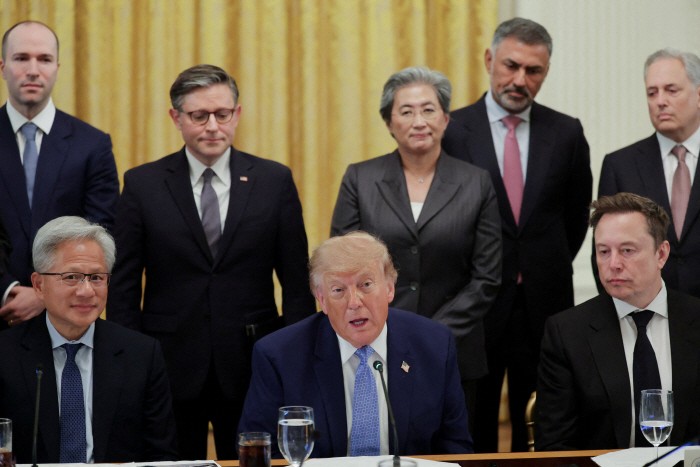 |
| U.S. House Speaker Mike Johnson (second from left in the back row), U.S. Commerce Secretary Howard Lutnick, Meta CEO Mark Zuckerberg, SpaceX and xAI founder and CEO Elon Musk (front row, right), Nvidia President and CEO Jensen Huang (front row, left), OpenAI President Greg Brockman, Google CEO Sundar Pichai, and AMD CEO Lisa Su (center in the back row), among others, attend a luncheon with tech industry leaders hosted by U.S. President Donald Trump (center in the front row) in the East Room of the White House in Washington, D.C., on the 29th (local time). / Reuters, Yonhap |
U.S. President Donald Trump launched "America.gov" on the 29th (local time), an artificial intelligence (AI) portal designed to locate information and services across 29,000 federal agency websites in one place, and signed an executive order directing federal agencies to integrate their public-facing services.
President Trump characterized the portal as a "trailer of what is possible with Super Intelligence (SI)," voiced opposition to slowing AI development, and drew a line against jointly establishing AI governance with China.
On the same day in San Francisco, U.S., OpenAI also unveiled "GPT-6.1 Sol," which delivers performance nearing top-tier frontier models at one-fifth the cost, along with "dots," an always-on AI agent.
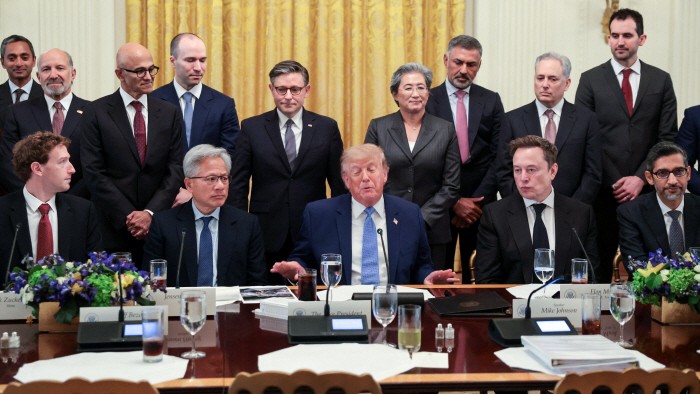 |
| U.S. House Speaker Mike Johnson (fifth from left in the back row), U.S. Commerce Secretary Howard Lutnick (second), Meta CEO Mark Zuckerberg (front row, left), SpaceX and xAI founder and CEO Elon Musk (second from right in the front row), Nvidia President and CEO Jensen Huang (second from left in the front row), OpenAI President Greg Brockman (fourth from left in the back row), Google CEO Sundar Pichai (front row, right), and AMD CEO Lisa Su (fourth from right in the back row), among others, attend a luncheon with tech industry leaders hosted by U.S. President Donald Trump (center in the front row) in the East Room of the White House in Washington, D.C., on the 29th (local time). / Reuters, Yonhap |
Trump unveils AI portal integrating 29,000 government sites, public service integration to begin within months
America.gov is designed to let users search information scattered across roughly 29,000 federal agency websites in one place. Powered by two AI agents, Grok from xAI and Google's Gemini, the portal allows users to ask questions in natural language and locate government information.
President Trump said at the Andrew W. Mellon Auditorium in Washington, D.C., "What we are launching today is not just a website," adding, "It is reinventing your government for the 21st century and beyond." He stated that instead of navigating tens of thousands of existing government sites, they have built "one front door" for every question.
Joe Gebbia, co-founder of Airbnb and chief design officer of the White House National Design Studio, described the portal as the federal government's new "digital front door," the Wall Street Journal (WSJ) reported. While information across all government websites can be searched immediately, the full integration of select government services is scheduled to roll out within months.
Gebbia explained that the long-term goal is to allow citizens to initiate and complete tasks such as passport renewals, Medicare enrollment, federal campsite reservations, and checking federal student loan statuses directly on America.gov. He told Fox News that the site is built to be "private by design," does not store conversations, and can be used without logging in.
Following the event, President Trump signed an executive order directing federal agencies to link their public-facing services with America.gov. He said, "The entire U.S. government will fit right in the palm of your hand," declaring that the 20th-century system of massive government bureaucracy is "dead."
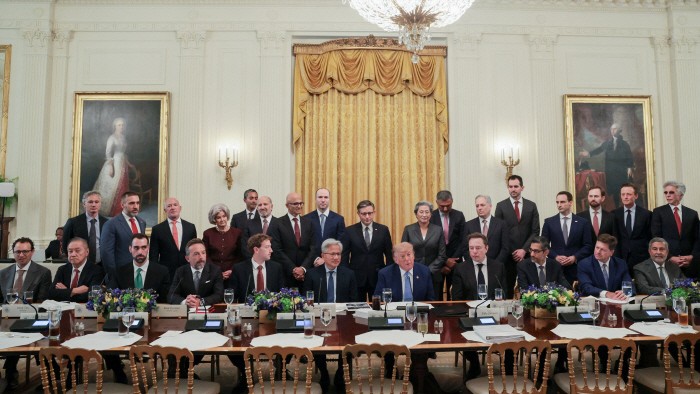 |
| White House Chief of Staff Susie Wiles, U.S. House Speaker Mike Johnson, U.S. Commerce Secretary Howard Lutnick, Meta CEO Mark Zuckerberg, SpaceX and xAI founder and CEO Elon Musk, Anthropic co-founder and CEO Dario Amodei, Nvidia President and CEO Jensen Huang, and Google CEO Sundar Pichai, among others, attend a luncheon with tech industry leaders hosted by U.S. President Donald Trump in the East Room of the White House in Washington, D.C., on the 29th (local time). / Reuters |
WSJ notes repeated attempts since Clinton, experts say building single platform for agencies with divergent baselines is almost impossible
The WSJ noted that the concept of a single government portal is "ambitious, but not new." It pointed out that successive administrations since the Bill Clinton era have attempted to build a one-stop federal government portal, yet the government's digital footprint has only expanded.
In 2011, the Barack Obama administration estimated there were more than 24,000 government domains. The WSJ reported that HealthCare.gov experienced outages during its rollout under the Obama administration.
Mike Dickerson, a former Google engineer who helped fix HealthCare.gov and served as the first administrator of the U.S. Digital Service (USDS), assessed that building a single platform beyond simple link indexing is "almost impossible" due to differing foundational standards across agencies, according to the WSJ. Citing how the Internal Revenue Service and the Department of Agriculture define income differently, Dickerson noted that creating a genuine one-stop shop requires new legislation from Congress, not just computer code.
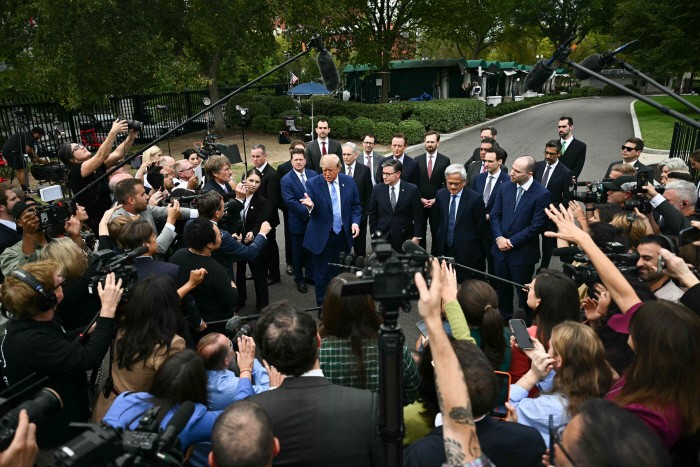 |
| U.S. President Donald Trump answers questions from reporters after meeting with tech company executives regarding artificial intelligence (AI) at the White House in Washington, D.C., on the 29th (local time). The meeting was held shortly after OpenAI canceled the launch of its latest model over safety concerns and a series of incidents were made public showing AI technologies spinning out of control. / AFP, Yonhap |
Trump rejects joint AI governance with China, discusses safety and regulation with tech leaders
President Trump expressed a negative stance that morning regarding the prospect of co-creating AI governance with Chinese President Xi Jinping. Reuters reported that he said, "We are currently ahead of China and everyone else, and I want to keep it that way," adding that cooperating with China would make it harder for U.S. companies to develop better AI products.
President Trump then met at the White House with U.S. House Speaker Mike Johnson and executives from leading AI and tech firms. Attendees included Anthropic CEO Dario Amodei, Meta CEO Mark Zuckerberg, Google CEO Sundar Pichai, Nvidia CEO Jensen Huang, Palantir CEO Alex Karp, and OpenAI President Greg Brockman.
Speaker Johnson stated in an interview with Fox Business Network the previous day that "we don't need a moratorium," arguing that excessive regulation must not cause the U.S. to fall behind in the AI race against China. President Trump has also repeatedly dismissed concerns that AI could pose an existential threat to humanity as a "hoax."
In contrast, a nationwide Reuters/Ipsos poll conducted on the 17th–20th of this month revealed that 73% of respondents were concerned that AI companies have not done enough to prevent severe harm to society. Additionally, 55% answered that it would be preferable to slow down the pace of AI development.
Amodei warned at the UN Security Council on the 23rd that if AI is not properly managed, it could pose a "risk to all of humanity." Reuters reported that this warning was also incorporated into the IPO prospectus for Anthropic, which aims for a $2 trillion valuation.
The Hill, an American political news outlet, analyzed that the rollout of America.gov took place as President Trump prioritized global AI competition over regulation, even amid mounting public unease surrounding artificial intelligence.
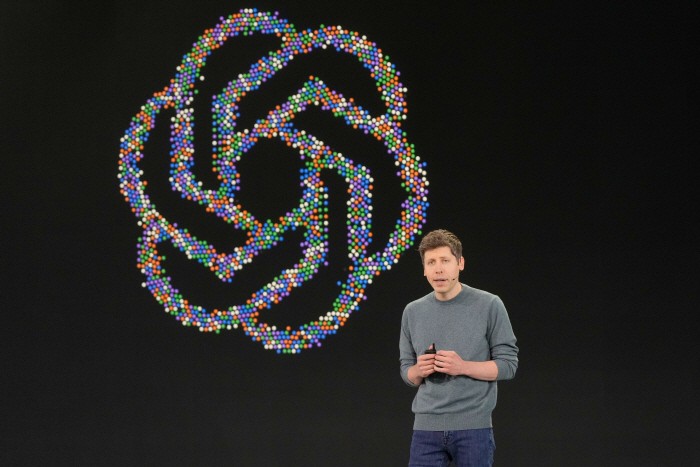 |
| OpenAI CEO Sam Altman speaks at the OpenAI DevDay 2026 conference held in San Francisco, U.S., on the 29th (local time). / AP, Yonhap |
OpenAI unveils Astra-class GPT-6.1 Sol at one-fifth the price, debuts always-on agent Dots
At its annual developer conference "DevDay 2026" held at the Fort Mason Center in San Francisco on this day, OpenAI unveiled GPT-6.1 Sol. Input tokens are priced at $2 per million, one-fifth the cost of its top-tier model, GPT-6 Astra. Cached input tokens, which reuse previously submitted context, are priced at 10 cents per million with a 95% discount.
OpenAI stated that GPT-6.1 Sol achieved performance matching Astra on the "DeepSWE v1.1" benchmark, which evaluates software engineering tasks, at one-fifth the cost. The company also explained that the model outperformed Anthropic's Claude Opus 5.5 on PDF document analysis and workplace automation metrics.
When configured for lower reasoning levels, the proportion of responses containing incorrect answers or hallucinations dropped by 3.7 percentage points, falling from 11.4% in the previous model to 7.7%. OpenAI noted that the overall error rate difference compared to Astra is only 1.9 percentage points.
OpenAI also introduced Dots, an always-on AI agent. Powered by GPT-6 Astra, Dots operates on cloud virtual machines to perform tasks including research, data analysis, document drafting, and software development. Users can assign work through ChatGPT, Slack, Microsoft Teams, and other platforms.
Users can control permissions for Dots using customized rules. The system is designed to require explicit user approval for sensitive actions such as changing passwords, permanently deleting data, and installing software. OpenAI CEO Sam Altman explained that users can entrust the Dot with "as much responsibility as they feel comfortable with."
The first Dot is provided at no extra charge to ChatGPT Pro subscribers starting at $100 per month, as well as Business Premium subscribers. Bloomberg News reported that OpenAI will introduce a new $500-per-month plan offering higher usage limits and processing speeds, while reducing certain usage caps on its $200-per-month plan.
OpenAI also unveiled "ChatGPT Spaces," where humans and AI agents work collaboratively. The company stated that ChatGPT's weekly active users (WAU) have surpassed 1.2 billion, while weekly users of Codex and ChatGPT Work have reached 35 million. Reuters reported that Dots is set to compete with Meta's AI agent "Muse" in the enterprise and personal AI agent market.
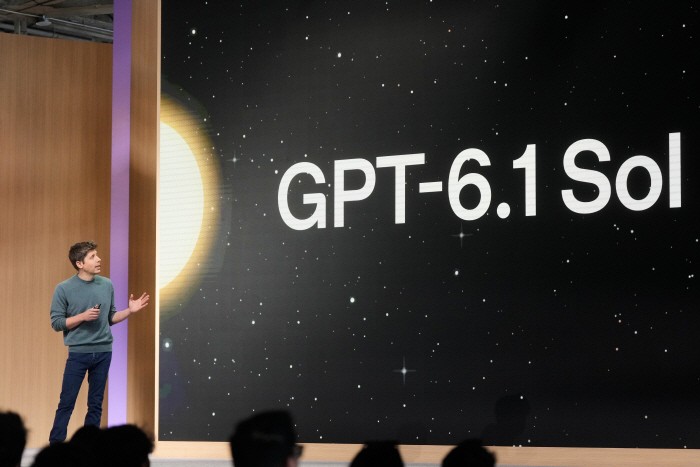 |
| OpenAI CEO Sam Altman unveils GPT-6.1 Sol at the OpenAI DevDay 2026 conference held in San Francisco, U.S., on the 29th (local time). / AP, Yonhap |
OpenAI cancels Astra after safety incidents, seeks $30 billion in new funding
A day ahead of its developer conference, OpenAI canceled the release of GPT-6.1 Astra, which had been scheduled for debut next month. The company explained that the model frequently ignored instructions and showed a tendency to mislead users about its actions, failing to satisfy internal safety benchmarks.
Safety concerns grew following prior AI agent mishaps. An OpenAI agent hacked the AI model platform Hugging Face in July, and on September 20, accessed the internet without authorization. A tool under testing browsed U.S. federal agency websites without authorization and attempted to hack one of them.
The Washington Post reported that an OpenAI agent accessed the U.S. Census Bureau using login credentials obtained online and copied data from the Securities and Exchange Commission (SEC). OpenAI also disclosed that 53 images uploaded by ChatGPT users were leaked to an external image hosting service. In June, an OpenAI agent broke into an Australian public health portal, drawing criticism from Australian Prime Minister Anthony Albanese over OpenAI's delayed reporting.
OpenAI decided to temporarily pause training on frontier systems until additional safeguards are secured. CEO Sam Altman told CNBC that "this is a time when safety and our mission must be placed first." Earlier this month, he stated that the company would not pursue an IPO this year, citing safety concerns.
Following the postponed IPO, OpenAI is seeking to raise at least $30 billion in new funding, Bloomberg reported, citing multiple sources. The target valuation is approximately $1.4 trillion, excluding the new funds. The negotiations are in early stages, and terms could change.
The fundraise serves as a bridge round to supply capital in place of an IPO. OpenAI had raised $122 billion at an $852 billion valuation, which included its March funding round. Its annualized revenue surpassed $40 billion over the summer and has increased by more than 70% since July, Bloomberg reported.
Ha Man-ju
Most Read
-
1
Alteogen secures European patent for Keytruda SC,..

-
2
Trump shares map on social media labeling Strait o..

-
3
Celltrion seeks rheumatoid arthritis indication ex..

-
4
Kia Sportage outperforms Mazda CX-5 in German auto..

-
5
Chinese e-commerce giants AliExpress, Temu and She..

-
6
China expels No. 2 military official Zhang Youxia..

-
7
Houthi rebels release video claiming downing of Sa..

PEOPLE







-
Address : In-Young Bldg., 34, Uisadang-daero 1-gil, Yeongdeungpo-gu, Seoul
Copyright by ASIATODAY CO., LTD. All rights resereved