



Hormuz crude oil exports recover to 80 percent, neutralizing Iran's blockade
Sep 29, 2026, 04:18 pm


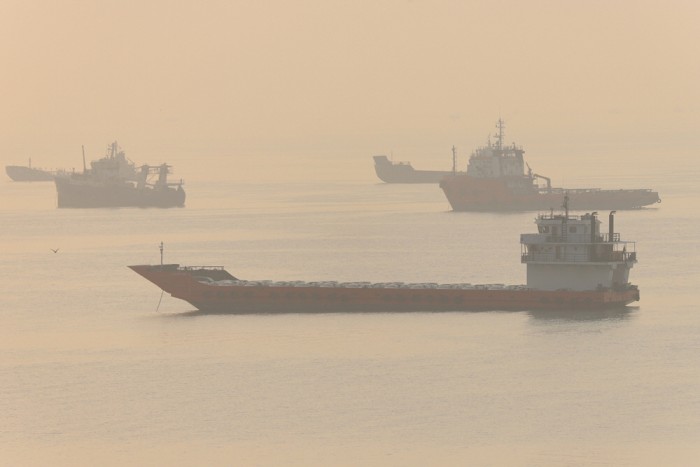 |
| Vessels sail through the Strait of Hormuz off the coast of Bandar Abbas, Iran, on the 28th local time. / Reuters, Yonhap |
As the U.S. Navy and Middle Eastern oil-producing nations establish transport networks bypassing Iran's blockade in the Strait of Hormuz, crude oil exports have recovered to roughly 80 percent of pre-conflict levels, prompting analysis that Iran's strategy of using global energy supplies as leverage to pressure the U.S. is losing steam.
According to The Wall Street Journal on the 28th local time, data analytics firm Kpler reported that crude oil export volumes passing through the Strait of Hormuz and alternative bypass routes as of last week neared approximately 80 percent of levels seen prior to the Middle East conflict.
Starting this month, crude oil volumes exported by major Middle Eastern producers such as Saudi Arabia, Iraq, and the United Arab Emirates through these routes rose to about 13 million barrels per day.
Ship-tracking firm Huax explained that crude oil exports from the region reached their highest level since February this year, when shipments stood at roughly 19 million barrels per day.
Saudi Arabia has resumed crude oil transport through damaged pipelines and has begun loading tankers in the Red Sea, according to people familiar with the matter.
Transport volumes, however, remain limited. A portion of the crude produced is being supplied to Saudi refineries.
Iran has been unable to transport crude oil through the Strait of Hormuz since the U.S. resumed its maritime blockade in July.
Kpler projected that Iran's crude stockpiles held outside the blockade network could be exhausted around mid-October.
This could result in cutting off a vital revenue source for Iran at a time when it faces severe economic strain from U.S. sanctions and war-related burdens.
These developments are neutralizing Iran's strategy to gain leverage in negotiations with the U.S. by weaponizing its capacity to control global energy supplies.
At the same time, this dynamic provides dangerous incentives for Iran. With Middle Eastern nations finding alternatives by securing bypass routes for oil exports, Iran is increasingly likely to resort to renewed physical attacks as virtually its sole remaining means to pressure the U.S.
Sanam Vakil, director of the Middle East and North Africa Programme at the London-based think tank Chatham House, remarked that Iran's approach to the Strait of Hormuz is steadily losing its utility, adding that this could lead to a situation where Iran feels compelled to provoke larger clashes or spark explosive incidents to escape its predicament.
Kim Hyun-min
Most Read
-
1
Trump shares map on social media labeling Strait o..

-
2
Trump demands rates fall below 1% as Fed hikes for..

-
3
Celltrion seeks rheumatoid arthritis indication ex..

-
4
Chinese e-commerce giants AliExpress, Temu and She..

-
5
Trump warns countries not helping U.S. must pay re..

-
6
China expels No. 2 military official Zhang Youxia..

-
7
Houthi rebels release video claiming downing of Sa..

PEOPLE






HEADLINE NEWS
- N. Korea declares nuclear status irreversible and condemns S. Korea, U.S., Japan at UN
- Japan tracks Ukraine fiber-optic drones, bolsters SDF electronic warfare
- Wave of undocumented Chinese caught in Argentina after Brazil's visa-free m..
- France's far-right National Rally forms first-ever parliamentary group in S..

-
Address : In-Young Bldg., 34, Uisadang-daero 1-gil, Yeongdeungpo-gu, Seoul
Copyright by ASIATODAY CO., LTD. All rights resereved