



With 20 percent of doctorate holders in Beijing, China's talent concentration sounds alarm
Sep 29, 2026, 03:50 pm


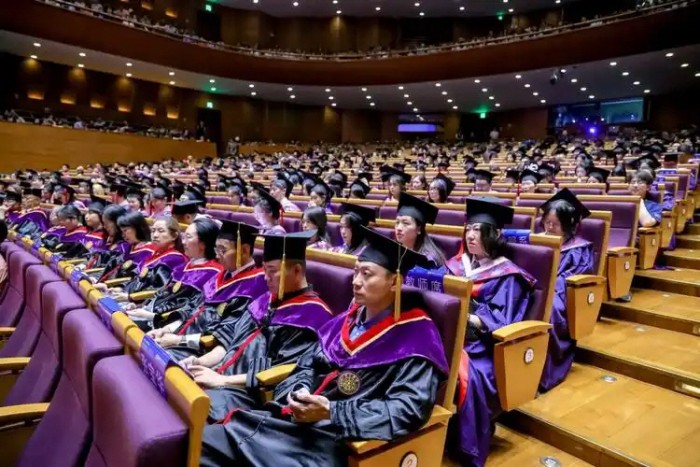 |
| Graduates attending the 2026 commencement ceremony at Tsinghua University, one of China's most prestigious institutions. Most of the doctoral degree recipients among them intend to reside in major cities, including Beijing. / Beijing News |
China's national competitiveness is being analyzed as facing severe challenges due to an excessive preference among doctorates and super talents for living in major cities such as Beijing. Ultimately, this is viewed as an inevitable stumbling block to China's ambition to replace the U.S. as the leading global superpower around 2035.
According to recent reports by media outlets including the Beijing News, the number of individuals who obtained doctoral degrees from Chinese universities and research institutes after 1983, when the academic system crippled by the Cultural Revolution in the 1960s and 1970s was normalized, is estimated at about 1.2 million as of the end of 2025. Given the popular quip that there are more PhDs than donkeys these days, this might seem enormous.
However, considering China's population of 1.4 billion, it can hardly be called large. Looking at statistics showing that doctorate holders aged 25 and older accounted for merely 0.12 percent of the total population as of late 2025, that reality becomes clear. It is entirely incomparable to the U.S. at 2.09 percent, not to mention Germany at 1.51 percent and the UK at 1.08 percent.
This is not all. The fact that R&D personnel stand at a mere 1,585 per million people also clearly illustrates that China's talent pool is at a severely deficient level. This reveals a staggering gap when compared directly to South Korea's 8,714, with no need to even mention the U.S., where the figure is estimated to easily exceed 10,000.
The issue lies in the fact that these scarce talents, so desperately needed by Chinese authorities, completely turn away from regions outside major cities like Beijing. This reality is readily apparent considering that an estimated 230,000 doctoral degree holders, or nearly 20 percent of China's total, reside in Beijing. The same holds true for students currently pursuing doctoral degrees. As of the end of 2025, roughly 175,000 individuals, or about 25 percent of the approximately 700,000 doctoral candidates nationwide, are estimated to be pursuing their studies in Beijing.
If the scope is expanded to Shanghai, where nearly half that of Beijing or some 115,000 doctorates reside, and Jiangsu Province, the figure nears a staggering 40 percent. Chen Yongqiang, a doctoral candidate in artificial intelligence at Beijing University of Posts and Telecommunications, stated, "Talents seeking doctoral degrees prefer megacities. Those heading to the provinces are viewed as losers," adding that none of his colleagues or acquaintances ever consider living in the provinces, a sentiment that is not without reason.
From China's standpoint, there are certainly benefits when talents concentrate in innovation hubs such as Beijing, Shanghai, and Shenzhen in Guangdong Province. The agglomeration effect, which significantly boosts R&D productivity, is a prime example. Yet the drawbacks far outweigh the gains. This is demonstrated by the single fact that severe job mismatching stemming from hyper-competition among talents in megacities leads to a massive waste of human resources.
Adding to this the worsening challenge provinces face in securing high-caliber talent makes the situation even more acute. Enhancing national competitiveness will inevitably remain a remote prospect. The picture turns even bleaker considering that the preference for major cities among an estimated 400,000 overseas doctorate holders over the past 40-odd years has been just as pronounced, if not more so. Concerns among Chinese authorities are bound to deepen further.
Hong Soon-do
Most Read
-
1
Trump shares map on social media labeling Strait o..

-
2
Trump demands rates fall below 1% as Fed hikes for..

-
3
Celltrion seeks rheumatoid arthritis indication ex..

-
4
Chinese e-commerce giants AliExpress, Temu and She..

-
5
Trump warns countries not helping U.S. must pay re..

-
6
China expels No. 2 military official Zhang Youxia..

-
7
Houthi rebels release video claiming downing of Sa..

PEOPLE






HEADLINE NEWS
- N. Korea declares nuclear status irreversible and condemns S. Korea, U.S., Japan at UN
- Japan tracks Ukraine fiber-optic drones, bolsters SDF electronic warfare
- Wave of undocumented Chinese caught in Argentina after Brazil's visa-free m..
- France's far-right National Rally forms first-ever parliamentary group in S..

-
Address : In-Young Bldg., 34, Uisadang-daero 1-gil, Yeongdeungpo-gu, Seoul
Copyright by ASIATODAY CO., LTD. All rights resereved