



Southeast Asia leads world in support for international cooperation, rejects both U.S. and Chinese dominance
Sep 23, 2026, 09:48 am


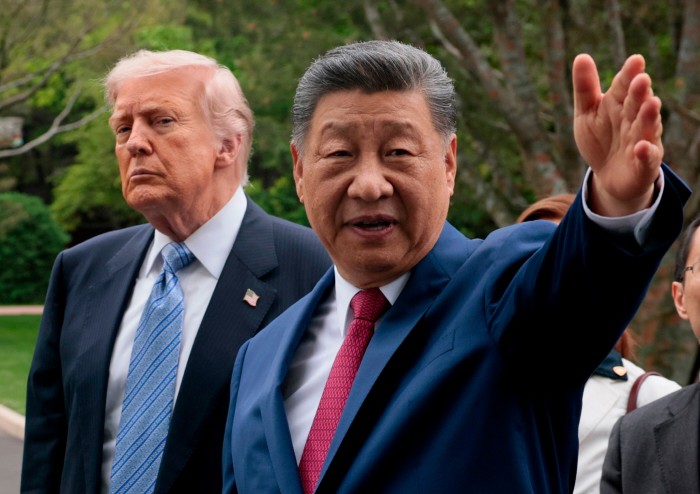 |
| Chinese President Xi Jinping welcomes U.S. President Donald Trump (left) at Zhongnanhai in Beijing on May 15. / AP, Yonhap News |
An international survey has revealed that while Southeast Asian nations express stronger confidence in international cooperation than any other region in the world, they remain averse to either the U.S. or China seizing global leadership.
According to the South China Morning Post (SCMP) on the 22nd (local time), 63% of respondents in Southeast Asia stated that "international cooperation is working effectively," as cited in the report "Seeking Security and Opportunity in a Stormy World" released this month by the U.S. Rockefeller Foundation. This figure significantly outpaces Western developed regions, such as the U.S. and Canada (37%), Oceania (32%), and Western Europe (31%). The survey polled more than 35,000 individuals across 34 countries worldwide, with Indonesia, the Philippines, and Singapore included from the Southeast Asian region.
Conversely, vigilance regarding an international order dominated by the U.S. and Chinese superpowers was pronounced. Across all surveyed participants, only 39% answered that they were comfortable with the U.S. taking on a global leadership role, while a similar 37% responded favorably toward China. Instead, 61% of respondents favored an approach in which countries cooperate to address global challenges without any single superpower dominating the agenda.
Threat perceptions varied sharply by country depending on their specific security environments. In Indonesia, 73% of respondents cited the U.S. as a "major threat," more than double the proportion pointing to China (31%). In contrast, in the Philippines, a claimant in the South China Sea territorial disputes, 70% labeled China as a threat, compared to just 33% who named the U.S. In Singapore, which maintains close security cooperation with Washington, 41% viewed the U.S. as a threat, outpacing China at 25%.
Diplomatic and security experts assessed that despite these divergences, Southeast Asia cannot simply be bifurcated into pro-U.S. or pro-China camps.
Alejandro Reyes, a senior fellow at the Centre on Contemporary China and the World at the University of Hong Kong, observed, "While the power of the U.S. and China is widely recognized, the appetite to accept either as the dominant leader of the international system is far lower. Southeast Asian countries are resisting the pressure to make a binary choice and are instead balancing between the two major powers on an issue-by-issue basis."
Joanne Lin, a senior fellow at the ASEAN Studies Centre of the ISEAS-Yusof Ishak Institute in Singapore, similarly pointed out, "While the U.S. and China remain the two major powers exercising the greatest influence in Southeast Asia, high influence does not equate to being welcomed. Small states, feeling uneasy about arbitrary rule-making by major powers in an order where might makes right, are seeking alternative solidarity that is not dominated by either side."
Observers also note that favorable views toward China do not entirely erase structural security anxieties. Addressing impressions that the survey reflects favorably on China, Collins Chong Yew Keat, a foreign affairs and security strategist at Universiti Malaya, evaluated the finding as "a temporary perceptual edge rather than a sign of an irreversible geopolitical realignment." He emphasized, "While Southeast Asia relies heavily on Chinese capital, infrastructure, and vast markets, U.S. tariff policies, political uncertainties, and Middle East policies have negatively affected Washington's image. However, economic incentives should not be confused with the resolution of strategic anxieties."
Ultimately, analysts argue that the overarching goal for Southeast Asian middle powers is securing "strategic autonomy." Charmaine Misalucha-Willoughby, an international relations professor at De La Salle University in Manila, explained, "For middle powers entangled with superpowers, exercising greater agency is an insurance policy against future risks. It is a matter of preparing for a world without the U.S. or China."
Lin recommended that ASEAN (the Association of Southeast Asian Nations) weave dense, multilayered partnerships with South Korea, Japan, the European Union (EU), Australia, India, and Canada across trade, climate, technology, and security. The goal is to broaden options rather than remain bound to a single hegemon.
However, realistic limitations remain, as middle-power coalitions cannot completely substitute for the tangible security role played by superpowers. Analyst Chong noted, "While middle-power cooperation can serve as a strategic buffer, it cannot replace U.S. military capability, alliance networks, and deterrence. Southeast Asia taking a more critical stance toward the U.S. does not mean it seeks a diminished U.S. role; that is precisely the essence and long-standing dilemma of Southeast Asia's hedging strategy."
Jeong Ri-na
Most Read
-
1
Trump demands rates fall below 1% as Fed hikes for..

-
2
Chinese e-commerce giants AliExpress, Temu and She..

-
3
Trump warns countries not helping U.S. must pay re..

-
4
Turkish Airlines named main club partner of Liverp..

-
5
China expels No. 2 military official Zhang Youxia..

-
6
Houthi rebels release video claiming downing of Sa..

-
7
U.S. allows Iranian delegation to attend UN Genera..

PEOPLE







-
Address : In-Young Bldg., 34, Uisadang-daero 1-gil, Yeongdeungpo-gu, Seoul
Copyright by ASIATODAY CO., LTD. All rights resereved