



Kakao Impact Foundation expands AX adoption in social innovation sector
Sep 23, 2026, 09:44 am


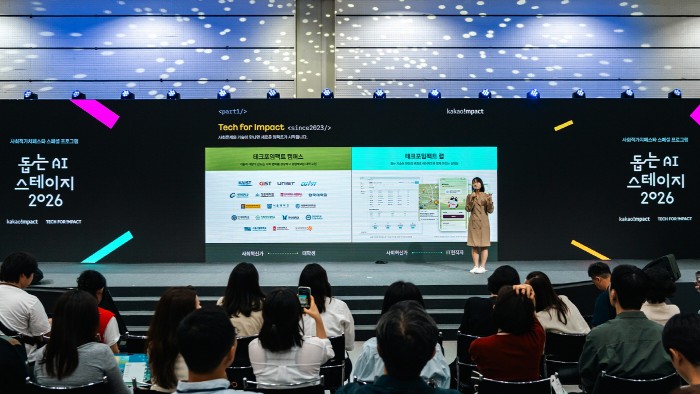 |
A representative from the Kakao Impact Foundation presents cases of AI transformation (AX) in social innovation at the 3rd Social Value Festa Korea held at COEX in Seoul on the 22nd. / Kakao
The Kakao Impact Foundation has disclosed its own AI transformation (AX) journey alongside practical applications in social innovation fields. Following support for staff AI utilization, the proportion of team members who experienced work process improvements surged from 29% to 65% within four months, prompting the foundation to also release a dedicated guide to assist social innovation organizations in navigating AX.
The Kakao Impact Foundation announced on the 23rd that it shared its AX experiences and field applications while participating in the 3rd Social Value Festa Korea, held from the 21st to the 22nd at COEX in Seoul.
Hosted by the Korea Chamber of Commerce and Industry (KCCI), the Social Value Festa Korea brings together corporations, government bodies, academia, and social innovation organizations to exchange solutions for social challenges and highlight cooperative initiatives. The Kakao Impact Foundation participated for the second consecutive year following last year.
Setting up the "Helping AI Stage" on the main stage, the foundation presented the outcomes of its internal AX initiatives conducted since April. The foundation supported employee AI adoption, encouraged internal sharing of related experiences, and periodically evaluated resulting operational shifts.
As a result, the share of employees reporting work process enhancements through AI jumped from 29% in April to 65% by the end of August. On average, staff perceived a daily working time reduction of 107 minutes through AI utilization.
The foundation also unveiled real-world examples of applying AI to social innovation initiatives. Operating the "Tech for Impact LAB," where social innovators collaborate with IT specialists to engineer technologies, the foundation is expanding its support this year to include AX and technological upgrades for related organizations to ensure field-level sustainability.
A prominent example is Caring Note, a medication consultation recording and analysis service developed jointly by the non-profit organization Neulpum Gachi and IT professionals. By transcribing consultation dialogues and automatically generating medication records with AI, the service reduced record management time to one-third of previous levels.
With administrative burdens alleviated, the operational scale in the field expanded significantly. Over the 18 months following implementation, consultation sessions at the "Visiting Medication Counseling Center" rose from 10 to 53, while clients served grew from 120 to 437. The number of participating pharmacists also increased from 6 to 30.
Since May, the foundation has been supporting Neulpum Gachi in planning and refining required field features directly using AI-assisted coding tools.
On the same day, the foundation also released the "AX Guide for the Social Innovation Ecosystem." The guide outlines a five-step AX roadmap: establishing AI usage standards for each organization, setting up personnel and data environments, measuring and inspecting changes, and expanding deployment organization-wide. It also incorporates evaluation questions and benchmark criteria to assess organizational workflows and current AI proficiency.
Ryu Seok-young, chair of the Kakao Impact Foundation, said, "AI is a technology capable of accelerating how non-profit organizations solve social issues. By sharing the experiences and trial-and-error we gained from being early adopters and integrating AI into our operations, we will work together with the ecosystem to create tangible ways AI can contribute to solving social problems."
Son Kang-hoon |
Most Read
-
1
Celltrion nears additional contract with major U.S..

-
2
Putin proposes trilateral U.S.-China-Russia summit..

-
3
U.S. weighs dropping MOAB, world's most powerful n..

-
4
"Aren't those foreigners on welfare?": M..

-
5
Attention centers on APEC for possible Trump-Xi-Pu..

-
6
Saudi Arabia, Iran hold first diplomatic talks to..

-
7
Saudi airport in Riyadh struck again, leaving at l..

PEOPLE







-
Address : In-Young Bldg., 34, Uisadang-daero 1-gil, Yeongdeungpo-gu, Seoul
Copyright by ASIATODAY CO., LTD. All rights resereved