



Lee vows to lay groundwork for talks among parties toward Korean Peninsula peace regime
Sep 23, 2026, 09:02 am


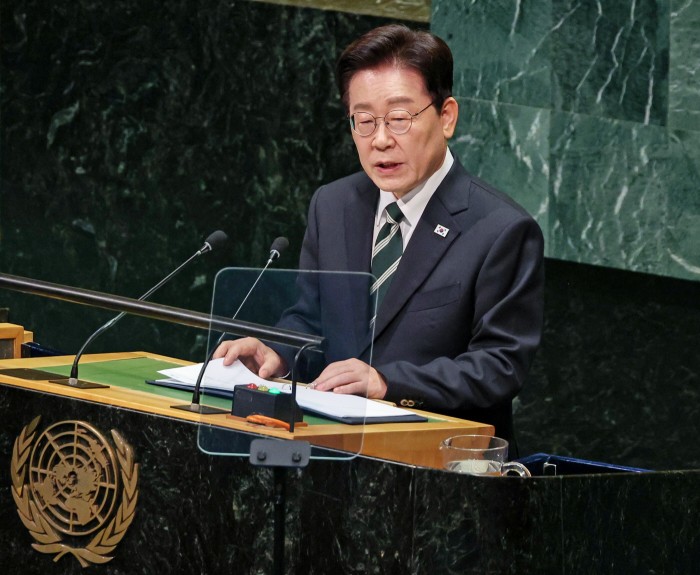 |
| President Lee Jae-myung delivers a keynote address at the United Nations General Assembly hall in New York on the 22nd local time. / Yonhap News |
President Lee Jae-myung touched on the prospect of North Korea-U.S. dialogue on the 22nd local time, emphasizing that South Korea will work to lay the groundwork so that long-stalled talks between Pyongyang and Washington can resume swiftly and evolve into dialogue among the parties concerned to end the war on the Korean Peninsula and establish a peace regime.
Delivering a keynote address at the UN high-level session in New York during his visit to the U.S., President Lee stated that the determination of U.S. President Donald Trump has fortunately created a hard-won opening for change in dialogue with North Korea.
With this, he presented the international community with a roadmap under which North Korea and the U.S. would resume dialogue first, after which South Korea and China would join discussions to consult on transitioning to a peace regime on the Korean Peninsula.
President Lee previously made a similar proposal for "dialogue among the parties concerned to end the war" during his Liberation Day address.
President Lee noted that establishing a peace regime on the Korean Peninsula has long been recognized as a necessary task discussed not only by the two Koreas but also by relevant countries including the U.S. and China. He then introduced a three-point blueprint for North Korea policy centered on "peaceful coexistence that is inclusive, stable, and contributing to world peace."
Regarding "inclusive peaceful coexistence," President Lee said South Korea will pursue shared growth through cooperation based on mutual respect for each other's systems and recognition of differences.
He added that South Korea will respect the North on the international stage and cooperate where cooperation is warranted, expressing hope that paths will open for multilateral cooperation in areas such as public health, disaster response, and the climate crisis.
Turning to "stable peaceful coexistence," President Lee outlined plans to build institutional mechanisms to prevent crises and manage conflict.
He remarked that restoring basic communication channels and rebuilding trust will be the crucial first step toward stable peaceful coexistence.
On "peaceful coexistence contributing to world peace," President Lee pledged to actively join efforts toward a world free from war and conflict, moving beyond a war-free, nuclear-free Korean Peninsula to foster stability and cooperation across Northeast Asia.
President Lee stressed that the most critical task above all is bringing an end to the prolonged war on the Korean Peninsula and establishing a peace regime. He expressed confidence that dialogue aimed at building a peace regime will serve as an effective framework not only for normalizing ties among the parties involved, but also for fostering shared growth through multilateral cooperation, as well as advancing stability and partnership in Northeast Asia.
President Lee also laid out a phased approach to denuclearization, which calls for halting the advancement of North Korea's nuclear and missile capabilities, reducing them, and ultimately achieving a nuclear-free Korean Peninsula.
He noted that the immediate priority would be halting the advancement of the North's nuclear and missile capabilities, followed by their reduction in the medium term, ultimately moving toward a nuclear-free Korean Peninsula over the long term.
In closing, President Lee expressed hope that the United Nations, which has shaped decisive turning points for peace on the peninsula, along with the Security Council, which has safeguarded global peace and stability, will play a responsible and constructive role. He promised that the South Korean government, as a key stakeholder and peacemaker, will do everything in its power to open and sustain the path of dialogue.
Hong Sun-mi
Most Read
-
1
Celltrion nears additional contract with major U.S..

-
2
"Aren't those foreigners on welfare?": M..

-
3
Houthis launch successive attacks on Saudi airport..

-
4
Saudi Arabia, Iran hold first diplomatic talks to..

-
5
Saudi airport in Riyadh struck again, leaving at l..

-
6
U.S. deploys carrier, 10,000 more troops to Middle..

-
7
Five ASEAN countries welcome Myanmar coup leader

PEOPLE






-
Address : In-Young Bldg., 34, Uisadang-daero 1-gil, Yeongdeungpo-gu, Seoul
Copyright by ASIATODAY CO., LTD. All rights resereved