



Far-right AfD tops another local election as Merz’s conservatives suffer heavy defeat
Sep 21, 2026, 01:04 pm


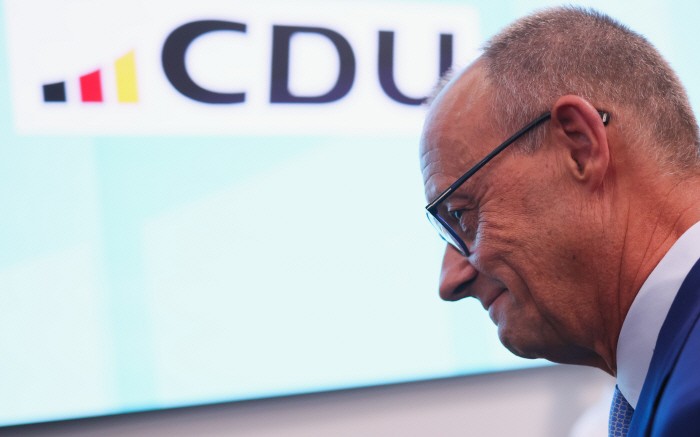 |
| German Chancellor Friedrich Merz holds a press briefing following the conclusion of the Berlin state election in Berlin, Germany, on the 20th (local time). /EPA, Yonhap |
Germany's far-right Alternative for Germany (AfD) party sent shockwaves through German politics with consecutive victories in state elections. In contrast, the mainstream conservative bloc led by German Chancellor Friedrich Merz's Christian Democratic Union (CDU) received its worst scorecard since 1949, plunging into a political crisis, Reuters reported on the 20th (local time).
According to German public broadcaster ZDF, the AfD garnered 38.2 percent of the vote in the northeastern state of Mecklenburg-Western Pomerania's parliament election, taking first place ahead of the center-left Social Democratic Party (SPD), which won 35.5 percent. With this result, the AfD placed first in a state-level election for the second time this month alone.
On the other hand, Chancellor Merz's CDU managed only 4.9 percent of the vote, falling short of the 5 percent electoral threshold for parliament entry and facing the risk of being ousted from the state legislature.
The established political order was also heavily shaken in the capital's Berlin state election held on the same day. The far-left Left Party (Die Linke) came in first for the first time in its history, capturing 25.7 percent. Led by Elif Eralp, dubbed the "Mamdani of Berlin," the Left Party has championed the nationalization of housing owned by large real estate corporations and the introduction of rent caps as core pledges in Berlin.
The CDU, which led the Berlin coalition government, plunged to 18.8 percent, while even in left-leaning Berlin, the AfD made strong inroads by securing 16 percent.
Immediately after the elections, Chancellor Merz conceded defeat, calling it a "catastrophe," but dismissed rumors of resignation raised by some quarters and made clear his resolve to remain in office and push forward with reforms.
"What we need right now is grit, determination, and patience," he stressed, adding, "These reforms are the only antidote that can ward off the poison and temptation of authoritarianism that is seeping deep into our society."
The outlook remains bleak. Marcel Fratzscher, president of the DIW Berlin institute, warned, "It has become much harder for the federal government to secure political backing to push fundamental reforms," adding, "If coalition parties cling only to their existing stances, political paralysis and economic stagnation will follow, increasing the likelihood that the AfD could take power in the 2029 federal election."
Advocating the forced deportation of foreigners, an exit from the eurozone, and the restoration of energy ties with Russia, the AfD has grown from a fringe group to a party contending for first place in national polls in just over a decade. Coming close to securing a majority in the Saxony-Anhalt state election on the 6th and surging in these latest elections, the party has put to the test the "firewall (Brandmauer)" principle, under which mainstream parties have refused to form coalitions with the far right.
Voter discontent is centered on high inflation and hardships in everyday livelihoods. Chancellor Merz, who took office promising to revive the flagging economy, has lost public support amid frequent communication missteps during pension, tax, and healthcare reform efforts. Although household support measures including fuel tax cuts were unveiled just before the elections, they were not enough to turn the tide of public anger.
Lee Jeong-eun
Most Read
-
1
Celltrion’s Omlyclo gains ground in major European..

-
2
Trump demands rates fall below 1% as Fed hikes for..

-
3
Trump makes $1 trillion bet ahead of midterm elect..

-
4
Iran resumes ballistic missile production, assembl..

-
5
Samsung Electronics, Mistral AI to jointly develop..

-
6
Trump warns countries not helping U.S. must pay re..

-
7
Seoul faces triple squeeze over troop deployment t..

PEOPLE






-
Address : In-Young Bldg., 34, Uisadang-daero 1-gil, Yeongdeungpo-gu, Seoul
Copyright by ASIATODAY CO., LTD. All rights resereved