



Seoul St. Mary's Hospital performs successful robotic surgery on 97-year-old stomach cancer patient
Sep 18, 2026, 03:10 pm


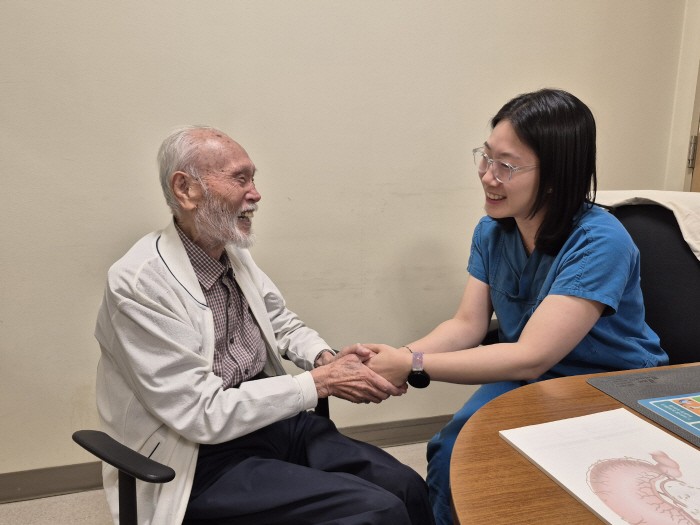 |
| Professor Kim So-jung of the Division of Gastrointestinal Surgery at Seoul St. Mary's Hospital and 97-year-old patient Y / Catholic University of Korea Seoul St. Mary's Hospital |
The Catholic University of Korea Seoul St. Mary's Hospital has successfully performed a highly complex robotic total gastrectomy on a 97-year-old stomach cancer patient. The case highlights a tailored treatment approach that evaluated the patient's physical and cognitive functions alongside recovery potential, rather than limiting therapeutic options based on age alone.
Seoul St. Mary's Hospital announced on the 18th that Professor Kim So-jung of the Gastrointestinal Surgery Division at the Gastric Cancer Center carried out the robotic total gastrectomy on a patient, identified as Y, born in 1929. Following postoperative recovery, the patient was discharged on the 15th and returned to daily life.
About a decade ago, Y underwent two endoscopic resections for early-stage gastric cancer in the lower stomach and had been receiving regular follow-up examinations since. During a checkup this year, a new tumor was discovered in the upper stomach near the esophagus.
Although the cancer was Stage 1, endoscopic resection was unfeasible due to the tumor's large size and unclear margins. With no remaining tissue to preserve in the lower stomach following earlier procedures, surgical removal of the entire stomach was unavoidable. Detailed examinations showed no signs of metastasis to other organs.
The medical team at Seoul St. Mary's Hospital did not rule out surgery simply because the patient was 97 years old. They comprehensively assessed that Y maintained sound physical and cognitive functions—living independently without a cane or hearing aids—and exercised regularly with walking and strength training. Concluding that the potential for postoperative recovery was substantial, the team decided to proceed with surgery in August.
Robotic surgery was chosen to minimize surgical burden on the patient. Total gastrectomy is among the most demanding gastric cancer procedures, requiring the removal of the entire stomach and surrounding lymph nodes followed by connecting the esophagus to the small intestine deep within the abdominal cavity. Precise execution is essential, as leakage or stricture at the anastomosis site can lead to severe complications.
The surgical team capitalized on robotic surgery's precise maneuverability in narrow, deep spaces to enhance surgical precision and minimize blood loss. Postoperatively, they monitored nutritional intake, exercise, underlying conditions, and complication risks to support the patient's swift return to daily life.
Visiting the outpatient clinic for the first follow-up after discharge, Y expressed gratitude to the medical staff and family, saying, "I feel like a very fortunate person." Formerly an educator, Y plans to spend the upcoming Chuseok holiday with family, including grandchildren who followed in those footsteps into teaching.
Professor Kim emphasized, "For elderly patients, postoperative care is just as critical as the surgery itself," stressing the need to meticulously monitor nutrition, exercise, underlying health conditions, and complication prevention to help patients smoothly resume daily life.
Having witnessed a family member battle cancer while attending medical school, Professor Kim rooted a clinical philosophy in that experience as a caregiver: "When treating patients, I try to look beyond the disease itself and understand what the patient and family are going through emotionally," underscoring that treating patients like family is vital to easing their anxiety.
Bae Da-hyun
Most Read
-
1
Celltrion’s Omlyclo gains ground in major European..

-
2
Trump demands rates fall below 1% as Fed hikes for..

-
3
Hyundai Motor Group breaks ground on integrated st..

-
4
U.S. strikes 3 Iranian oil tankers, Iran vows reta..

-
5
Trump makes $1 trillion bet ahead of midterm elect..

-
6
Iran resumes ballistic missile production, assembl..

-
7
Samsung Electronics, Mistral AI to jointly develop..

PEOPLE






-
Address : In-Young Bldg., 34, Uisadang-daero 1-gil, Yeongdeungpo-gu, Seoul
Copyright by ASIATODAY CO., LTD. All rights resereved